
ANALYSIS OF THE EFFECTIVENESS OF DISINFECTION OF DRINKING WATER BY ULTRAVIOLET EXPOSURE
ANALYSIS OF THE EFFECTIVENESS OF DISINFECTION OF DRINKING WATER BY ULTRAVIOLET EXPOSURE
Abstract
A study of the technological process of drinking water treatment using chlorination and ultraviolet disinfection methods has been conducted. It has been established that active chlorine interacts with natural organic substances contained in water, which leads to the formation of various organochlorine compounds with high toxicity and the ability to bioaccumulate in the tissues of organisms, which poses a significant threat to human health and the sustainability of ecosystems. In order to determine the effectiveness of ultraviolet disinfection, an assessment of the dynamics of changes in the intensity of the water dose was carried out on installations of the SOV-UF-2,5, SOV-UF-5,0 and SOV-UF-10,0 models. Graphical dependences reflecting the change in the radiation dose depending on the water consumption have been constructed using computational modeling methods. Microbiological analysis of the samples taken during the experiments confirmed the high efficiency of the ultraviolet method of disinfection of drinking water.
1. Introduction
Surface and underground sources of drinking water often do not comply with hygienic standards established for safe use. For this reason, pre-cleaning and disinfection of such water is required before it is delivered to consumers, which is a necessary measure to ensure human health and prevent the spread of infectious diseases. The most important criteria determining the quality of drinking water include its safety from the point of view of epidemiology, the absence of harmful chemicals in the composition, as well as the availability of acceptable organoleptic parameters. Taking into account the above-mentioned factors, special regulations have been developed in different countries that establish drinking water quality standards, including microbiological and parasitological indicators. These documents serve as the basis for ensuring public health and environmental protection, and also take into account quality control requirements at different stages from the water source to the end user
, , .Today, chlorination methods using chlorine gas and its derivatives continue to be widely used in neighboring countries and some other countries. The reasons for the popularity of chlorination are the high degree of bactericidal action of chlorine products, as well as the simplicity of equipment designs and the ability to quickly control the process. Nevertheless, along with the listed advantages, there is also a serious disadvantage of this method: the formation of organochlorine compounds with high toxicity, mutagenic and carcinogenic properties. These substances can accumulate and cause physiological changes in living organisms, including biological reactions, and leading to their death.
Numerous studies clearly demonstrate how chlorination of drinking and wastewater leads to significant levels of mutagenic activity and toxicity. When treating water with chlorine-containing substances, products with pronounced genotoxicity, such as trihalomethanes, chlorophenols, n-nitrochlorobenzene, bromoform, and others, were detected and isolated. It is especially important to note that chloroform and carbon tetrachloride, which are organohalogen compounds with potential long-term biological effects, have been found to have carcinogenic properties. In this regard, these compounds are considered dangerous to human health. Therefore, it is necessary to pay special attention to the search and implementation of alternative water treatment methods that would reduce or eliminate the formation of these harmful by-products
, , .Currently, when designing modern water treatment systems, there is a transition from the use of liquid chlorine to safer and easier-to-use sodium hypochlorite. However, this technological solution is also associated with a number of significant drawbacks. Firstly, when sodium hypochlorite is added to water, it receives a significant amount of chloride ions, the content of which accelerates corrosion processes on the inner surface of carbon steel pipelines through which purified water is sent to consumers. Secondly, the use of sodium hypochlorite does not reduce, and in some cases even increases, the amount of organochlorine compounds formed, such as trihalomethanes, which, according to some studies, are associated with the risk of cancer. In addition, sodium hypochlorite has less bactericidal activity compared to liquid chlorine. In this regard, to achieve a similar disinfection effect, it is necessary to significantly increase the contact time, which affects the productivity of the plants
, , , , .These disadvantages highlight the need for further research and development of more effective and safe alternative water disinfection methods that could avoid the problems associated with both liquid chlorine and sodium hypochlorite.
Among the physical methods of disinfection of water, the most popular is the ultraviolet method. Other physical methods, such as gamma radiation irradiation, the use of high-voltage discharges, low-power electrical discharges, alternating current, heat treatment and ultrasonic treatment, are much less common due to their high energy intensity and complexity of technical implementation.
The bactericidal effect of ultraviolet rays is primarily due to photochemical reactions that lead to irreversible damage to the DNA of microorganisms. However, ultraviolet radiation also affects other cellular structures such as RNA and cell membranes. UV radiation with wavelengths from 200 to 280 nm has the greatest ability to damage and inactivate bacterial cells. This is due to the fact that radiation in this range is effectively absorbed by the nucleic acids (DNA and RNA) of microorganisms. The maximum effectiveness of this effect, that is, the peak of bactericidal activity, is observed at wavelengths in the range of 250–260 nm. The main sources of UV radiation in water disinfection plants are gas-discharge lamps filled with a mixture of mercury vapor and inert gases. These lamps are classified by operating pressure into two main types: low and high pressure.
Low-pressure lamps are characterized by relatively low electrical power (from 2 to 200 watts) and a moderate bulb operating temperature (40–150 °C). At the same time, low-pressure lamps have high energy conversion efficiency, namely, up to 30% of the electricity consumed is transformed into UV radiation with a wavelength of 254 nm.
High-pressure lamps are characterized by significantly higher unit power (from 50 W to 10 kW and above), high operating temperature (600–800 °C), and a wide range of radiation covering both UV and visible areas. The disadvantage is the lower efficiency in generating short-wavelength UV radiation (including 254 nm) compared to low-pressure lamps. However, despite their lower efficiency in the bactericidal range, high-pressure lamps are used in water treatment due to their high total power, which makes it possible to process large volumes of water or water with low UV transmission using fewer lamps.
One of the key parameters of the disinfection process using UV radiation is its dose, which is defined as the radiation power per unit area for a given time. The dose of ultraviolet radiation is determined by a number of factors, including the power of the source in the ultraviolet range, the ability of water to absorb this radiation, the susceptibility of microorganisms to ultraviolet rays, the initial number of microorganisms in the water, as well as the required degree of disinfection. In addition, it is necessary to take into account the temperature of the water, its turbidity, as well as the possible presence of various chemical compounds that can reduce the effectiveness of exposure to ultraviolet radiation. It is important to note that in order to achieve effective disinfection, all these factors must be carefully considered. For example, different types of microorganisms may exhibit different sensitivity to UV radiation, so individual adjustment of treatment conditions may be necessary for each specific situation
, , , .2. Research methods and principles
In order to study the effectiveness of the disinfection process, the authors conducted a number of tests of flow-through disinfection units, mass-produced by the plant Sovremennaya Avtomatika LLC, Kazan. SOV-UF installations are certified and comply with the requirements of the technical regulations of the Customs Union "On the safety of machinery and equipment", "On the safety of low-voltage equipment", "Electromagnetic compatibility of technical means". The characteristics of the installations submitted for testing are shown in Table 1.
Table 1 - Technical characteristics of supply water disinfection units
№ | Parameter | Meaning | ||
SOV-UF-2,5 | SOV-UF-5,0 | SOV-UF-10,0 | ||
1 | Household pit performance. (waste) water, m3/h | 2,5(1,2) | 5,0(2,5) | 10,0(5,0) |
2 | The dose of UV radiation for household pit. (waste) water, MJ/cm2 | 25 (40) | 25 (40) | 25 (40) |
3 | Case diameter, mm | 63 | 63 | 108 |
4 | Pipe diameter, mm | 25 | 32 | 50 |
5 | Lamp type | UVL-100HO | UVL-19140 | UVL-19180 |
6 | Number of lamps, pcs. | 1 | 1 | 1 |
7 | Electrical power, W | 100 | 140 | 180 |
8 | UV power, W | 40 | 48 | 60 |
9 | Lamp length, mm | 846 | 842 | 843 |
10 | Lamp arc length, mm | 753 | 740 | 764 |
11 | Lamp tube diameter, mm | 19 | 19 | 19 |
12 | Installation dimensions (LxWxH), mm | 980х70х140 | 1000х70х140 | 980×108×200 |
The water disinfection unit consists of a metal case made of AISI 304 stainless steel, inside of which there is a quartz case with a germicidal lamp. Threaded pipes are provided on the body for the supply and discharge of treated water. A stream of pressurized water passes through the installation body, washes the quartz case and is treated with ultraviolet light. Depending on the type of source water, the flow rate, and the required radiation dose, a different number of lamps can be placed in one installation. A UV intensity sensor is installed on the housing to control the degree of radiation and timely replacement of the lamp. The efficiency of the design and reliability of the operation of UV disinfection plants directly depend on the consideration of a number of parameters. These include the organoleptic characteristics of the treated water and the impurities present in it (since they affect the passage of UV rays), as well as the estimated system performance and energy consumption
, , , , .In order to practically test and evaluate the performance of UV installations under controlled conditions, a technological scheme of the test bench was developed and installed. This stand simulates the water treatment process and includes: a source water storage unit, a pumping station, a UV disinfection unit, a flow meter for accurate measurement of the volume of treated water and a purified water storage unit. The basic technological scheme is shown in Figure 1. Water for the experiment was used from an artesian spring. The water analysis protocol is shown in Table 2. It can be seen from the analysis results that the water does not comply with SanPiN 2.1.4.1074-01 in terms of bacteriological parameters. In this regard, when operating this water supply source, it is necessary to provide a water treatment system that ensures that drinking water meets the sanitary and hygienic requirements and standards established for the distribution network. Such a system should guarantee the safety, reliability and stable quality of water, preventing possible risks to the health of consumers.
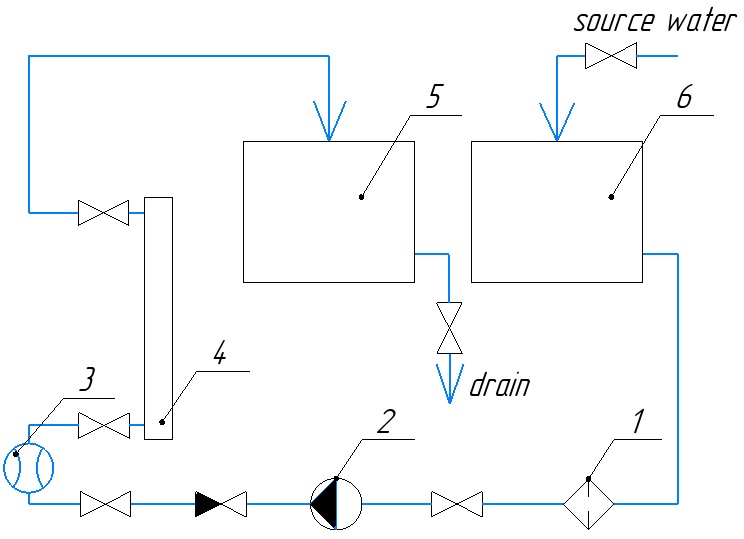
Figure 1 - Schematic technological diagram of the experimental installation
Note: 1 – disc filter; 2 – pumping unit; 3 – flow meter; 4 – flow disinfectant; 5 – clean water tank; 6 – source water tank
Table 2 - Protocol for the analysis of the quality of the source water
№ | Defined indicators | Test results | The value of the acceptable level | Regulatory documents on research methods |
Organoleptic analysis | ||||
1 | Smell, score | 1 | No more than 3 | GOST R 57164-2016 |
2 | Taste, score | 1 | No more than 3 | GOST R 57164-2016 |
3 | Color, degree | 5 | No more than 30 | GOST 31868-2012 |
4 | Turbidity, EMF | 1 | No more than 2,6 | GOST R 57164-2016 |
Sanitary and hygienic research | ||||
1 | Mass concentration of ammonia and ammonium ions, mg/dm3 | Less than 0,1 | Not more than 1,5 | GOST 33045-2014 |
2 | Mass concentration of the gamma isomer of hexachlorocyclohexane, mg/dm3 | Less than 0,1 | It is not standardized | GOST 31858-2012 |
3 | Mass concentration of potassium, mg/dm3 | 2,7±0,5 | It is not standardized | MND F 14.1: 2: 4.138-98 |
4 | Mass concentration of sodium, mg/dm3 | 10,5±1,5 | No more than 200 | MND F 14.1: 2: 4.138-98 |
5 | Mass concentration of cyanides, mg/dm3 | Less than 0,01 | Not more than 0,07 | GOST 31863-2012 |
6 | Hydrogen index, unit pH | 7,5±0,2 | 6,0-9,0 | MND F 14.1: 2: 3: 4.121-97 |
7 | Dry residue, mg/dm3 | 406±10 | No more than 1,500 | GOST 18164-72 |
8 | Overall stiffness, coolant | 5,6±0,5 | Not more than 10,0 | GOST 31954-2012 |
9 | Permanganate oxidizability, MgO/dm3 | 1,2±0,15 | Not more than 7,0 | GOST R 55684-2013 |
10 | APAV, mg/dm3 | Less than 0,01 | Not more than 0,5 | GOST 31857-2012 |
11 | Mass concentration of nitrite ions, mg/dm3 | Less than 0,02 | No more than 3 | MND F 14.1: 2: 24.3-95 |
12 | Mass concentration of nitrates, mg/dm3 | 10,3±1,5 | No more than 45 | GOST 33045-2014 |
13 | Sulfates, mg/dm3 | 44,5±2,0 | Not more than 500 | GOST 31940-2012 |
14 | Chlorides, mg/dm3 | 18,0±2,0 | No more than 350 | GOST 4245-72 |
15 | Mass concentration of iron, mg/dm3 | 0,13 | Not more than 0,3 | MND F 14.1: 2: 4.139-98 |
Bacteriological studies | ||||
1 | E.coli, CFU/100 cm3 | 8 | absence | GOST 31955.1-2013 |
2 | Coliphages, BOE/100 cm3 | 1 | absence | MG 4.2.1018-01 |
3 | Generalized coliform bacteria, CFU/100 cm3 | 8 | absence | MG 4.2.1018-01 |
4 | Total microbial number, CFU/100 cm3 | 73 | No more than 100 | MG 4.2.1018-01 |
5 | Enterococci, CFU/100 cm3 | Not detected | missing | GOST ISO 7899-2-2018 |
3. Main results
Table 3 - Technical conditions of the experiment for the installation of SOV-UF-2,5
Experiment number | Flow rate, m3/h | Average speed, m/s | Irradiation time, s | Dose, mJ/cm2 |
1 | 1,5 | 0,93 | 0,81 | 46,15 |
2 | 1,7 | 1,05 | 0,71 | 40,45 |
3 | 1,9 | 1,18 | 0,64 | 36,46 |
4 | 2,1 | 1,3 | 0,58 | 33,04 |
5 | 2,3 | 1,42 | 0,53 | 30,20 |
6 | 2,5 | 1,55 | 0,48 | 27,35 |
7 | 2,7 | 1,67 | 0,45 | 25,64 |
8 | 2,9 | 1,79 | 0,42 | 23,93 |
9 | 3,1 | 1,92 | 0,39 | 22,22 |
10 | 3,3 | 2,04 | 0,37 | 21,08 |
Table 4 - Technical conditions of the experiment for the installation of SOV-UF-5,0
Experiment number | Flow rate, m3/h | Average speed, m/s | Irradiation time, s | Dose, mJ/cm2 |
1 | 4,4 | 1,14 | 0,65 | 33,37 |
2 | 4,7 | 1,22 | 0,61 | 31,31 |
3 | 5,0 | 1,3 | 0,57 | 29,26 |
4 | 5,3 | 1,38 | 0,54 | 27,72 |
5 | 5,6 | 1,45 | 0,51 | 26,18 |
6 | 5,9 | 1,54 | 0,48 | 24,64 |
7 | 6,2 | 1,61 | 0,46 | 23,61 |
8 | 6,5 | 1,69 | 0,44 | 22,59 |
9 | 6,8 | 1,77 | 0,42 | 21,56 |
10 | 7,1 | 1,84 | 0,40 | 20,53 |
Table 5 - Technical conditions of the experiment for the installation of SOV-UF-10,0
Experiment number | Flow rate, m3/h | Average speed, m/s | Irradiation time, s | Dose, mJ/cm2 |
1 | 9,1 | 0,95 | 0,80 | 36,83 |
2 | 9,4 | 0,98 | 0,78 | 35,91 |
3 | 9,7 | 1,01 | 0,76 | 34,99 |
4 | 10,0 | 1,04 | 0,73 | 33,61 |
5 | 10,3 | 1,08 | 0,71 | 32,69 |
6 | 10,6 | 1,11 | 0,69 | 31,77 |
7 | 10,9 | 1,14 | 0,67 | 30,85 |
8 | 11,2 | 1,17 | 0,65 | 29,93 |
9 | 11,5 | 1,2 | 0,64 | 29,47 |
10 | 11,8 | 1,23 | 0,62 | 28,55 |
It can be seen from the experimental results that the installations correspond to the characteristics declared by the manufacturer. If the rated flow rate through the SOV-UF-2,5 installation is exceeded, the radiation dose is reduced below the permissible value of 25 mJ/cm2 set for drinking water. The SOV-UF-5.0 and SOV-UF-10,0 installations are designed with a certain power reserve, so the radiation dose in them is reduced to 25 mJ/cm2 and 28.55 mJ/cm2 after exceeding the flow rate by 10,7% and 15,3%, respectively. Such a power reserve will be a great advantage for the consumer when choosing the appropriate equipment.
Figures 2–4 show graphical dependences of the radiation dose intensity when the water flow through the installation changes. The radiation dose is also affected by the processes of converting wave energy into heat and changing its direction and frequency when interacting with water. To assess this effect, the absorption coefficient was used, the value of which was determined by the organoleptic and sanitary-hygienic characteristics of water, in particular, by the level of turbidity and the quantitative content of substances such as iron, manganese and phenol. The presence and high concentration of these impurities attenuates the radiation. In addition, the wavelength of UV radiation also affects the degree of attenuation: shorter wavelengths are absorbed more intensively. Consideration of these factors is necessary when designing and operating water disinfection systems using UV radiation, since the effectiveness of disinfection directly depends on how deeply the radiation penetrates the aquatic environment ,
, , , .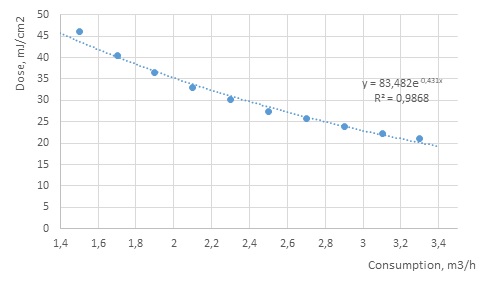
Figure 2 - Dependence of the radiation dose intensity upon a change in water flow through the SOV-UF-2,5 installation
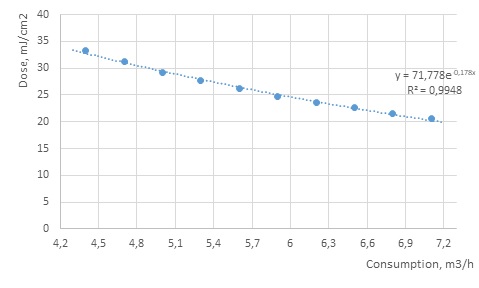
Figure 3 - Dependence of the radiation dose intensity upon a change in water flow through the SOV-UF-5.0 installation
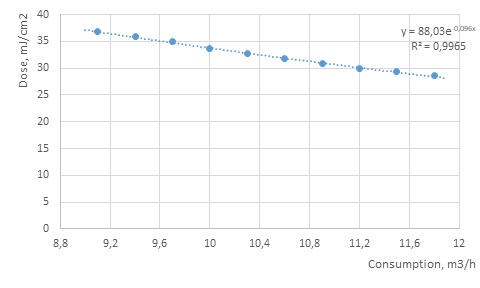
Figure 4 - Dependence of the radiation dose intensity upon a change in water flow through the SOV-UF-10.0 installation
4. Discussion
During each experiment, three 500 ml water samples were obtained. For the purity of the experiment, water samples were collected from a sampler mounted on the outlet pipe of the installation. The total number of samples for the two installations was 90 units. For water quality control, the method of determining E. coli bacteria was chosen, since the main type of this group of bacteria, E.coli, has one of the highest coefficients of resistance to ultraviolet disinfection in the general range of interobacteria, including pathogenic ones. Bacteriological analysis of water, as a key stage in assessing the effectiveness of disinfection, was carried out by an external accredited laboratory. The final results shown in Table 5. are the average values. Three parallel analyses were performed for each experimental condition (operating mode of the installation), and then the average value was calculated, which made it possible to increase the statistical reliability of the conclusions.
Table 6 - Results of bacteriological analysis of treated water
Experiment number | E.coli value, CFU/100 cm3 | ||
SOV-UF-2,5 | SOV-UF-5,0 | SOV-UF-10,0 | |
1 | Not detected | Not detected | Not detected |
2 | Not detected | Not detected | Not detected |
3 | Not detected | Not detected | Not detected |
4 | Not detected | Not detected | Not detected |
5 | Not detected | Not detected | Not detected |
6 | Not detected | Not detected | Not detected |
7 | Not detected | 1 | Not detected |
8 | 1 | 1 | Not detected |
9 | 2 | 1 | Not detected |
10 | 2 | 2 | Not detected |
From the results of Table 5. it follows that the SOV-UF-2,5, SOV-UF-5.0 and SOV-UF-10.0 installations provide a biocidal effect with high efficiency, allowing the analyzed water to be used as drinking water. However, despite the high efficiency of ultraviolet disinfection, it is necessary to take into account the types of UV radiation sources used and their possible impact on the physico-chemical characteristics of the treated water. Different types of lamps may have different spectral power, service life, and operating characteristics, which affects the stability and effectiveness of processing. This highlights the importance of further research aimed at improving and adapting UV technologies to various water treatment conditions. Optimization of radiation parameters, selection of efficient plant designs and consideration of water properties are all necessary to ensure reliable, safe and environmentally friendly disinfection.
5. Conclusion
1) Chlorination methods using chlorine gas and its derivatives are widely used for disinfection of water from underground and surface sources. Modern research has shown that these methods contribute to the formation of organochlorine compounds in water, which are highly toxic and have the ability to accumulate in living organisms, cause physiological changes, including biological reactions, and lead to their death.
2) Compared with other disinfection methods, the bactericidal effect is not accompanied by the formation of carcinogenic transformation products of chemical compounds in water, which eliminates the risk of an overdose of UV radiation.
3) The results of the work will make it possible to draw the attention of operating organizations to the need for regular monitoring of the operating conditions of UV systems in order to maintain a stable and high-quality result.
4) Microbiological analysis of water samples showed the presence of common coliform bacteria at an irradiation dose of 23,93 mJ/cm2 and lower for the SOV-UF-2,5 installation, at an irradiation dose of 23,61 mJ/cm2 and lower for the SOV-UF-5,0 installation. The SOV-UF-2,5 and SOV-UF-5,0 units correspond to the manufacturer's specifications, according to which an effective dose of 25 mJ/cm2 is achieved at a flow rate of 2,5 m3/h and 5,0 m3/h, respectively.
5) During the experiment, it was revealed that the flow rate and velocity of water significantly affect the intensity of the radiation dose in the installations. The obtained equations describing the course of the experiment will make it possible to determine the optimal water consumption for its effective disinfection and intended use. Thus, understanding and managing these variables will optimize the UV disinfection process, which, in turn, will increase its efficiency and ensure the safety of the treated water.