
Advances in Cancer Therapy with biASO (Binary Antisense Oligonucleotides): Dual-Targeting Strategies for Precision Oncology Therapeutics
Advances in Cancer Therapy with biASO (Binary Antisense Oligonucleotides): Dual-Targeting Strategies for Precision Oncology Therapeutics

Abstract
RNA-targeted therapeutics represent a promising avenue in cancer treatment. Binary antisense oligonucleotides (biASOs) have emerged as a novel class of oligonucleotide-based therapeutics designed for targeted RNA modulation. Distinct from conventional antisense oligonucleotides (ASOs), biASOs employ a bifunctional, two-component system for marker-dependent RNA degradation, presenting an innovative therapeutic strategy. biASOs are meticulously engineered with a sensing module to recognize cancer-specific marker RNA and a therapeutic module to trigger target RNA cleavage via RNase H activation upon the formation of a unique four-way junction complex. In vitro, studies have demonstrated the capacity of biASOs to selectively degrade target RNAs in a marker-dependent manner, suggesting enhanced specificity and reduced off-target potential when compared to traditional ASOs. This review summarizes the current understanding of biASO design, mechanism of action, and in vitro validation, while critically assessing the challenges inherent in their preclinical and clinical development. Key future research directions outlined encompass in vivo efficacy studies, delivery optimization, comprehensive safety evaluations, and scalable manufacturing approaches. Despite being in the early phases of development, biASOs present a compelling vision for the future of personalized cancer therapy. They offer a potentially more precise and effective approach to RNA-targeted therapeutics. Continued research, particularly focusing on in vivo validation, delivery systems, safety profiles, and manufacturing scalability, is essential to fully realize their therapeutic potential.
1. Введение
Cancer remains a significant global health crisis and a leading cause of mortality worldwide
. In 2020, it was responsible for approximately 10 million deaths globally, and projections estimate that new cases will reach 28.4 million annually by 2040, this translates to approximately one in six deaths globally being attributable to cancer . Alarmingly, projections indicate a potential rise to 35 million cancer cases worldwide by 2050 . This increase is linked to factors such as unhealthy diets, physical inactivity, and increased alcohol and tobacco use, particularly in developing regions. While the current cancer treatments predominantly rely on radiotherapy, chemotherapy, and surgery, these methods are often associated with significant side effects and the development of chemoresistance, creating an urgent need for innovative therapeutic strategies . Gene therapy (GT) has emerged as a promising alternative due to its versatility and potential to target the genetic basis of cancer , . Gene therapy involves treating diseases, including cancer, by delivering genetic material into targeted cells to modify their function .According to the U.S. Food and Drug Administration (FDA), effective GT agents should repair or replace disease-causing genes, introduce therapeutic genes, or modulate the expression of faulty genes
. The growing number of FDA-approved GT products, such as antisense oligonucleotides (ASOs), recombinant proteins, viral vectors, cell-based therapies, and oncolytic viruses, highlights the increasing clinical relevance of this field . Among GT modalities, oligonucleotide-based therapies, particularly those targeting RNA, have garnered considerable interest in cancer treatment . This focuses on RNA targeting stems for the crucial roles RNA plays in cancer development and progression because it is now not only recognized as a mere messenger but it actively participates in diverse cellular processes and therefore its dysregulation causes a heavy impact on tumorigenesis , , . Oncogenes, which promote cancer development, often exert their effects through messenger RNA (mRNA) upregulation . Furthermore, non-coding RNAs (ncRNAs), including microRNAs (miRNAs), are now recognized as key players in cancer biology, promoting proliferation, metastasis, and drug resistance .Targeting aberrant RNA splicing, which leads to the synthesis of cancer-specific protein variants, also presents a promising therapeutic avenue
. These strategies of selectively targeting disease-associated RNAs allow for the disruption of key oncogenic pathways. Antisense oligonucleotides (ASOs) are a significant class of oligonucleotide-based GT agents, these short, synthetic DNA or RNA molecules are designed to bind to specific RNA sequences, enabling the modulation of gene expression . ASOs typically function by recruiting ribonuclease H (RNase H) to degrade the targeted RNA or by sterically blocking its translation . While ASOs offer advantages such as high efficiency compared to deoxyribozymes, lower toxicity than siRNAs, and ease of design and protection from cellular degradation , single ASO agents have not yet achieved widespread success as standalone anticancer therapies. This is because, single ASO have limitations such as rapid RNase H-mediated degradation of exogenous RNAs, limited tissue penetration hindering effective delivery to target sites , potential of off-target effects in normal tissues causing toxicities, and an inability to inherently trigger cancer cell death solely by targeting overexpressed RNA .To address these limitations, innovative approaches utilizing marker-activated antisense agents are being explored. This review focuses on binary antisense oligonucleotides (biASOs), a novel strategy designed to enhance both target specificity and the therapeutic impact of conventional ASOs. biASOs are engineered with a unique “sensing module” that recognizes cancer-specific marker RNAs, coupled with a “therapeutic module”, similar to conventional ASOs, that aims to suppress vital housekeeping genes . This marker-dependent activation strategy seeks to confine therapeutic activity primarily to cancer cells while inducing a more potent cytotoxic effect by targeting essential cellular functions. This review will explore the novelty and transformative potential of biASOs in targeted cancer therapy. We will examine their mechanism of action, discuss current challenges in their development, and outline future directions for this promising therapeutic modality.
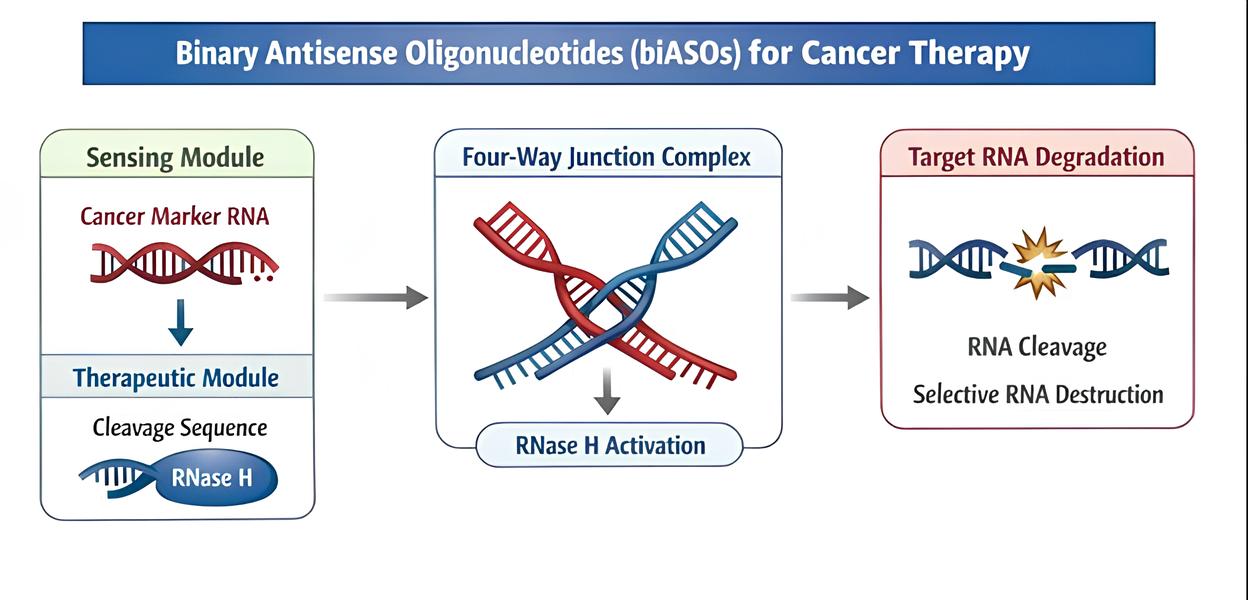
Graphical Abstract
GT — Gene Therapy;
FDA — Food and Drug Administration;
mRNA — messenger Ribonucleic Acid;
miRNA — micro–Ribonucleic Acid;
nc-RNA — non-coding Ribonucleic Acid;
si-RNA — single interfering Ribonucleic Acid;
RNA — Ribonucleic Acid;
biASO — binary antisense oligonucleotides;
ASO — antisense Oligonucleotide;
4WJ — Four-way junction;
RNase H —Ribonuclease H;
SNP — single nucleotide polymorphism;
KRAS — Kirsten rat sarcoma virus;
S/B — signal to background ratio.
2. Design and Mechanism of Action
Binary antisense oligonucleotides (biASOs) represent a significant departure in both design and functional mechanism from conventional antisense oligonucleotides (ASOs). Unlike their predecessors, biASOs employ a two-component system to achieve highly targeted RNA degradation
. As illustrated in Figure 1, a biASO agent is composed of two distinct oligonucleotide strands, denoted as ASOa and ASOb. Crucially, each strand is modular, possessing a “sensing module” responsible for recognizing an activator RNA and a “therapeutic module” that is complementary to the target messenger RNA (mRNA). This target mRNA is often specific to a particular cancer marker RNA, allowing for disease-specific targeting . In the presence of the designated activator RNA, the two biASO components, ASOa and ASOb, are brought into close proximity to the activator RNA, this spatial arrangement facilitates the cooperative binding of both ASO strands to the target mRNA hence promoting cooperative binding which is critical, in promoting the formation of a unique four-way junction (4WJ) structure , , . This intricate 4WJ complex is composed of the activator RNA, ASOa, ASOb, and the targeted mRNA. The formation of this 4WJ structure is paramount for the therapeutic activation of the biASO's therapeutic module . This mechanism contrasts sharply with conventional ASOs, where a single oligonucleotide strand directly binds to the targeted RNA to initiate hydrolysis by ribonuclease H (RNase H).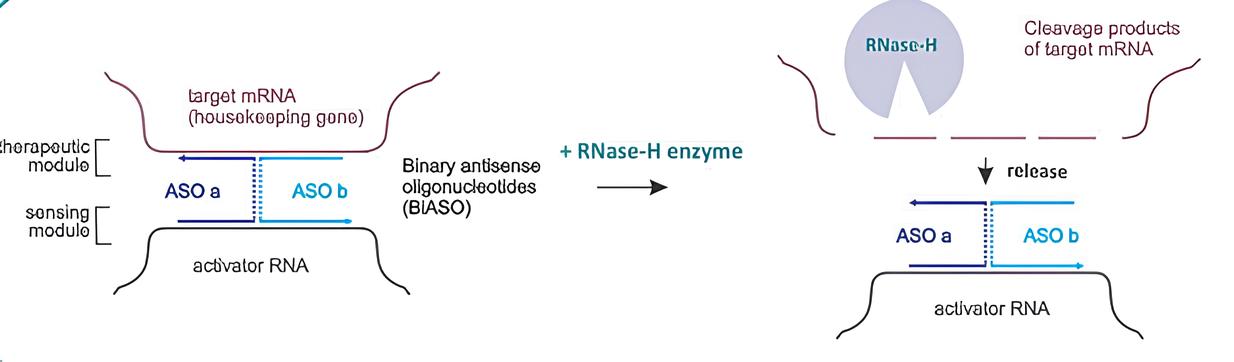
Mechanism of action of binary antisense oligonucleotides (biASOs)
In the presence of activator RNA, ASOa and ASOb strands assemble to form a four-way junction (4WJ) structure with the target mRNA of a housekeeping gene. This 4WJ complex becomes a substrate for RNase H, leading to target mRNA cleavage and release of biASO components for further catalytic activity. Adapted from [6]
By design, the biASOs are deliberately engineered to be inert in the absence of the intended activator RNA, a feature that enables their conditional activation, restricting their activity to cells expressing the specific marker RNA and thus enhancing target specificity
. This conditional activation is achieved through the spatial separation of the sensing and therapeutic modules across the two distinct oligonucleotide strands, and it also provides a special unique architecture for the assembly of the 4WJ complex, and consequently, therapeutic RNA degradation, occurs predominantly, if not exclusively, in the presence of the specific cancer-associated marker RNA . This marker-dependent activation strategy represents a crucial advancement in oligonucleotide-based therapeutics, paving the way for more precise and targeted gene modulation in cancer therapy and potentially mitigating off-target toxicities associated with earlier generations of antisense oligonucleotides .3. Features and advantages
The new approach of using binary antisense oligonucleotides (marker-activation strategy) during the construction of biASOs gives them a greater advantage over the conventional ASOs thus addressing some of the limitations faced by conventional ASOs. This approach gives the biASOs a high selective advantage and unlimited efficacy because the method confines the therapeutic activity to maker-positive cells and enables the targeting of vital housekeeping gens . This pathway offers an enhancement in both safety and effectiveness of oligonucleotide-based cancer therapy. The approach enhances the specificity due to formation of [biASO-4WJ]-complex increasing target specificity. This complex formation is so specific that even a single nucleotide change in the activator RNA (single base mismatches) can be easily discriminated by the sensing module. The inherent sensitivity of 4WJ probes in differentiating single nucleotide polymorphisms (SNP) which is a well-documented feature in the development of diagnostic tools
, . This huge precision allows the reduction of off target effects and improves the therapeutic index. The selectivity is improved as the therapeutic activity is linked to the marker-RNA allowing selective activation “marker-dependant” which in turn reduced the toxicity and side effects which are evidenced as the most predominant limitations of conventional ASOs in therapy applications , .Lastly, the biASOs are versatile and easily tuned to specific desires due to the modular design which provides a considerable flexibility. The sensing module can be easily made to adapt to recognising a variety of RNA markers including different cancer-specific transcripts, combined markers and others
. Also there is a possibility to adjust the sensing module to differentiate between varying concentrations of the activator RNA hence nuanced control and better therapeutic activation for future applications . This versatility can make the biASOs tailored to specific cancer types and individual patient profiled which aligns with the principles of personalized medicine .Table 1 - Shows the key Features and Advantages of the biASO, Compared to conventional ASOs
Key feature | Advantage | Reference |
Enhanced specificity | The design nature of biASO which employs the 4WJ complex formation highly enhances its target specificity. According to Drozd et al. (2022) even a subtle sequence variation in the activator RNA (like a single base mismatch) can be readily discriminated by the biASO sensing module thus less background activation. | |
Improved selectivity | The marker-dependant activation greatly reduces the potential for unwanted gene suppression in healthy tissue lacking specific targeted makers hence minimizing system toxicity and side effects. | |
Tunability and Versatility | The modular design gives biASO flexibility tunability because the sensing module can be adapted to recognise a variety if RNA markers such as different cancer transcripts, and combinations of makers for increased specificity. |
4. Potential Applications of biASO-Based RNA Modulation in Cancer Therapy: In Vitro Evidence
Despite the promising design and mechanism of binary antisense oligonucleotides (biASOs), direct evidence for their efficacy in treating cancer in vivo remains to be established. Clinical trials are yet to commence, and preclinical studies in animal cancer models are anticipated to follow. However, current evaluations of biASOs’ therapeutic potential are predominantly derived from in vitro studies that rigorously examine their mechanism of action and capacity for marker-dependent RNA degradation
. The existing evidence for biASOs' potential in cancer therapy hinges on the meticulous investigation of their fundamental characteristics. A pivotal study by Drozd et al. (2022) provides critical insights into the potential applications of biASOs for targeted cancer RNA degradation. In their research, they designed experiments to assess the core functionality of biASOs, employing a well-defined model system. This system utilized synthetic RNA fragments, specifically a 60-nucleotide fragment of GFP mRNA as the targeted RNA and a 29-nucleotide fragment derived from KRAS mRNA as the activator RNA . The selection of KRAS mRNA as the activator is clinically relevant, as KRAS is a proto-oncogene frequently overexpressed in a wide spectrum of cancers, making it a pertinent cancer marker . To further enhance the clinical relevance and examine specificity, both wild-type KRAS (KRAS-G) and a cancer-associated mutant KRAS (KRAS-A), characterized by a single nucleotide substitution (G to A) at position 58, were employed as activator RNAs in their experiments , , , .This allowed for the assessment of biASO activation in response to both common and cancer-specific KRAS variants. The efficiency of RNA cleavage, serving as a direct readout of biASO activity, was quantified as the percentage of GFP-RNA cleaved by RNase H in the presence or absence of the KRAS activator RNA. Initial experiments focused on optimizing the biASO design to achieve robust activator-dependent cleavage. This was done by systematic variation of the length of GFP-RNA binding sites within the biASO constructs, hence they identified that the biASO construct designated as a8-b10 were exhibiting the greatest signal-to-background ratio (S/B)
. This optimal construct, biASO a8-b10, demonstrated high cleavage efficiency specifically in the presence of the KRAS-G activator, robustly confirming the marker-dependent activation mechanism and versatility of the biASO approach. Importantly, the individual ASOa8 and ASOb10 strands exhibited minimal self-association and low background cleavage activity in the absence of the activator. This key finding highlights a significant advantage of biASOs over many conventional ASOs, which often suffer from limitations related to self-association and off-target activity.5. Challenges and Future Directions for biASO-Based Therapeutics
Even though the binary antisense oligonucleotides (biASOs) present a compelling and innovative approach to targeted RNA modulation, it is crucial to acknowledge the significant challenges that must be addressed to translate biASOs in vitro promise into clinically effective cancer therapeutics.
Current Limitations and Knowledge Gaps: A primary limitation at present is the absence of preclinical and clinical data demonstrating in vivo efficacy. As biASOs are a nascent technology, their therapeutic potential in complex biological systems and living organisms remain largely unexplored. Extensive in vivo studies using relevant animal cancer models are urgently needed to evaluate biASOs’ ability to effectively target tumors, modulate intended RNA targets within the tumor microenvironment, and elicit anti-cancer effects in a physiologically relevant way. Like all other oligonucleotide-based therapeutics, biASOs face inherent challenges of delivery. Thus effective target delivery of oligonucleotides to tumor cells, with sufficient intracellular uptake to reach their RNA targets, remains a significant hurdle
. Therefore, strategies to enhance biASO delivery, such as nanoparticle encapsulation, conjugation to targeting ligands, use of carbon nanotubes (CNTs) as carries , or chemical modifications to improve cellular uptake and endosomal escape, are areas of critical investigation.Future Research Directions: Several key avenues must be pursued to advance the biASOs to transition to clinical trials. Preclinical Efficacy and Mechanism Validation In Vivo: The immediate priority would be to conduct comprehensive preclinical studies in animal cancer models. These might be important in the evaluation of biASO efficacy in reducing tumor growth, metastasis, and improving survival outcomes. Mechanistic studies in vivo are also essential to confirm target RNA modulation, marker-dependent activation, and the intended mechanism of action within the complex tumor environment. Optimization of biASO Design and Delivery: Efforts in exploring the effects of various chemical modifications to enhance stability, improve cellular uptake and delivery. This can be aided by the development of advanced delivery systems, such as nanoparticles or exosomes, tailored for biASO therapeutics. Toxicology and safety studies: For better understanding of the safety of biASO in physiological systems, several preclinical toxicology studies are essential so as to evaluate the immunogenicity and the long-term effects of these GT-agents in animal models so as to initiate a transition to clinical trial design. Lastly, increased research in the exploration of different types of cancer, combined therapy and transition to personalized medication as this would open a new door for more versatile applications of biASO in human health leading to sustainable health and reduced mortality rates. The biASOs hold a significant promise to a key aspect of the futuristic approach to personalized medication in cancer therapy due to their inherent specificity, achieved through marker-dependent activation coupled with the potential for RNA modulation. This positions them as promising candidates for targeted cancer treatment.
6. Conclusion
Binary antisense oligonucleotides (biASOs) represent a novel and conceptually advanced class of oligonucleotide-based therapeutics. By employing a bifunctional, two-component design and a marker-dependent activation mechanism, biASOs offer the potential to overcome key limitations associated with conventional antisense oligonucleotides. In vitro studies have provided compelling evidence for their mechanism of action and ability to selectively degrade target RNAs in a marker-dependent approach
. The ingenious strategy of separating recognition and therapeutic functions within the biASO architecture offers a pathway towards enhanced target specificity and potentially reduced off-target toxicities, offering a critical advancement in the field of RNA-targeted therapeutics. Being in its early stages of development, biASOs have significant research evidence for validation of their therapeutic efficacy and safety in preclinical models and ultimately a transition to human clinical trials. Limitations such as delivery method, and toxicology validation if overcame will further allow the us to realize the full potential of biASOs. Despite these challenges, the innovative approach and marker-activated functionality of biASOs give them a compelling vision in the future of targeted cancer therapy, hence unlock a new and unique way in the quest for more precise and effective cancer treatment.