
Prospects of the use of Teff protein hydrolysates
Prospects of the use of Teff protein hydrolysates

Abstract
Teff is an annual cereal crop native to Ethiopia and Eritrea. It thrives in harsh climates. Growing global demand for this grain is driven by its gluten-free nature, high levels of essential amino acids (EAAs), mineral richness, low glycemic index (GI), high crude fiber content, longer shelf life, and slower staling compared to wheat, sorghum, rice, barley, and corn. Teff is a valuable and promising source of bioactive peptides with potential for regulating blood pressure, reducing oxidative stress, and managing blood sugar levels. Most studies are in the preclinical stage, and further studies, including in vitro studies, are needed to confirm these effects in humans, in vivo and clinical trials.
1. Введение
Teff (Eragrostis tef), a traditional grain crop of Ethiopia and Eritrea, has gained wide international recognition due to its nutritional and functional properties
, . The ability of this plant to adapt to adverse climatic conditions makes it an important resource for the modern food industry . Teff is grown all over the world, including the USA, Canada and a number of European countries, since this is a promising alternative to traditional cereals , .The growing demand for gluten-free food makes teff more and more in demand, since this crop initially does not contain gluten
. Teff is a valuable source of nutrients: it contains "slow" carbohydrates, healthy fatty acids, dietary fiber, phytochemicals, and a wide range of minerals . One of the key merits of this crop is its remarkably low glycemic index . Owing to its techno-functional properties—which enhance structural consistency, water-binding capacity, and storage stability—teff serves as a highly viable ingredient for manufacturing gluten-free products . Additionally, this grain boasts a substantial concentration of proteins and bioactive peptides. Regarding its proteomic profile, it is on par with wheat and provides a complete spectrum of indispensable amino acids, yet it notably stands out for its elevated lysine concentration . Subjecting these crop proteins to enzymatic hydrolysis frequently yields bioactive peptides exhibiting antioxidant and blood-pressure-lowering effects, showcasing superior bioactivity relative to other cereal grains .Teff represents a promising reservoir of protein content and bioactive peptide fractions. Regarding quantitative metrics of its proteomic profile, this grain rivals wheat, yet outperforms it concerning lysine levels, whereas the protein matrix within the grain encompasses a complete spectrum of indispensable amino acids
. Proteolytic hydrolysis of teff proteins facilitates the generation of peptides exhibiting marked free radical-scavenging and blood pressure-lowering properties, with biological potency that surpasses analogous substances derived from other cereal grains .This study uses the method of analytical literature review. The process included setting the research objectives, searching the MEDLINE, PubMed, and Google Scholar databases for relevant peer-reviewed articles, and subsequent data analysis.
2. Main Results and Discussion
2.1. Proteins and biologically active peptides of teff
Proteins represent macromolecular biological polymers composed of amino acid chains connected through peptide linkages. Their three-dimensional structural arrangement dictates their specialized biological functions within living organisms. These macromolecules fulfill diverse physiological responsibilities: they furnish structural integrity to tissues, serve as biocatalysts for biochemical transformations, operate as hormonal regulators and carrier substances, and engage in modulating cellular activities.
In comparison to wheat and maize, teff exhibits comparable mean crude protein levels
. Investigations into the protein profile of teff grains have substantially advanced our comprehension of its nutritional composition and value . Research conducted by Gebru and colleagues demonstrated that total protein concentration reached 9.37%, while essential amino acids constituted an average of 40.9% . Teff's proteomic profile encompasses albumins, globulins, prolamins, and glutelins, exhibiting isoelectric points at pH values of 3.6, 3.0, 4.4, and 3.4, correspondingly .Comparative examination against wheat proteins—the benchmark material for bread production—uncovers distinct structural variations. Drawing upon findings from Quan and collaborators, this study illustrates the molecular mass distribution patterns of principal protein fractions from both teff and wheat (see Fig.1)
.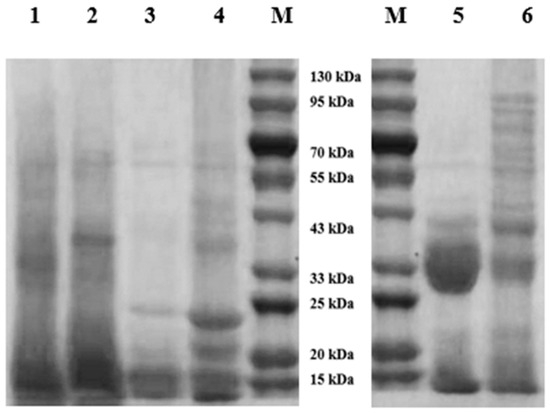
Electrophoretic analysis of protein fractions:
1 - teff albumins; 2 - teff globulins; 3 - teff prolamins; 4 - teff glutelins; 5 - wheat gliadins; 6 - wheat glutenins; M - molecular weight marker
redrawn by the authors based on data from [12]
Lane 1 (albumin): shows a broad distribution of high-molecular-weight proteins, which differs from wheat albumin. The presence of intense bands above 33 kDa indicates the presence of large protein molecules.
Lane 2 (globulin): proteins with a molecular weight below 25 kDa predominate, with a particularly pronounced band in the 23–25 kDa range. This indicates that teff globulins are predominantly low-molecular-weight proteins.
Lane 3 (prolamin): characterized by the presence of several distinct bands. The most intense band is located around 23 kDa, with bands also visible at 19.5 kDa and around 15 kDa. This indicates that teff prolamins are composed of monomers with a relatively low molecular weight, which is significantly different from wheat prolamins (gliadins).
Lane 4 (glutelin): shows a predominance of proteins with a molecular weight below 25 kDa. A key observation is the complete absence of high-molecular-weight glutelin subunits (HMW-GS), which are critical for the formation of a strong gluten network in wheat.
Lane 5 (gliadin): shows a typical wheat gliadin profile—multiple bands concentrated in the 25–43 kDa range. This indicates the presence of longer polypeptide chains compared to teff prolamins.
Lane 6 (glutelin): a distinctly visible band in the 33–43 kDa region corresponds to high-molecular-weight glutelin subunits (HMW-GS). These subunits, linked by disulfide bonds, form the basis for the elastic and strong cross-linked structure of gluten, which provides the unique rheological properties of wheat dough.
A study conducted by Quan and his colleagues showed that teff proteins have distinctive structural features compared to wheat proteins. Using the FTIR method, scientists concluded that teff prolamin contains the largest amount of α‑helical structures (27.08%), which lack random coiled conformations, and demonstrates higher heat resistance compared to wheat gliadin. A comparative analysis of secondary conformation using the FTIR method showed that teff glutenin, unlike wheat glutenin, is characterized by a smaller number of β‑bends and the complete absence of α‑helical structures. Using SDS‑PAGE and DSC techniques, it was established that teff glutenin lacks high‑molecular‑weight subunits and is less thermostable than wheat glutenin. Using a fluorescent probe technique with ANS and spectrophotometric determination of sulfhydryl groups in prolamine and glutenin from Tef, a lower number of disulfide bonds and reduced surface hydrophobicity were detected
.Essential amino acids cannot be endogenously produced by the human organism and must be acquired exclusively through consumption of dietary sources abundant in these nutrients. In contrast to non-essential amino acids, which cellular mechanisms can synthesize from precursor compounds, essential amino acids fulfill a critical function in protein biosynthesis, hormone and neurotransmitter production, and immune system support. Inadequate dietary intake may result in impaired protein metabolism, compromised tissue development and repair, weakened immune response, and other adverse health outcomes
. The overall amino acid profile of teff grain is well-balanced and superior to most cereal grains . Table 1 provides a comparative analysis of the amino acid composition of cereal crops (see Tab.1).Table 1 - Amino acid composition of cereal crops
Raw materials | Teff | Wheat | Sorghum |
Crude protein (g) | 11.0 | 11.7 | 8.30 |
Amino acids (g/100g) | |||
Lysine | 0.41 | 0.25 | 0.02 |
Isoleucine | 0.45 | 0.43 | 0.06 |
Leucine | 0.94 | 0.82 | 0.17 |
Valine | 0.61 | 0.48 | 0.07 |
Phenylalanine | 0.63 | 0.57 | 0.07 |
Tyrosine | 0.42 | 0.27 | 0.06 |
Tryptophan | 0.14 | 0.13 | 0.02 |
Threonine | 0.47 | 0.32 | 0.04 |
Histidine | 0.35 | 0.25 | 0.03 |
Arginine | 0.57 | 0.41 | 0.05 |
Methionine | 0.45 | 0.18 | 0.02 |
Cystine | 0.28 | 0.28 | 0.02 |
Asparagine | 0.70 | 0.60 | — |
Serine | 0.45 | 0.59 | 0.07 |
Glutamine + Glutamic acid | 2.40 | 3.45 | — |
Proline | 0.90 | 1.19 | 0.11 |
Glycine | 0.34 | 0.47 | 0.04 |
Alanine | 1.11 | 0.42 | 0.13 |
Teff albumins and globulins contain more arginine, asparagine, and lysine, but less leucine, phenylalanine, glutamic acid/glutamine, and proline compared to teff prolamin and glutelin. It is noteworthy that teff exhibits protein levels comparable to wheat, yet demonstrates a markedly elevated concentration of the indispensable amino acid lysine relative to other cereal grains, measuring 0.41 g/100 g—approximately 1.5-fold greater than wheat and substantially exceeding sorghum levels
, . However, the actual contribution to daily nutritional requirements depends not only on the amino acid composition but also on protein digestibility, the presence of antinutrients (e.g., phytates), the food matrix, and processing methods , .Furthermore, teff possesses substantial quantities of additional essential amino acids, including threonine, isoleucine, leucine, valine, and tryptophan. Specifically, per 100 g of grain, teff contains threonine (0.47 g), isoleucine (0.45 g), leucine (0.94 g), valine (0.61 g), and tryptophan (0.14 g). While wheat surpasses teff in glutamine and glutamic acid content, sorghum exhibits the lowest concentrations across nearly all amino acids.
The amino acid score serves as a quantitative metric for assessing protein quality, indicating the extent to which a food product's or diet's amino acid composition aligns with the WHO-recommended reference pattern of essential amino acids necessary for fulfilling human physiological demands. This score is determined by calculating the ratio between each essential amino acid's concentration in the test protein versus its concentration in the reference protein, with the lowest ratio representing the 'limiting' amino acid—the one that most critically constrains the body's protein utilization efficiency.
In accordance with WHO/FAO standards, the amino acid profile of a complete protein should correspond to the established reference values (in mg per 1 g of protein): lysine — 45, isoleucine — 32, leucine — 59, valine — 39, threonine — 26, tryptophan — 6, histidine — 19. The total content of sulfur—containing amino acids (methionine + cystine) should be at least 25 mg/g, and aromatic amino acids (phenylalanine + tyrosine) — at least 58 mg/g.
The conversion of amino acid content from g/100 g of raw material to mg/g of protein is calculated using formula 1.
Next, the amino acid score is calculated using formula 2.
Table 2 presents a comparison of the amino acid scores of cereal crops (see Tab.2).
Table 2 - Amino acid score of cereal crops
Raw materials | Teff | Wheat | Sorghum |
Crude protein, g | 11.0 g/100 | 11.7 g/100 | 8.3 g/100 |
Lysine (limiting), % | 82.8 | 47.5 | 5.4 |
Isoleucine, % | 127.8 | 114.9 | 22.6 |
Leucine, % | 144.8 | 118.8 | 34.7 |
Methionine + Cystine, % | 265.5 | 157.3 | 19.3 |
Phenylalanine + Tyrosine, % | 164.6 | 123.8 | 27.0 |
Amino acid score, % | 82.8 | 47.5 | 5.4 |
A comparative analysis of the calculated amino acid scores indicates that teff exhibits a higher theoretical amino acid score (82.8%) compared to wheat and sorghum. While this suggests a more favorable essential amino acid profile among the studied crops, it is important to note that the amino acid score reflects only the theoretical composition. The actual biological value and physiological efficacy of the protein are further determined by its digestibility, the food matrix, and processing conditions. The amino acid content in wheat is 47.5%, which is typical for most grain crops, where the main limiting factor is the low lysine content. Sorghum has the lowest amino acid content — only 5.4% — due to a critical deficiency of almost all essential amino acids, especially lysine, threonine, and valine; the amino acid profile of sorghum requires supplementation with other protein sources, especially those rich in limiting amino acids.
The biological activity of functional peptides directly depends on their amino acid sequence. Due to its high lysine content and optimal balance of essential amino acids, teff is a valuable raw material for the production of biologically active compounds with desired properties.
Peptides are short chains of amino acids that occupy an intermediate place between individual amino acids and complete proteins. Due to their antioxidant and antihypertensive properties
, bioactive peptides are considered an important component for the production of functional foods. One of the promising sources of such substances is teff. It has been found that enzymatic hydrolysis of teff flour proteins makes it possible to obtain peptides with high antioxidant activity and the ability to lower blood pressure (ACE inhibition) , . The high content of glutelins and prolamins in teff interested researchers in studying in detail its protein hydrolysates as a potentially useful ingredient for the food industry , .A study by Zarei et al. confirms that the degree of hydrolysis and functional properties of peptides depend on the process conditions (temperature, time, enzyme/substrate ratio) and the choice of enzyme
. For the teff protein, the choice of enzyme is a key factor determining the profile of the biological activity of peptides.Research methods included the use of commercial proteases such as Alcalase, Flavourzyme, and Protamax, as well as digestive enzymes such as pepsin, to produce teff hydrolysates. Yun's study and Park used three commercial proteases (Protamax, Flavourzyme, Alcalase) at different concentrations and incubation times to generate brown teff hydrolysates
.The antioxidant activity of protein hydrolysates was further investigated using 2,2-diphenyl-1-picrylhydrazyl (DPPH) radical scavenging assay (see Fig.2), total antioxidant capacity (TAC) (see Fig.3), and reducing antioxidant capacity (ROAC) tests using ferrous iron (see Fig.4).
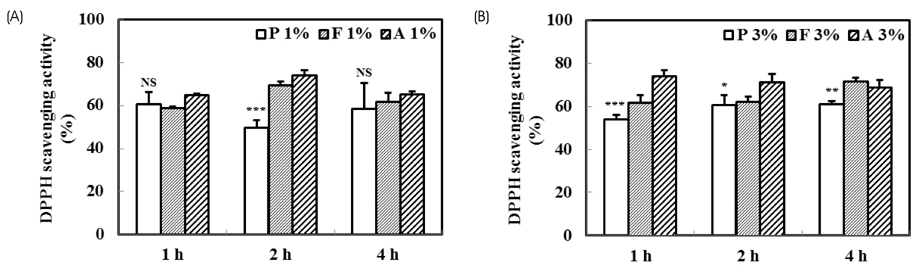
DPPH radical scavenging activity of brown teff hydrolysates obtained by enzymatic hydrolysis with 1% (A) and 3% (B) enzyme-to-substrate ratio of Protamax (P), Flavorzyme (F), and Alcalase (A)
redrawn by the authors based on data from [16]; values are expressed as mean ± SD (n = 3); NS: not significantly different; *- p < 0.05, **- p < 0.01, ***- p < 0.001; statistical analysis was performed by one-way ANOVA using GraphPad Prism 7 software
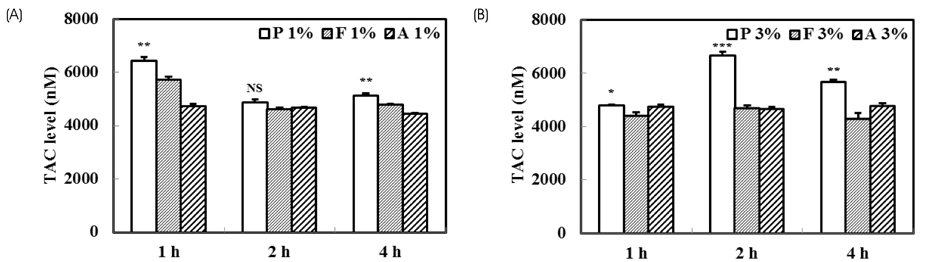
Total antioxidant capacity (TAC) of brown teff hydrolysates obtained by enzymatic hydrolysis with 1% (A) and 3% (B) enzyme-to-substrate ratio of Protamax (P), Flavourzyme (F), and Alcalase (A)
redrawn by the authors based on data from [16]; values are expressed as mean ± SD (n = 3); NS: not significantly different; *- p < 0.05, **- p < 0.01, ***- p < 0.001; statistical analysis was performed by one-way ANOVA using GraphPad Prism 7 software
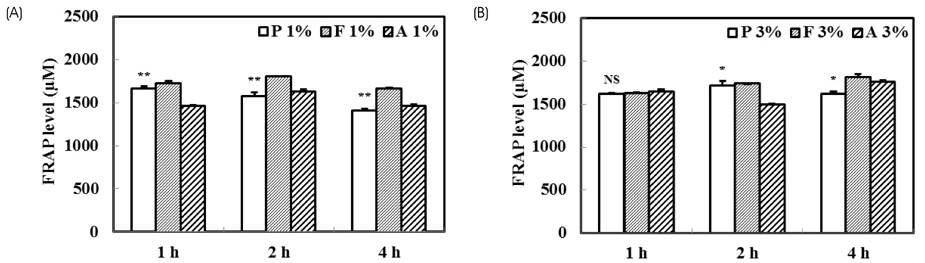
Ferric reducing antioxidant power (FRAP) of brown teff hydrolysates obtained by enzymatic hydrolysis with 1 wt% (A) and 3 wt% (B) enzyme-to-substrate ratio of Protamax (P), Flavourzyme (F), and Alcalase (A)
adapted from [16]; values are expressed as mean ± SD (n = 3); NS: not significantly different; *- p < 0.05, **- p < 0.01, *** - p < 0.001; statistical analysis was performed by one-way ANOVA using GraphPad Prism 7 software
Bioactive peptides are hidden within the original protein sequences and can influence many physiological functions beyond basic nutrition
. They exhibit a number of health benefits, including antioxidant, anti-inflammatory, anticancer, antimicrobial, immunoregulatory, and hypotensive effects . Teff hydrolysates produced using proteases such as Alcalase and Flavourzyme exhibit increased DPPH, FRAP, and total antioxidant activity, thus, the hydrolysates can be used as natural antioxidant additives to slow lipid oxidation and increase the shelf life of products , , , . They have potential for use as potential functional food ingredients aimed at reducing cardiovascular risk .Studies of teff protein hydrolysates have shown significant bioactive properties with potential use in functional foods and nutraceuticals.
2.2. Application of Teff protein and biologically active peptides in industry
From a functional point of view, teff proteins have shown promising properties for the development of gluten-free products
, . In terms of fractionation and structure, they exhibit water-holding capacity, fat-binding capacity, and emulsifying capacity in composite doughs and liquid semi-finished products. Several studies have shown that fine milling and optimized fractionation can improve these technical-functional properties. Particle size reduction significantly improves the functional properties: finer flour fractions (90–160 μm) exhibit better water absorption capacity, fat absorption capacity, swelling capacity, and solubility index compared to larger particles . In a study by Ziec, et al., it was found that bread enriched with teff flour and chia seeds contained more protein, fat, ash, and dietary fiber than products made from pure wheat. Therefore, these raw materials can be considered useful for bakery products .According to experimental studies, teff prolamins do not contain the immunogenic motifs inherent in wheat gliadin. This characteristic partially explains the suitability of teff as a safe raw material for gluten-free nutrition and provides a basis for fundamental biotechnological research exploring the structural properties of cereal proteins. For example, experimental studies have shown that teff α-globulin can be expressed in corn, forming storage vacuoles and polymerizing via disulfide bonds similarly to wheat glutenins
. While this serves as an interesting proof-of-concept for modifying the structural properties of other cereals, the practical application of such transgenic approaches requires extensive further research. Specifically, comprehensive assessments of the immunogenicity of the modified host plant, protein stability, agronomic performance, and strict regulatory approvals are necessary before any commercial applications can be considered.Functional food ingredients are components that have a positive effect on human health, including the prevention and treatment of diseases. These include healthy and functional foods, as well as biologically active food supplements (BAS), subject to regulatory approval and safety assessment. Functional foods, in addition to their nutritional value, also have an additional positive effect on the human body due to the functional food ingredients. A BAS is a food supplement containing one or more food ingredients (vitamins, amino acids, fats, carbohydrates, minerals, plant components, amino acids, and dietary fiber)
. Purified or enriched peptide fractions from the cereal teff can be encapsulated as potential functional food ingredients aimed at maintaining blood pressure or reducing oxidative stress , .3. Conclusion
For centuries, teff (Eragrostis tef) has been highly valued for its unique nutritional profile, particularly its high-quality protein and high content of the essential amino acid lysine
, . Research has shown that teff proteins can release bioactive peptides with antioxidant, antihypertensive, and antidiabetic properties, making it a promising candidate for use in functional foods and nutraceuticals , . However, despite the potential, peptides derived from teff grain are limited compared to other well-studied cereals such as wheat, soy, and rice. There are also gaps in our knowledge of the nutritional value and health effects of teff, as studies often do not account for differences between teff varieties and growing conditions , .Furthermore, the role of fermentation and processing in enhancing teff protein digestibility and peptide activity remains poorly understood. Larger clinical trials are needed to fully unlock the therapeutic potential of teff
. This would allow us to harness the benefits of teff for global health promotion, disease prevention, and the development of sustainable nutrition strategies, particularly in the context of the rising prevalence of noncommunicable diseases .