
Деловая игра как педагогический инструмент для развития глобальных компетенций школьников
Деловая игра как педагогический инструмент для развития глобальных компетенций школьников

Аннотация
В данной статье рассматривается проблема разработки педагогических инструментов и условий для развития глобальных компетенций у школьников. Цель исследования:
1) разработка структуры деловой игры, способствующей развитию глобальных компетенций у учащихся общеобразовательной школы;
2) описание практического применения этой структуры при разработке конкретных деловых игр для школьной образовательной практики.
В статье предлагается новая структура деловой игры и приводится пример деловой игры «Внеочередная сессия Генеральной конференции ЮНЕСКО», разработанной на основе этой структуры. Научная новизна исследования заключается в разработке структуры деловой игры, основанной на интеграции синергетического, деятельностного и коучингового подходов. Теоретическая значимость исследования состоит в теоретических положениях, лежащих в основе структуры деловой игры, которые будут способствовать расширению и обогащению теории разработки педагогических технологий для развития глобальных компетенций у школьников. Практическая значимость исследования заключается в применении структуры деловой игры в профессиональной практике учителей при разработке внеклассных деловых игр, направленных на формирование глобальных компетенций у школьников.
1. Introduction
The Russian Federation's "Education Development" program until 2030 highlights educational outcomes as a key objective of state educational policy. The quality of education in Russia is assessed, in part, by the results of international PISA studies, which serve as a significant and recognized indicator of competitiveness and the quality of general education among 60 countries worldwide. These educational outcomes are aligned with the concept of functional literacy, which encompasses the global competencies of schoolchildren .
Global competence is defined as a student's ability to critically examine, discuss, study, interpret, and analyze global issues and intercultural dialogue within society. This includes the capacity for critical thinking and the identification of diverse perspectives that arise from differing cultural, political, and social conditions .
Consequently, to fulfill the objectives of state educational policy concerning the development of functional literacy, it is necessary to address the challenge of creating pedagogical tools that foster students' global competencies as a core component of this literacy.
The research problem, therefore, is the development of pedagogical tools and conditions that facilitate the cultivation of global competencies in comprehensive school students. The aim of this article is to develop a business game structure for this purpose and to describe its practical application by teachers in designing specific business games for educational practice.
2. Literature Review
Contemporary domestic researchers employ various pedagogical tools to develop global competencies in schoolchildren. These include project-based activities, modeling of real-life situations, role-playing games, group problem-solving tasks, and digital interactive educational technologies . Other methods involve dialogue scenarios for decision-making on global environmental issues ; telecommunication projects, online quizzes, and teleconferences ; the creation of multi-level tasks, including those addressing global human challenges ; and specialized courses focused on intercultural interaction, such as "Formation of Humanitarian Culture in High School Students" , "Towards Intercultural Dialogue" , "Values of French Culture," and "Russia and France in a Multicultural Dimension" , . Additional approaches encompass celebrating national holidays; organizing Olympiads, exhibitions on national culture, folk games, and folklore concerts ; facilitating interethnic communication through simulation-game formats ; coordinating project activities on themes like "Tolerance" and "Drugs" that reveal global societal problems ; and implementing role-playing, educational games, and club work .
In international research, the development of students' global competencies is linked to the concept of global citizenship education. This is pursued through pedagogical means such as fostering students' critical thinking (Bosio, E.) ; teaching courses on global citizenship pedagogy (MacCallum) ; implementing the concept of education for global citizenship (Dominici, P.) ; and student engagement with programs on both global and national citizenship (Benzehaf, B.) . Further strategies involve incorporating global issues — such as sustainable development, technological innovation, and climate change — into academic subjects (Miao, S.) ; shifting teacher practices towards more flexible transcultural communication (Sun, T.) ; executing international programs that address growing global challenges (Li, C.) ; and organizing group research and volunteering within extracurricular activities (Hong, Y. H.) .
Thus, contemporary domestic and international scholars concur that fostering schoolchildren's global competencies should be achieved through:
1) utilizing multicultural educational content;
2) implementing courses and special courses that address global problems of intercultural interaction and citizenship;
3) designing project-based learning around global issues, using examples from real-life situations across various spheres of human activity;
4) organizing volunteer work, research activities, business games, and similar experiential methods.
3. Materials and Methods
We posit that business games are a pedagogical tool for developing schoolchildren's global competencies. The theoretical and methodological foundation for designing such a business game is based on an integration of the following approaches: the synergetic approach (theory of self-organization) (N.V. Poddubny , I. Prigogine ), the coaching approach (M. Atkinson ), the activity-based approach (A.N. Leontiev ), and game theory (A.P. Panfilova ). The business game structure developed through this integration involves solving a problem within the game by synthesizing knowledge from various academic disciplines. This is followed by a conscious, voluntary choice by students to implement this solution in society and the educational environment for the benefit of others.
We will now consider the structural components of the business game and outline the specific propositions from the synergetic, activity-based, and coaching approaches that informed its design.
The structural components of the business game are as follows:
· Stage I: Introduction to the Business Game.
· Stage II: Immersion in the Business Game.
· Stage III: Summing Up the Results.
· Stage IV: Reflection on the Business Game (Figure 1).
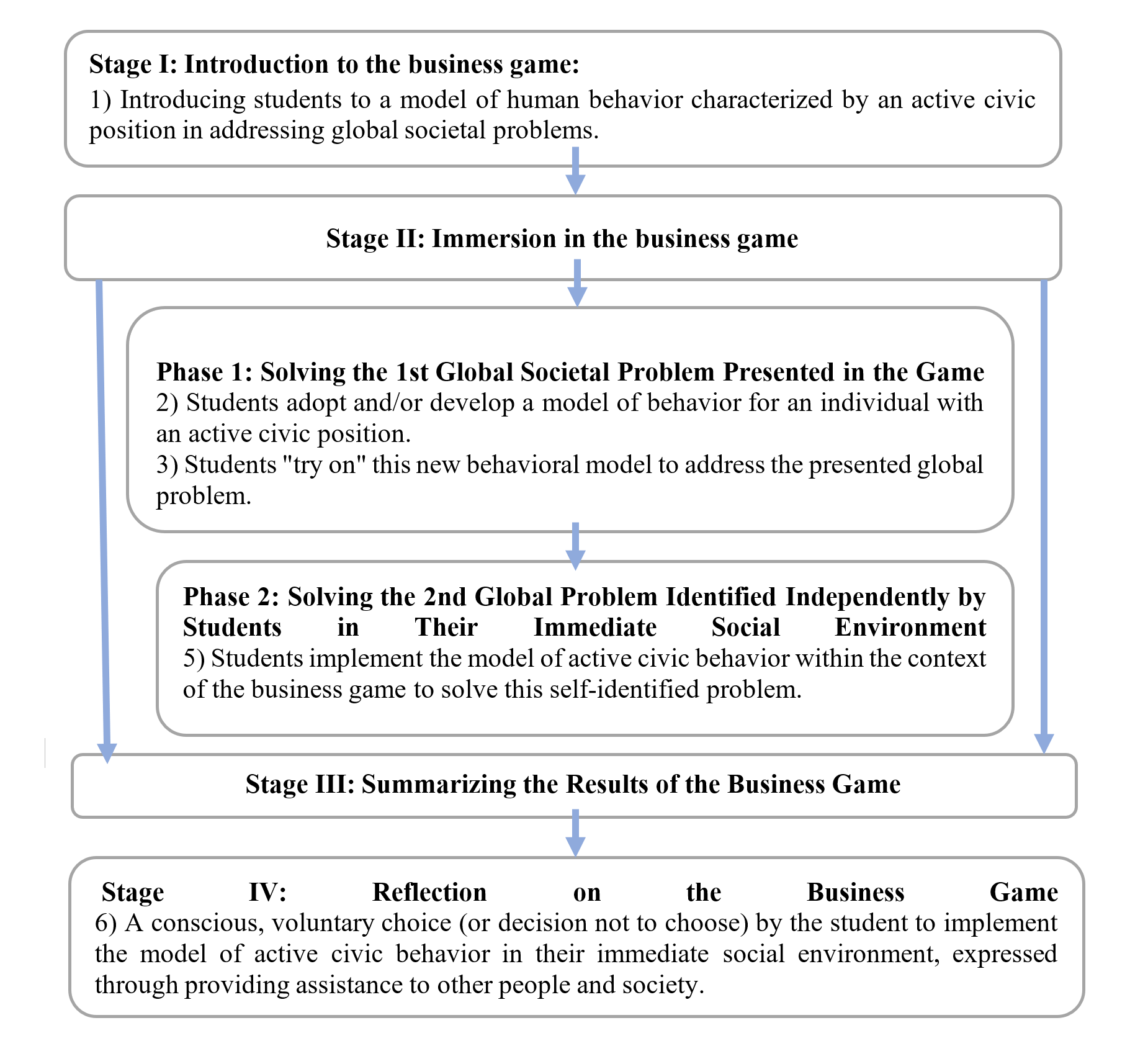
Figure 1 - Structure of a business game to solve global problems of society
This stage involves discussing the goals and objectives of the game, establishing the rules, distributing roles among participants, familiarizing students with the procedures and norms, and assessing their readiness (e.g., checking pre-assigned homework).
The design of this stage integrates the activity-based and synergetic approaches. A key element is introducing students to models of active civic behavior, which facilitates their transition from a zone of equilibrium to a zone of non-equilibrium. This transition is characterized by the emergence of feelings such as anxiety, confusion, concern, agitation, and self-dissatisfaction.
The aforementioned elements are grounded in the following theoretical propositions of the synergetic approach:
· A non-equilibrium state of a system is a prerequisite for the emergence of self-organization (I. Prigogine ).
· A symmetry break, caused by an influx of energy and information into an open system (such as an individual), induces non-equilibrium states manifesting as anxiety, confusion, concern, etc. (N.V. Poddubny ).
· The system-forming factor of any self-organizing system is its self-preservation. Such systems maintain stability through constant interaction between their parts, preserving energy at a constant level, which embodies the principle of energy conservation in specific conditions (S.P. Kurdyumov, N.V. Poddubny, A.S. Shcherbakov ).
· An adaptive system is a self-organizing entity capable of refining its structure and control mechanisms in response to changes in the external environment and internal state, based on accumulated experience .
It should be noted that self-organization is a mechanism of human self-development. A normative model of behavior encompasses actions aligned with societal norms and intentions, reflecting an individual's life strategies and problem-solving style.
The design of this stage is also informed by the following propositions of the activity-based approach:
· The zone of actual development in pedagogy refers to the knowledge and skills a child has mastered and can apply independently.
· The zone of proximal development is the level of achievement a child can reach with guidance from an adult or in collaboration with peers. What a student accomplishes with assistance today, they can do independently tomorrow. Learning that occurs within this zone is inherently developmental (L.S. Vygotsky ).
3.1.1. Integration of Synergetic and Activity-Based Approaches in Stage I
The synergetic approach posits that a student exists in and is drawn to a zone of equilibrium, where activities proceed routinely with minimal energy expenditure. This aligns with the activity-based approach: in the zone of actual development, a student operates independently. Activities within this equilibrium state require little additional energy. Consequently, if a teacher proposes engaging with a global societal problem within a business game, a student lacking prior experience or internal motivation may resist leaving this comfortable state. The teacher's role, therefore, is to guide the student from the zone of equilibrium to the zone of non-equilibrium.
Within the "Introduction to the Business Game," a teacher can organize sample activities such as:
1. Discussion of Best Practices: Engaging students in examining successful initiatives by peers in Russia and worldwide related to solving global problems. This includes:
o Presenting case studies of such activities.
o Facilitating a discussion on the topic: "Can students make a feasible contribution to society by addressing its global problems (e.g., ecology, multiculturalism)?" This comparison between the active civic stance of others and their own perceived inaction can trigger self-dissatisfaction, catalyzing the transition to a non-equilibrium state.
2. Round Table Participation: Students assume roles (e.g., ministers of education, industry leaders, business representatives) to discuss questions like: "What should a school graduate of 2030 be like?" or "What skills will employers need in 2030?" Engaging with such future-oriented dilemmas can evoke excitement, anxiety, and concern, thereby facilitating the exit from the equilibrium zone.
Thus, the theoretical foundation for the "Introduction to the Business Game" is the interpenetration of the synergetic and activity-based scientific approaches.
3.2. Stage II: Immersion in the Problem and Its Solution
In the designed business game, students are presented with two sequential problems to solve.
3.2.1. Phase 1: Solution of the 1st Problem
This phase involves the following steps:
1. Role Adoption: Students assume roles that involve adopting or developing a model of behavior for an individual with an active civic position. This allows them to demonstrate their individuality in addressing a global societal problem. The designed roles reflect a normative behavioral model, requiring students to act as if they are such civically engaged individuals. This normative model is characterized by the following skills:
o The ability to propose reformist concepts and participate in implementing innovative social ideas, movements, or projects, including those aimed at solving global problems.
o The ability to raise awareness of public or social issues, including those of a global nature that were previously not perceived as urgent.
o The ability to reconsider entrenched, traditional views on the means and methods of solving global societal problems . Through this, students master the role of a person with an active life stance, accepting, creating, and constructing stable normative models of civic behavior.
Global problems that can be framed within the business game for students include: military (peace preservation); ecological (ecosystem change, radioactive contamination); medical (e.g., AIDS); social (inequality, refugees, child welfare, human rights protection); criminal (terrorism); and technological (downplaying risks from unfriendly artificial intelligence).
2. "Trying On" the Behavioral Model: A competition is announced among student teams for the best solution to a global problem. Each team prepares one or two members to present and defend their solution. Thus, students "try on" the model of active civic behavior by advocating for their position in this competition. This process can lead students to new knowledge, values, or a shift in their worldview.
The content of student activity in Phase 1 is grounded in the following propositions of the synergetic approach:
· A non-equilibrium state is normalized through self-analysis (of one's thoughts, judgments, actions) and the creation of stable normative behavioral models. This leads to new meanings, value orientations, and the construction or restructuring of one's worldview .
· The emergence of a non-equilibrium state in a system under external influence, and the non-linear relationships within its environment, facilitate the rise of self-organizing systems .
3.2.2. Phase 2: Solving the 2nd Problem
This phase requires the student to take an active civic stance: to identify a global problem within their immediate social or educational environment and subsequently develop ways to solve it. The process includes:
· Identifying current issues in their immediate surroundings that have a global dimension (e.g., local environmental degradation, digital inequality).
· Predicting the potential impact and consequences of their actions on the environment and community.
· Proposing creative, non-standard approaches to solving the identified problem.
· Developing an action plan to realize the solution, such as organizing a social campaign or project.
The activity in Phase 2 is based on the activity-based approach. If the first problem was solved collaboratively within the game's framework, solving this second, self-identified problem allows the student to develop personal experience and skills in addressing global issues. Consequently, the student's zone of proximal development in solving societal problems gradually transitions to their zone of actual development, signifying personal growth.
Thus, the complementarity and interpenetration of the synergetic and activity-based approaches contribute to developing the student as an active subject and forming their experiential knowledge in taking a civic stance.
3.3. Stage III: Summing Up the Results
This stage involves:
· Generalizing the different problem-solving approaches used by the teams.
· Identifying what new experiences, meanings, cognitive methods, and skills have enriched the students.
· Discussing the potential for implementing the theoretically proposed solutions in real-world practice for the benefit of others. Guiding questions may include:
o "In the game, you assumed an active civic position through a specific role. Does this align with your real-life position?"
o "You played the role of someone responsible for societal issues (e.g., terrorism, ecology). What are you responsible for in society? How can you contribute to solving global problems?"
3.4. Stage IV: Reflection of the Business Game
This stage comprises two core student activities:
1. Students engage in comprehension and self-evaluation during a structured reflective session.
2. Students make a voluntary, conscious decision to implement the solution to the second problem — developed theoretically ("on paper") during the game — in society for the benefit of others.
The rationale for this stage is grounded in the integration of synergetic, activity-based, and coaching approaches. As established, the initial stage moves the learner from a zone of equilibriumto a zone of non-equilibrium. To remain in this productive state and avoid regression, the student must adopt, construct, or refine a new behavioral model and subsequently defend it during the in-game competition. To internalize this new model of active civic engagement, the student identifies and addresses a problem within their immediate social context (the second problem). The reflective session then guides the student toward a voluntary, conscious choice to translate this theoretical solution into real-world, productive action. In essence, the student is encouraged to voluntarily enact the model of active civic behavior in practical, everyday life.
According to activity theory, activity is structured by needs, motives, and goals — supported by positive emotions, valued attitudes, and will — which collectively constitute motivation . However, the specific psychological-pedagogical mechanisms for motivating such activity are not fully detailed in existing literature. Coaching, defined as a process that inspires individuals to maximize their personal and professional potential, offers reflective techniques. Standard coaching sessions (e.g., "What do you want?", "How can you achieve it?") are designed for those already intrinsically motivated to change . In typical educational settings, where tasks are often mandatory, students are not accustomed to making such conscious, voluntary choices. Therefore, initiating a reflective session with "What do you want?" is premature, as students may not yet perceive a personal need for the activity.
To address this gap and facilitate the shift from external to internal motivation, a novel reflective session was developed by integrating coaching and activity-based approaches. This session is structured as follows:
Stage 1: Recognizing the Need to Initiate/Engage in the Activity.
· Sample Questions: "You can take a civic position and benefit society by implementing activities to solve [specific global problem]. Who are the people for whom this activity is relevant and important? Whom can you help? Why is this activity important to them?"
Stage 2: Identifying Resources and Imbuing the Activity with Meaning.
· Sample Questions: "Does contributing to society mean prioritizing its goals over individual needs? What does it mean to live for the sake of others? Can your personal achievements and victories contribute to society?"
Stage 3: Understanding the Significance and Value of the Chosen Activity.
· Sample Questions: "How might the activity you choose affect the meanings and values of other people? What is most valuable to you in this activity? The activity is characterized by certain values. Do these align with your own?"
Stage 4: Reflecting on the Purpose of the Activity.
· Sample Questions: "If you asked a friend or parent to describe the purpose of your chosen activity, what would they say? On a scale from 1 (low satisfaction/achievement) to 10 (high success), where are you now? Where do you aspire to be? What can you learn from this activity? What is its ultimate purpose?"
Stage 5: Determining How to Achieve the Activity's Goals.
· Sample Questions: "How can you increase your satisfaction while performing this activity? What steps can you take to rank higher on a "skill scale" for this activity? How can you develop greater expertise?"
Stage 6: Managing Emotional and Value-Based Attitudes Toward the Activity.
· Sample Questions: "Imagine you have successfully completed this activity for the benefit of others, and they are satisfied. Who among the people important to you would be proud? How would their admiration affect your self-esteem and confidence in undertaking this activity?"
Stage 7: Regulating Volitional Actions.
· Technique: Re-evaluating the importance of a motive through the opinions of significant others. Students watch a short video where important individuals (peers, parents, teachers) express gratitude for the students' past prosocial activities .
· Sample Questions: "Imagine your planned activity has been completed to a high standard. What words of encouragement would your future self offer to your present self? Say these words of support and affirmation to yourself now."
Stage 8: Building Conviction in Successful Completion.
· Sample Questions: "On a scale of 1 to 10, how enthusiastic are you about completing your chosen activity brilliantly? What signs would people who know you recognize as indicating you are triumphantly approaching your goal?"
Stage 9: Imaging the Desired Outcome.
· Sample Questions: "Describe what you will be doing when you are at an 8 or 9 on your scale. How will your actions at level 7 differ from those at levels 8 or 9? What new elements will these actions bring to your project? What will success look like at levels 8 or 9?"
Stage 10: Making a Conscious, Voluntary Choice (or Non-Choice) Regarding the Activity.
· Teacher's Concluding Statement: "Everyone, we will meet tomorrow to begin working on [the named activity]."
Results and Practical Application
The study demonstrates that teachers, within innovative pedagogical work, can develop specific business game models for any academic subject or extracurricular activity using the structural components outlined above. An example of such an applied business game follows.
3.5. Business Game: "Extraordinary Session of the UNESCO General Conference"
Purpose of the Game: To foster global competencies in schoolchildren.
3.5.1. Stage I: Introduction to the Business Game
1. Checking Homework Readiness: Verification of preparatory work, including research on societal development issues in different countries within the context of the fifth and sixth technological paradigms.
2. Problem Identification:
o The teacher introduces N.D. Kondratiev's theory of cyclical scientific and technological revolutions, which occur in approximately 50-year waves.
o The fifth paradigm (1985–2035) is characterized by advances in microelectronics, informatics, biotechnology, genetic engineering, new materials, energy, space exploration, and satellite communications.
o The emerging sixth paradigm (2036–) will focus on robotics, nanotechnology, artificial intelligence, global information networks, and integrated high-speed transport, grounded in the convergence of NBIC (nano-, bio-, info-, cogno-, socio-) theories and technologies. Its development is underway in technologically advanced nations.
o The teacher cites Max Planck: “Science is an internal whole. Its division into separate branches is conditioned not so much by the nature of things as by the limitations of human cognition. In fact, an unbroken chain stretches from physics and chemistry through biology and anthropology to the social sciences, a chain that cannot be broken at any point except arbitrarily” .
o The teacher notes that scientists emphasize the need to transform the education system to overcome its disciplinary fragmentation . In contrast, current schooling often isolates subjects (chemistry, physics, mathematics).
o Consequently, the central problems for the game are framed: “How can education keep pace with societal development and the processes of convergence?” and “Can schoolchildren contribute to their country's society within this context?”
3. Introducing a Model of Active Civic Behavior: The teacher presents examples of students with an active civic stance addressing global issues.
o Examples include students participating in integrated extracurricular programs (e.g., "Anodic Nanoporous Aluminum Oxide Films" combining physics and chemistry) and achieving success in various Olympiads.
o This leads to a student discussion on: “Can schoolchildren contribute to societal development by addressing its global problems (e.g., in education, ecology, multicultural society)?”
4. Game Regulations: The game spans two class periods (total ~90 minutes):
o 15 min: Introduction
o 5 min: Role Allocation
o 50 min: Problem Solving
o 10 min: General Discussion, Reflection, and Summary
5. Role Distribution:
o Director-General of the Session: Teacher.
o Conference Presidium (Chairperson, Vice-Chairperson): Selected students.
o National Delegates: Each student assumes a role (e.g., Permanent Representative to UNESCO and two delegation members) representing a chosen country (e.g., Saudi Arabia, Australia, Brazil, Canada, China, Russia).
6. Announcement of Procedures, Norms, and Rules: The teacher outlines the conduct and protocols for the session.
3.5.2. Stage II: Immersion in the Problem and Its Solution
Students address two problems sequentially.
Phase 1: Solution to the 1st Problem Task: Develop a position on how education can keep pace with societal convergence. Process:
1. Students form groups of 2–3, each representing a UNESCO member state.
2. The Director-General (teacher) opens the session in Paris, stating the agenda.
3. Each country’s delegation collaborates to prepare a brief report (based on homework) outlining their nation's approach to integrating knowledge and overcoming disciplinary silos in education.
4. Permanent Representatives present their country's report.
5. The Presidium evaluates each presentation on a pre-defined 100-point scale, creating a competition for the best solution.
6. Debates and discussions lead to drafting a session resolution.
Phase 2: Solution to the 2nd Problem Task: Address the question, “Can schoolchildren contribute to solving the problem of education lagging behind society?” Process:
1. Each national delegation discusses and formulates a concrete answer.
2. The Permanent Representative presents their delegation's conclusion to the General Conference.
3. The session summarizes the solutions and identifies the most viable options.
Designer's Note: Just as a teacher prepares lesson solutions, the game designer must anticipate potential student solutions and guide thinking. Suggested solutions that students might propose include:
1. School-Wide "Week of Integrated Projects": Organize a dedicated week where all classes work on cross-disciplinary group projects, culminating in a competition. To initiate this, participating students could brief all grades on concepts like NBICS and convergence to build support.
2. Convergent Extracurricular Programs: Develop programs integrating various clubs/labs.
o Example A: Students attend subject-specific clubs (e.g., Biology, Physics, Robotics) in the first semester. In the second semester, mixed "expert" teams from different clubs collaborate on integrative projects (e.g., developing an automatic irrigation system for a community garden or an automatic door mechanism for a nursing home).
o Example B: Students from a "Psychology Club" and a "Young Computer Scientist Club" collaborate in the second semester on a project like “How to protect elderly people from online fraud?” or “Informing elderly residents about common fraud schemes (SMS, calls, online services).”
3.5.3. Stage III: Summarizing the Results of the Business Game
This stage involves generalizing the positions and problem-solving approaches of the different teams and guiding participants to discuss the possibility of translating the proposed solution — developed theoretically ("on paper") during the game — into practical action within the educational environment and society.
Guiding Questions from the Teacher: "During the game, you assumed the role of participants in a UNESCO General Conference session, taking an active civic position to solve a global educational problem. In real life, is such active citizenship a myth or a reality for you? What is your responsibility to society? How can you help society and others in addressing educational challenges? What are you capable of doing for the benefit of other people?"
3.5.4. Stage IV: Reflection of the Business Game
This stage is designed to facilitate the student's conscious, voluntary choice — or decision not to choose — to implement and transfer the solved global problem of education, specifically "overcoming disciplinary silos in education", from a theoretical framework into practical action for the benefit of the educational environment and society. The reflection process aims to solidify the student's commitment to the normative model of human behavior as an active subject in real-world contexts.
Examples of Post-Reflection Activities: Following the reflective session, students may consciously and voluntarily organize activities such as:
· Teaching computer skills and helping seniors navigate internet services as part of a project titled "Informing Elderly Residents about Common Fraud Schemes (SMS, phone calls, online services)".
· Conducting workshops and case-study analyses based on the theory of manipulative technologies within the project "How to Prevent Elderly People from Becoming Victims of Online Fraud?"
Additionally, students might undertake technical projects like designing and installing an automatic door/barrier mechanism or an automated irrigation system for flower beds at a local nursing home.
3.6. Experimental Work and Assessment
As part of experimental work in the extracurricular program of the Lyceum of Istra (Moscow Region), pedagogical tools — specifically business games such as the "BRICS Countries Summit" and the "International Summit on the Development of Asian and African Countries (Volunteer Activities)" — were developed and implemented to foster students' global competencies. These games were conducted with 124 students in grades 6–9.
The development of students' global thinking was assessed using two primary criteria: criticality and morality.
· Criticality Criterion: Measured by:
1. The ability to evaluate the significance, validity, and reliability of information based on internal consistency, alignment with objective data, and personal experience.
2. The ability to critically examine global and intercultural issues from multiple perspectives and to act effectively within such situations (assessed via E.V. Veselovskaya's test ).
· Morality Criterion: Indicators included: willingness to help a person in need (scale 9); ability to accept other cultures, maintain a positive attitude toward cultural differences, and consider other cultures through the lens of personal values; and awareness of one's moral attitude toward the world, society, and self (scales 1-6, based on S.S. Bubnov's methodology ).
3.7. Results and Analysis
Analysis revealed that students in the experimental groups demonstrated superior critical thinking skills compared to the control groups.
· Experimental Groups: High level: 19.67%; Above-average level: 30.32%.
· Control Groups: High level: 9.2%; Above-average level: 17.64%.
· The proportion of students with a low level of critical thinking was significantly lower in the experimental groups (24.59%) than in the control groups (38.65%).
Statistical analysis confirmed significant differences at the low (φ* = 2.36; p ≤ 0.01), high (φ* = 2.33; p ≤ 0.01), and above-average (φ* = 2.32; p ≤ 0.01) levels. No significant difference was found at the average level (φ* = 1.53; φ_emp* < φ_crit).
Assessment of moral skills related to intercultural acceptance also yielded more favorable results for the experimental groups (High: 22.41%; Above-average: 39.65%) versus the control groups (High: 10.92%; Above-average: 25.21%). A smaller proportion of experimental group students exhibited a low level of these abilities (16.37%) compared to the control groups (29.41%). For the average level of these skills, the difference was not statistically significant (φ* = 2.2; φ_emp* < φ_crit – zone of uncertainty).
3.8. Conclusion
Therefore, the positive dynamics in the development of students' global thinking experience can be attributed to the implementation of business games designed through the integration of synergetic, coaching, and activity-based scientific approaches.
4. Discussion
This study developed structural components for a business game designed by integrating activity-based, synergetic, and coaching approaches. Specific business games were subsequently created based on this framework. An analysis of their implementation within the educational process confirms that business games are an effective tool for fostering learners' global competencies. However, the successful implementation of these games is contingent upon specific pedagogical conditions. Key conditions discussed include conducting seminars and master classes for teachers on the design and application of business games, as well as employing psychological and pedagogical mechanisms to engage teachers in the process. For instance, business games for teachers and reflective sessions utilizing coaching techniques were employed to transform external motivation into intrinsic motivation, thereby encouraging teachers' involvement in innovative activities. The electronic service Tilda was used to host an "Innovative Activities of the Educational Organisation" page, featuring a "Hall of Fame" section to showcase teacher achievements through photos, videos, and other materials.
5. Conclusion
The scientific novelty of this research lies in the development of a business game framework based on the integration of synergetic, activity-based, and coaching approaches. The interpenetration of these approaches led to the creation of new structural components for the game.
The theoretical significance of the study is the proposed structure of a business game aimed at developing students' global competencies. This structure comprises the following components:
Stage 1: Introduction to the Business Game.
1. Problem identification and setting of the game's goals and objectives.
2. Moving students from a "zone of equilibrium" (zone of actual development) to a "zone of non-equilibrium" (zone of proximal development). This transition is characterized by feelings of concern, uncertainty, and self-dissatisfaction among students, and is prompted by their exposure to models of active civic engagement aimed at solving global societal problems.
3. Explanation of the game rules.
4. Role distribution based on students' interests, needs, capabilities, and abilities. e) Establishment of procedures, norms, and rules for the game.
Stage 2: Immersion in the Business Game.
· Phase 1: Solving the first predefined global societal problem presented in the game.
· Phase 2: Identifying and solving a second global problem within the students' immediate social environment.
Stage 3: Summarizing the Results.
Stage 4: Reflection (using coaching techniques). This stage is designed to facilitate a conscious, voluntary decision by the learner to transfer the solution of the global problem, initially addressed "on paper" in the game, into real-world practice within their social and educational environment.
The practical significance of the study is demonstrated by the application of this structure to design a specific business game. In particular, the game titled "Extraordinary Session of the UNESCO General Conference" was developed to address the problem of disciplinary silos in education and to foster students' global competencies. An analysis of the implemented business games within the extracurricular activities of an educational organization revealed a positive trend in the development of students' global thinking. Consequently, this analysis substantiates the effectiveness of the proposed pedagogical tools and conditions for developing global competencies in schoolchildren. Further research will focus on developing business games for fostering global competencies within formal classroom activities.