
Значение биофизики в формировании профессиональной компетентности будущих специалистов-медиков
Значение биофизики в формировании профессиональной компетентности будущих специалистов-медиков
Аннотация
Биофизика как одна из фундаментальных дисциплин занимает особое место в медицинском образовании, развивая у будущих врачей научное понимание физико-химических принципов, лежащих в основе биологических процессов. Изучение биофизики позволяет студентам-медикам понять механизмы жизнедеятельности на молекулярном и клеточном уровнях, закладывая основу для понимания патологических явлений, а также современных диагностических и терапевтических подходов. В настоящей статье рассматриваются ключевые методологические принципы преподавания биофизики в медицинских вузах, их отличительные особенности, а также подчеркивается важнейшая роль этой науки в подготовке квалифицированных медицинских специалистов. Приводятся некоторые аспекты преподавания биофизики в Воронежском государственном медицинском университете имени Н.Н. Бурденко.
1. Введение
In light of the rapid development of medical technologies and increasing requirements for professional training levels, the role of Biophysics is becoming ever more critical. Its study and integration into educational standards are necessary to develop highly qualified medical specialists capable of ensuring quality and safety in medical care based on fundamental physical knowledge. Therefore, Biophysics holds a vital place in the modern medical education system, serving as an essential link in training doctors oriented towards science and innovation. Without fundamental knowledge in Biophysics, it is impossible to correctly interpret the functioning of modern medical equipment and examination methods, such as ultrasound diagnostics, radiography, magnetic resonance imaging, and others. These tools are based on physical principles and require an understanding of their physical foundations for effective use and proper interpretation of the results. Furthermore, Biophysics helps understand the mechanisms of cellular, tissue, and organ functions at the molecular and systemic levels, which is fundamental for identifying pathology and developing new treatment methods. Mastering Biophysics promotes the development of analytical thinking, logic, and a systemic approach in future doctors, which are necessary for modern clinical reasoning.
2. Educational Standards
Transformations in the higher professional education system, including changes to educational standards under Federal State Educational Standards (FSES) 3++, have led to modifications in the list of taught disciplines. Within medical higher education institutions, the discipline “Physics. Mathematics” was replaced by “Biophysics.” The All-Russian Classification of Scientific Specialties (017—2013), introduced from July 1, 2014, classifies Biophysics under biological sciences, while UNESCO’s nomenclature (Proposed International Standard Nomenclature for Fields of Science and Technology) places it in section 24, Life Sciences, which includes subsections: 2406.01 Bioacoustics, 2406.02 Bioelectricity, 2406.03 Bioenergetics, 2406.04 Biomechanics, 2406.05 Biooptics, 2406.06 Medical physics . The interest in this science continues to grow, as evidenced by inquiries related to various aspects of Biophysics of living systems on platforms such as PubMed (Fig. 1) , , :
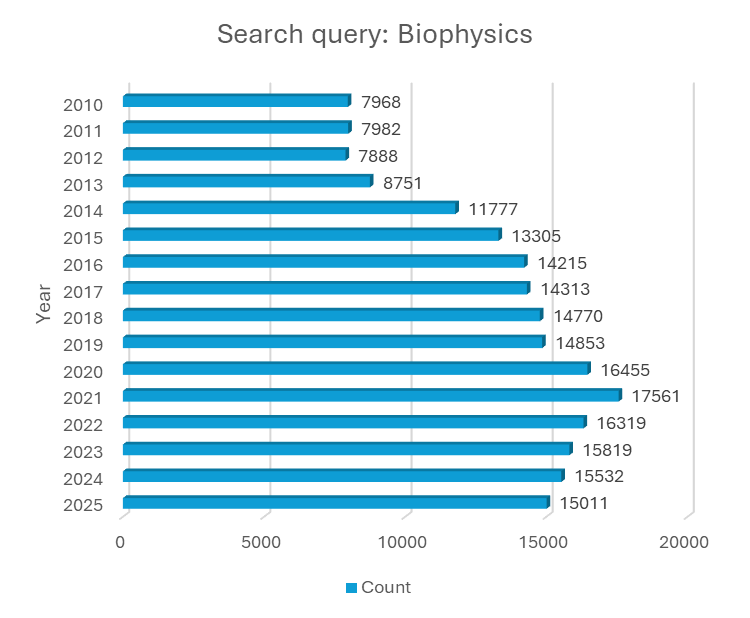
Figure 1 - The rate of inquiries related to various aspects of Biophysics
1. To develop students' systemic knowledge about the physical properties and processes occurring in biological objects, and the ability to apply a physical approach and tools to solve medical problems.
2. To form theoretical knowledge and practical skills in the use of mathematical tools and statistical methods in evidence-based medicine.
3. To cultivate a materialistic worldview and logical thinking based on the natural science nature of the studied material.
Discipline objectives:
1. To study the general biophysical principles underlying processes in the body.
2. To examine the mechanical properties of certain biological tissues and the biophysical properties of biological fluids.
3. To characterize physical factors (environmental, therapeutic, clinical, industrial), revealing the biophysical mechanisms of their effects on the human body.
4. To analyze the physical characteristics of information output from medical devices.
5. To study the technical specifications and purposes of main types of medical equipment.
6. To develop safety techniques for working with medical devices and equipment.
Within higher medical educational institutions, the discipline Biophysics is part of the foundational curriculum for higher education programs in specialties like 31.05.01 “General Medicine,” 31.05.02 “Pediatrics,” 31.05.03 “Dentistry,” 33.05.01 “Pharmacy,” and 32.05.01 “Public Health.” To study Biophysics, students must possess basic knowledge of fundamental laws from school physics and mathematics courses . This is because the discipline reveals the fundamental basis of applying physical methods in diagnostics and therapy, as well as the application of theoretical knowledge and practical skills with medical instruments and devices.

Figure 2 - The dynamics of changes in the workload of Biophysics (Physics, Mathematics) with the evolution of educational standards
Follow safety rules and procedures in physics laboratories;
1. Understand fundamental physical laws, phenomena, and regularities underlying biophysical processes in the human body.
2. Describe characteristics and biophysical mechanisms of the influence of physical factors on the body.
3. Grasp the physical basis of the functioning of medical equipment, understanding its device and purpose.
4. Comprehend the physico-chemical nature of processes at molecular, cellular, tissue, and organ levels.
5. Apply physico-chemical methods of analysis in medicine.
These knowledge areas are critically necessary for acquiring basic skills in working with physical equipment of varying complexity.
3. Methodological Approaches in Teaching Biophysics
1. Traditional Discipline-Oriented Approach. This is one of the most common approaches in teaching Biophysics, based on systematic study of the subject as an independent discipline with its own conceptual framework, methods, and objectives . As Bakayeva M. notes , Biophysics in this context is viewed as an independent science with defined goals, tasks, and history.
In this approach, students study:
– theoretical foundations of molecular biophysics and Biomembranology;
– physical principles of biological processes;
– methodological basis of biophysical research.
This approach ensures fundamental training but may create difficulties in integrating acquired knowledge with clinical disciplines, limiting understanding of the practical significance of biophysics for medical practice.
2. Integrative Approach. The most modern and promising model, the integrative approach combines knowledge from various scientific disciplines to form a holistic understanding of biological processes and their physico-chemical bases. As Nurmatova F.B. emphasizes , integration in education involves “not mechanical connection but mutual penetration and interaction of parts, leading to a new integrity with systemic qualities.” Applied to biophysics, this means interdisciplinary links with physics, chemistry, biology, and medicine, fostering a comprehensive scientific worldview and the ability for integrated application of knowledge. An example is the teaching of "Bioacoustics" together with "Otorhinolaryngology." Students explore physical foundations of sound phenomena, sound propagation, physiological mechanisms of auditory perception and sound formation, and diagnostic and therapeutic applications of ultrasound in medicine. This approach enables students to not only learn theoretical aspects but also understand practical applications, significantly enhancing the quality of future physicians’ training.
3. Practice-Oriented Approach. This approach emphasizes developing practical skills and the ability to apply biophysical knowledge in professional activities through laboratories and practical classes . It includes:
– laboratory studies of biological objects’ physical properties;
– practical exercises on mathematical data processing;
– modeling methods in Biophysics;
– mastering modern physico-biophysical research techniques.
It allows students to gain experience with diagnostic equipment, interpret biophysical research results, and understand the physical foundations of instrumental diagnostic methods .
4. Modular and Systemic Approaches. Modular approach involves structuring Biophysics content around key themes; for example, Samoylov V.O.'s "Medical Biophysics" organizes material into five main sections:
– transport of substances through biological membranes;
– bioenergetics;
– biological electrodynamics;
– biomechanics;
– information and regulation in biological systems.
Systemic approach focuses on studying the functional systems of the body from a biophysical perspective, such as blood circulation, respiration, substance absorption/excretion, sensory systems, and motility systems.
5. Problem-Based Learning. This method emphasizes solving clinical problems using biophysical knowledge, analyzing pathological processes as violations of biophysical mechanisms , , . It fosters analytical thinking and application skills relevant to clinical practice.
In conclusion, teaching biophysics in medical universities is crucial for preparing competent physicians capable of scientific analysis and informed decision-making in clinical settings. Learning Biophysics promotes a scientific worldview of the living organism and ongoing processes, facilitating understanding of fundamental life processes and establishing connections between molecular-level disturbances and clinical manifestations.
4. Experience of Integrating Biophysics Knowledge into Medicine at the Department of Normal Physiology, VSMU named after N.N. Burdenko
4.1. Overview
Since 2023, the Department of Normal Physiology at VSMU has been teaching Biophysics in the first semester of the first year in accordance with the requirements of Federal State Educational Standards (FSES) 3++. The discipline’s educational and methodological complex fully complies with all educational standards. The curriculum, designed for 72 academic hours, includes practical, lecture-based lessons, and assessments of students’ independent work. The course is delivered in both Russian and English and is one of the core disciplines tailored for medical students following programs such as “Medicine,” “Pediatrics,” and others.
Content of the Discipline.
1. The curriculum comprises three main sections:
2. Introduction to Biophysics: Fundamentals of metrology, electrodynamics, physical processes in biological membranes.
3. Mechanical Oscillations and Waves: Acoustics, Hemodynamics, flow, and properties of liquids.
4. Optics and Ionizing Radiation.
Due to limitations in the number of hours allocated for lectures (only 6 hours), the thematic plan was adjusted accordingly:
1. Electrodynamics: Basic biophysical principles of diagnostic and therapeutic tools.
2. Geometric and wave optics.
3. X-ray radiation and dosimetry.
4.2. Teaching Approach and Course Material
In order to make the lessons engaging, memorable, and meaningful within these tight timeframes, the department developed a set of situational case studies used during practical sessions and exams . These case studies cover all sections of Biophysics. Below are examples:
Task 1: Rotation of the Plane of Polarization
Questions:
How substances that cause rotation of the polarization plane of light passing through them are called?
Provide examples of substances with optical activity.
What are the optically active isomers?
Under what conditions will an optically active solution not rotate polarized light?
Task 2: Ultrasonography of Internal Organs
Questions:
What is ultrasound?
What frequency of radiation is used in diagnosing internal organs?
What happens to ultrasound at the boundary between two media with significantly different acoustic impedances?
Why is gel used during ultrasound research?
What is the main parameter registered by the ultrasound sensor during diagnosis?
Task 3: Doppler Effect in Diagnostics
Questions:
What parameters of the body can be measured using the Doppler effect?
What physical parameter does the device used in examination register?
In what units is this parameter typically expressed?
What additional two parameters must be known for conducting the study?
What range of mechanical waves is usually used in Doppler-based methods?
Task 4: Auscultation with a Stethoscope
Questions:
How the method of listening to sounds inside the body is called?
What is resonance?
What condition is necessary for resonance to occur?
Which subjective characteristic of sound changes due to resonance in the stethoscope?
What is the measurement unit used for this characteristic?
Task 5: Variation in Blood Flow Velocity
Questions:
Why blood flow velocity in capillaries is 1000 times lower than in the aorta?
Why is flow velocity in capillaries less than in veins?
Where in the circulatory system is blood pressure highest?
What causes the pressure to decrease?
How does the volumetric blood flow rate change from arteries to capillaries to veins?
4.3. Educational Methodology
Each case facilitates discussion where students actively participate, fostering deep understanding of physical phenomena in biological objects. The department emphasizes not only theoretical knowledge but also practical application of physical principles. Students further engage through scientific research work, with results regularly presented at student research meetings, conferences, and Olympiads. A key task for educators is to stimulate interest and motivation, which enhances the ability to apply physical knowledge in future medical practice — an outcome achievable through well-organized educational processes.
5. Conclusion
Teaching Biophysics in medical universities is a multifaceted process involving various approaches ranging from traditional discipline-based to integrative and problem-based learning. Effective preparation of future physicians requires a combination of methods that foster both a solid understanding of the physical and chemical foundations of life processes and practical skills for clinical application. The integration of Biophysics with other medical disciplines is increasingly important amid rapid technological advancements and higher professional standards. Universities worldwide are progressively shifting from a purely discipline-oriented curriculum toward an integrated approach, enabling students to synthesize facts into a comprehensive understanding of clinical situations.
In summary, modern teaching approaches aim to develop students' holistic understanding of the physico-chemical processes in the human body and their relevance to medical practice — an essential component for training highly qualified healthcare professionals.