
EFFECT OF POTASSIUM IODIDE CONCENTRATIONS ON THE YIELD AND FRACTIONAL COMPOSITION OF RADISH ROOT CROPS
EFFECT OF POTASSIUM IODIDE CONCENTRATIONS ON THE YIELD AND FRACTIONAL COMPOSITION OF RADISH ROOT CROPS

Abstract
This article presents laboratory and field studies of the effect of potassium iodide on germination, yield, and root fraction composition of the French Breakfast radish variety. Radish is a valuable precocious vegetable crop. Radish occupies a special place among all vegetable crops, as it is characterized by a high content of vitamins and enzymes that help improve metabolism in the human body. Bioassay studies revealed positive concentrations of potassium iodide solutions for treating radish seeds, which have a positive effect on the test parameters. A dose of 0.01% potassium iodide had the greatest effect on germination energy and seed germination. When using a 0.15% solution of potassium iodide, the negative effect of this compound was manifested, which was reflected in a decrease in germination energy and seed germination compared to the control variant. In the field experiment, the effect of different concentrations of potassium iodide on the yield and fractional composition of radish root crops was studied. According to the results of the study, it was concluded that potassium iodide has a significant effect on the yield and size of radish root crops. It was found that the highest yield (1336.0 g/m2) compared with the control (772.2 g/m2) and the largest proportion of large (>20 g) root crops were obtained in the variant using a non-root treatment of plants with 0.01% KI solution. It was shown that this concentration of potassium iodide solution also had the best effect on growth rates during the germination of radish seeds. In addition, it is worth noting that in all variants with the use of potassium iodide, a decrease in the proportion of radish roots unsuitable for storage and consumption for food purposes was revealed. However, the largest decrease in the proportion of root crops unsuitable for storage by 1.3 times in comparison with the control was obtained in the variant using 0.1% KI.
1. Introduction
The main task of modern agriculture is to obtain the highest yields of agricultural crops. An important place among them is occupied by vegetable crops, which are valuable food crops.
In improving the supply of vegetables to the population of our country, green vegetable crops, which can be grown both in open and protected ground, should play an important role.
The value of green vegetable crops is largely determined by their precocity, cold resistance, and high content of various vitamins and biologically active substances .
Radish is the most common vegetable crop from the green group, which is grown both in industrial conditions and in individual gardens.
Radish, being a valuable vegetable crop, is of significant importance in human nutrition, which is determined by the presence in it of easily digestible mineral salts, calcium, potassium, phosphorus, iron, magnesium, as well as vitamins and enzymes that help improve metabolism in the human body. The presence of essential oils and glycoside compounds in radish roots gives them a special taste and sharpness, which ensures good digestibility in the human body .
Radish is cultivated throughout all regions of Russia, and high yields can be successfully achieved both in open fields and under protected cultivation. According to statistical classifications, radish belongs to the category of other vegetable crops for which official yield data are generally not reported in Russia. Nevertheless, published studies indicate that root yields may reach 3–4 kg/m² under protected cultivation , while in open-field production they can attain 10–12 t/ha. Radish is characterized by its short growing period, allowing harvests in protected cultivation during early spring and in open fields throughout the vegetation season. This feature is particularly valuable for human nutrition, since radish provides mineral compounds, vitamins and essential oils earlier than most other vegetable crops .
The application of mineral fertilizers is an effective approach for increasing vegetable crop productivity. Vegetable species are among the crops with the highest demand for adequate nutrient availability in the soil. Furthermore, the primary macronutrients—nitrogen, phosphorus and potassium—not only improve yield but also enhance product quality and contribute to greater plant tolerance to environmental stress.
Besides the essential macronutrients required by radish, the crop also depends on an adequate supply of micronutrients, among which iodine occupies a particularly important position . Investigations into the influence of iodine on plant growth and development have demonstrated that potassium iodide can positively affect both the productivity and chemical composition of several agricultural crops , . It has also been established that insufficient iodine levels in soils and the atmosphere adversely influence both crop yield and product quality .
At present, micronutrients are commonly applied through pre-sowing seed treatment or foliar application to growing plants , . In contrast to the majority of ash-derived elements, iodine compounds can be effectively absorbed through the leaf surface. Therefore, foliar spraying with iodine salt solutions during the early stages of plant development may represent one of the most promising approaches for iodine fertilization .
High iodine application rates (> 5 kg/ha applied directly to the soil) exhibit phytotoxic effects , whereas low soil application rates are generally inefficient. Consequently, determining the optimal concentrations of iodine compounds for crop cultivation remains an important objective of scientific research. Plant responsiveness to various elements, chemical substances and toxic compounds during the initial stages of development is commonly evaluated using biotesting techniques , . These methods assess the sensitivity of phytosystems by quantitatively recording plant responses to the tested substances. Laboratory, vegetation and field biotesting approaches provide effective tools for ecological and toxicological investigations conducted within state, industrial and agricultural environmental monitoring programs , . In accordance with international standards, phytotoxicity assessments are performed using a range of agricultural crops, including cereals (winter wheat and barley), legumes, radish and squash , . Depending on the objectives of the study, parameters such as germination energy, germination percentage, shoot length and primary root length are determined .
It should be noted that the optimal concentration of potassium iodide for growing various agricultural crops, particularly radishes, remains understudied. The impact of iodine on the yield and particle size distribution of radish roots has also not been studied. Therefore, laboratory and field trials were conducted to determine the optimal concentration of potassium iodide solution for foliar application to the French Breakfast radish variety and to assess changes in plant yield and particle size distribution of roots.
2. Research methods and principles
To achieve the research objectives, laboratory, pot, and field experiments were conducted from 2023 to 2026. This article presents the results of laboratory and field studies on the French Breakfast radish variety, which is characterized by its early maturity. This radish variety has pink, cylindrical roots with a white tip. Laboratory experiments were conducted using a bioassay method to determine the optimal concentration of potassium iodide during radish seed germination. Radish served as a test crop in these studies, due to its high sensitivity to toxic substances. Despite the known impact of toxic substances on plants, it is worth noting that agricultural crops selectively respond differently to certain classes of pollutants . For these studies, radish seeds treated with different concentrations of potassium iodide solution (0.005%, 0.01%, 0.05%, 0.10%, 0.15%) were sown in Petri dishes (50 seeds per dish) in accordance with GOST 12038-84 . Seeds not treated with potassium iodide served as a control. The experiments were repeated four times. Germination energy and seed viability were determined in the experiments.
It should be noted that laboratory experiment results cannot provide a completely objective answer to the question of what concentration of potassium iodide is optimal for growing radishes. Therefore, studies evaluating the effectiveness of potassium iodide in growing radishes were continued in the field.
Field experiments were conducted in 2024-2025. At the field experimental station of the Russian State Agrarian University — Moscow Agricultural Academy named after K. A. Timiryazev, the soil was cultivated on soddy-shallow-podzolic, profile-gleyic, deeply arable, light loamy soil. The agrochemical characteristics of the soil are presented in Table 1. The study duration was 21–22 days.
Agrochemical characteristics of the soil of the experimental site
Organic Substance, % | pHKCl | Hydrolytic acidity, mg-ekv/100g of soil | S, mg-ekv/100g of soil | V, % | Nщг, mg/kg of soil | P2O5, mg/kg of soil | K2O, mg/kg of soil |
according to Cornfield | according to Kirsanov | ||||||
1,8 | 5,5 | 1,8 | 10,0 | 84,6 | 95 | 240 | 120 |
class | 4 | 2 | 5 | 3 | |||
The laying of field experience, fertilization, maintenance of experience during the growing season, as well as harvesting and determining the structure of the crop were carried out according to generally accepted methods . The plants were grown in plots with a registered area of 1 m2 in a fourfold repeat. Sowing was carried out with seeds of 2-3 g per 1 plot.
The field experiment design included four variants, including a control (background) and three different concentrations of potassium iodide (0.01%, 0.05%, and 0.1%), selected using a laboratory bioassay method. The highest concentration (0.15%) was excluded from the study due to its significant negative impact on plants, which significantly affected the germination energy and seed viability (Fig. 1). In turn, the lowest concentration of potassium iodide (0.005%) did not show reliable changes compared to the control variant, and therefore was not reflected in the experimental part of this article. The mineral background was created by applying ammonium sulfate and potassium sulfate as the main fertilizer at doses of N120K150. Potassium iodide was applied by foliar treatment of vegetative radish plants in the form of solutions and appropriate salt concentrations. Weather conditions during the growing seasons during the study varied slightly. In May and June 2024, temperatures were more than 2°C higher, and precipitation exceeded 40% of the long-term average. In May and June 2025, temperatures were 5°C and 2°C higher, respectively, than the long-term average. Precipitation in early May was approximately 20% below normal, then increased sharply in the second half of May by more than 30%. In June, precipitation was within the long-term average.
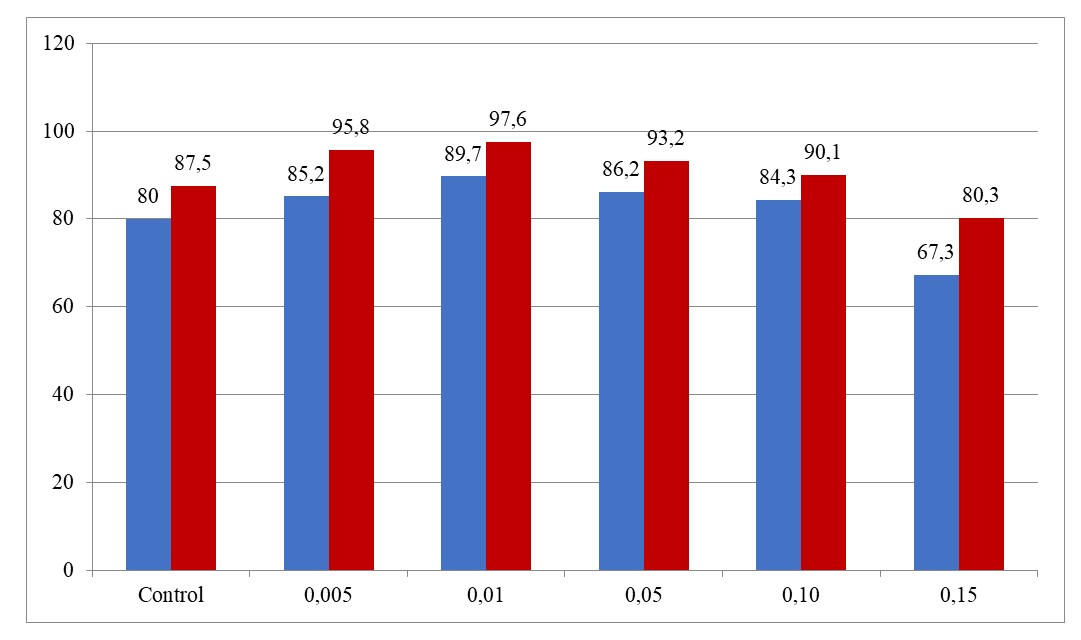
The effect of different concentrations of potassium iodide on germination energy (blue) and seed germination (red)
average for two experiments. LSD05 (germination energy) = 4.1%; LSD05 (germination) = 4.5%
Mathematical data processing was carried out by the method of variance analysis.
3. Main results
Evaluation of the effectiveness of potassium iodide in the germination of radish seeds in laboratory experiments using the biotesting method showed a positive effect of potassium iodide on test parameters.
The positive effect of potassium iodide on germination energy and seed germination at doses from 0.005% to 0.10% was revealed (fig. 1). In these variants, an increase in the germination energy and germination of seeds was obtained relative to the control variant. The highest values of the studied parameters were obtained when using 0.01% potassium iodide solution. Germination energy in this variant was 89.7%, seed germination was 97.6% compared to the control of 80.0% and 87.5%, respectively. With a further increase in the concentration of the potassium iodide solution for seed treatment, it contributed to a decrease in the values of germination energy and seed germination compared to the variant where a 0.01% solution was used. When using a 0.15% solution of potassium iodide, a decrease in the germination energy and germination of seeds was obtained compared with the control, which indicates the manifestation of the toxic effect of the iodine-containing compound. In this variant, germination energy was 67.3%, seed germination was 80.3% compared to the control, where the values of the studied indicators were 80.0% and 87.5%, respectively. Thus, the results of studies using the biotesting method showed that the use of potassium iodide for seed treatment increases the studied test parameters and allowed us to identify concentrations of the compound that have a positive effect on the early stages of plant development. Positive changes in the test parameters were obtained at doses of potassium iodide solution from 0.005% to 0.10%, which were used for further research in field experiments. The results of studies using the biotesting method made it possible to determine threshold concentrations of potassium iodide when positive values of the test parameters were obtained. A toxic concentration of potassium iodide was also detected, which revealed toxic changes in the seedlings of radish plants in the early stages of development.
The results of field studies showed that, on average, over two years of research, the use of foliar treatment of plants with potassium iodide solutions contributed to an increase in the yield of radish plants in all variants of its application relative to the control. As a result of the analysis of radish root crop yield data (Fig. 2), it was revealed that the greatest increase was achieved in the variant using 0.01% KI, it amounted to 73% compared with the control. In addition, the positive effect of potassium iodide on the yield of root crops in all variants using KI was noted.
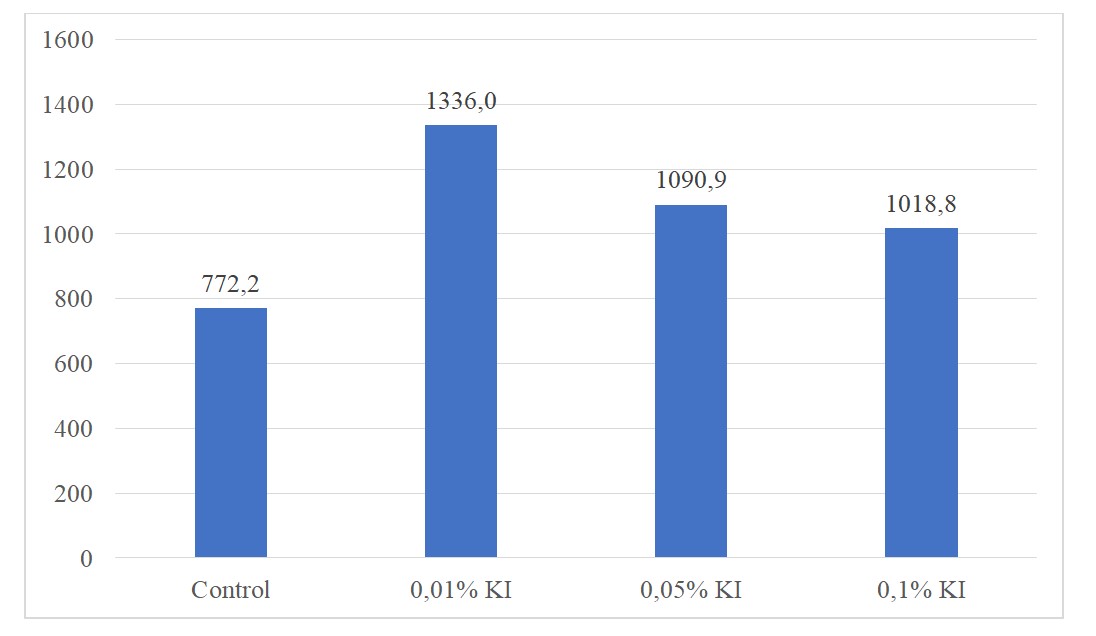
The effect of different concentrations of potassium iodide on the yield of radish root crops
average for two experiments; LSD05 – 13.9 g
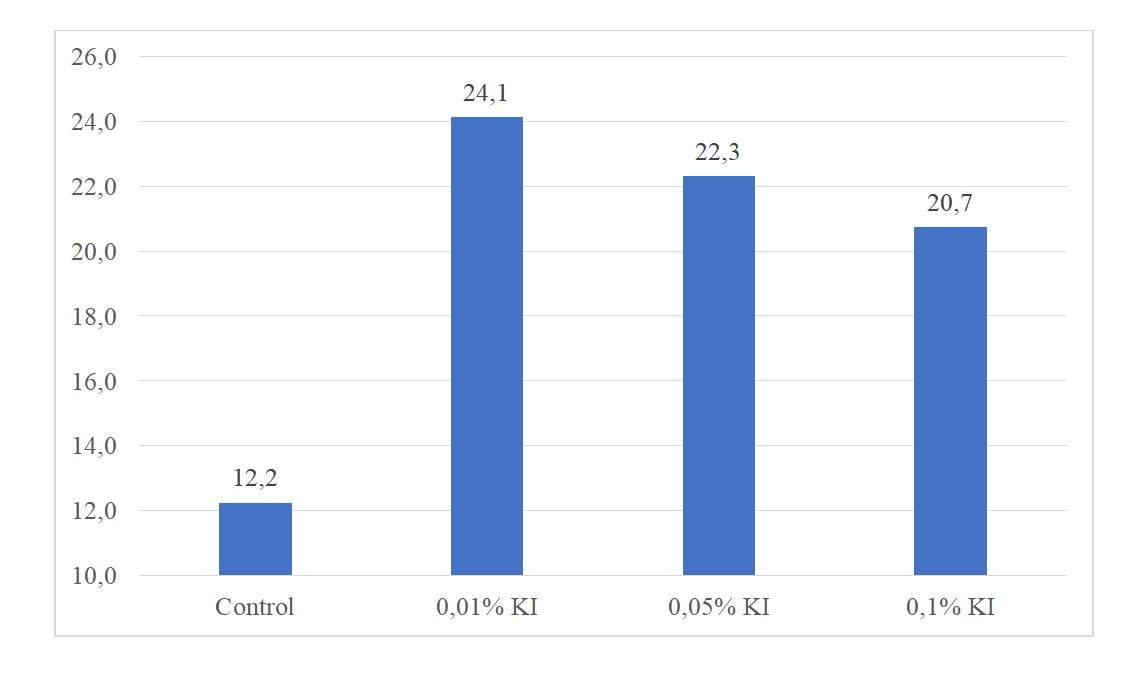
The effect of different concentrations of potassium iodide on the proportion of large (>20 g) radish root crops
average for two experiments; LSD05 – 1.1 %
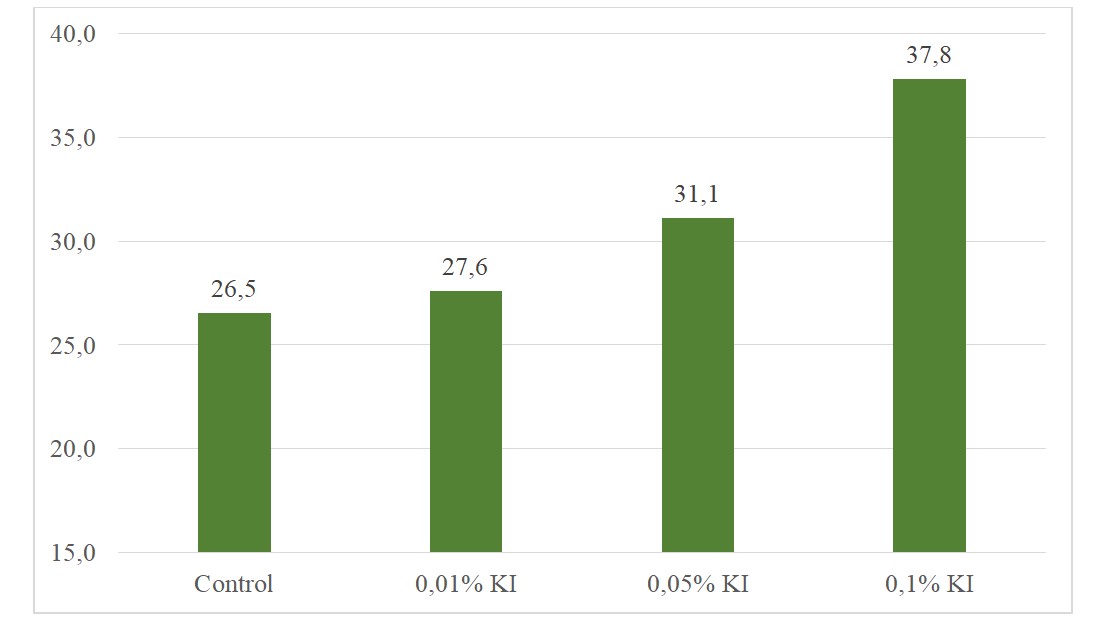
The effect of different concentrations of potassium iodide on the proportion of medium (10-20 g) radish root crops
average for two experiments; LSD05 – 1.6 %
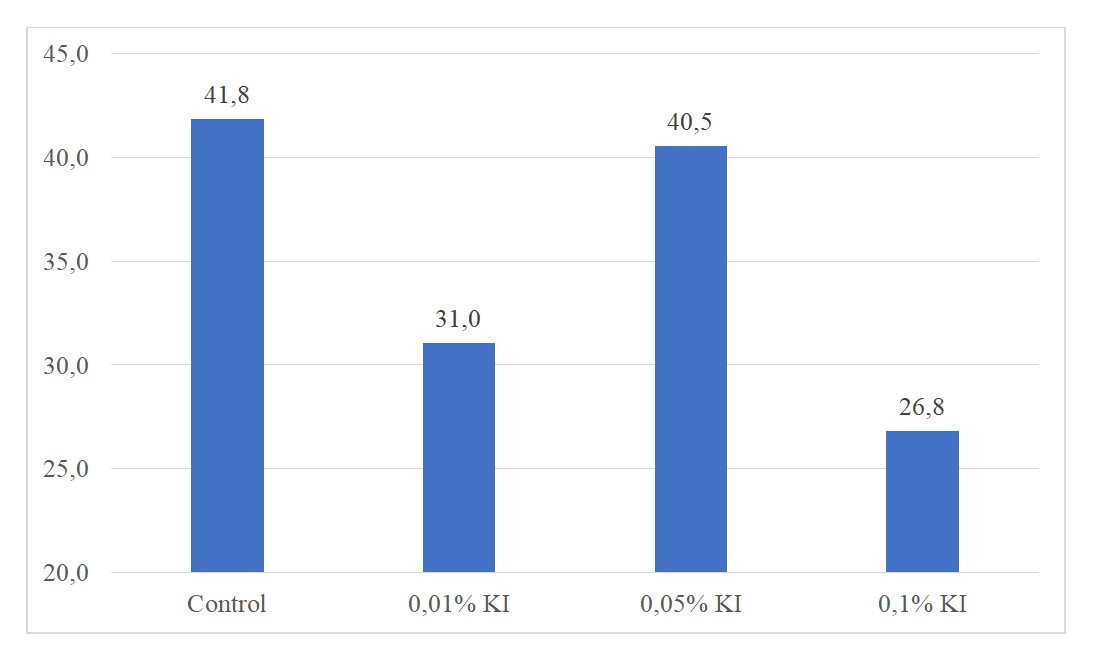
The effect of different concentrations of potassium iodide on the proportion of small (<10 g) radish root crops
average for two experiments; LSD05 – 1.8 %
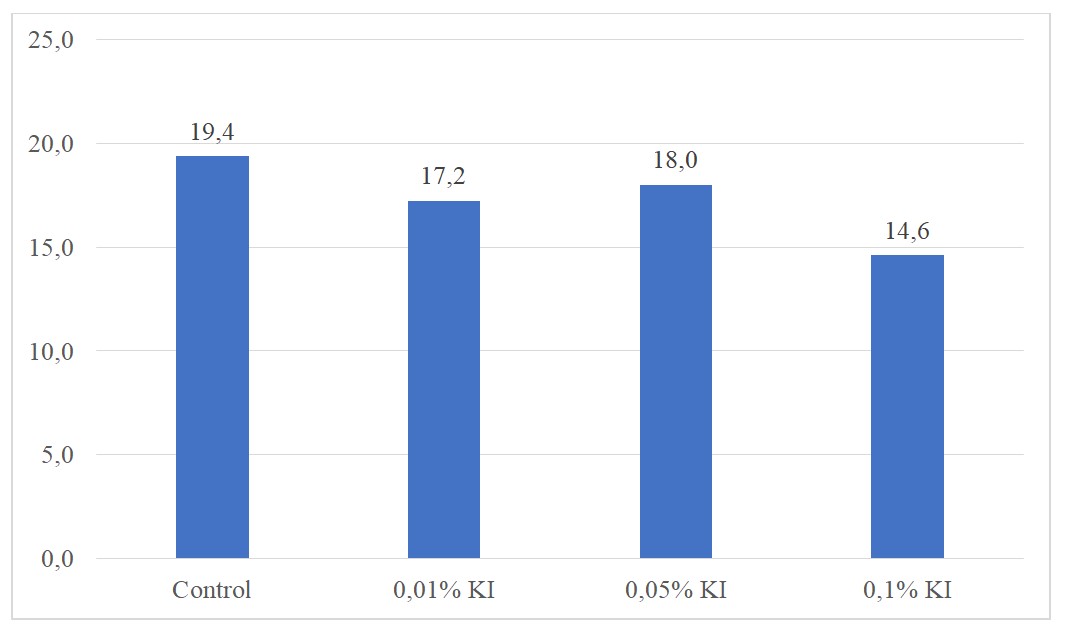
The effect of different concentrations of potassium iodide on the proportion of radish roots unsuitable for storage and consumption
average for two experiments; LSD05 – 0.91 %
4. Discussion
The data obtained in this study are relevant and comparable to those obtained by other authors with various agricultural crops , , , , . The authors found a positive effect of the iodine-containing compound on the yield of vegetables, grain forage crops, and potatoes. Significant increases in the yield of the main agricultural products were obtained, confirming the results obtained in our research , , , , .
Unlike previous experimental results published by other authors, our research allowed us to examine not only the effect of potassium iodide on radish yield but also the formation of the fractional composition of radish roots. Furthermore, our research using bioassays allowed us to identify optimal potassium iodide concentrations for radish cultivation. Therefore, the research we conducted and presented in this article and previously published studies allows us to update and expand our understanding of the feasibility of using iodine-containing salts in agricultural crop cultivation, as well as the effect of iodine on the physiological processes of plant development.
5. Conclusion
1. Using the biotesting method, the effect of different concentrations of potassium iodide on the test parameters of radish plants in the early stages of development was studied. The positive effect of potassium iodide solutions in doses of 0.005% to 0.10% on stimulating the germination of radish seeds was revealed. An increase in the values of germination energy and germination of seeds of the studied crop was revealed. The highest values of the test parameters were obtained when using 0.01% potassium iodide solution for seed treatment. It was noted that when using a 0.15% solution of potassium iodide, it contributed to the manifestation of a toxic effect when a decrease in test parameters was detected.
2. It was revealed that the highest yield of radish root crops is achieved when using the 0.01% KI option. The yield in this variant increased by 73% compared to the background variant and by 23% compared to the 0.1% KI variant, which was the second most effective.
3. It has been established that the use of potassium iodide as a non-root treatment affects the fractional composition of radish root crops. The largest proportion of large (>20g) root crops was obtained in the variant using 0.01% KI (24.1%), medium–sized—in the variant using 0.1% KI (37.8%) and small— in the variant using 0.05% KI (40.5%). It follows from this that the most effective is a non-root top dressing of 0.01% KI.
4. It has been revealed that the use of foliar top dressing with potassium iodide can significantly reduce the proportion of radish roots unsuitable for storage. Thus, in the variant using 0.1% KI, the greatest decrease in such root crops is observed—by 1.32 times in comparison with the background variant.