
Social economy in the virtual world: the impact of buying things in games on real socio-economic relations (Counter-Strike 2 case study)
Social economy in the virtual world: the impact of buying things in games on real socio-economic relations (Counter-Strike 2 case study)
Abstract
This study explores the phenomenon of the social economy in the virtual world, using the game Counter-Strike 2 as an example. The main focus is on analyzing the impact of in-game purchases, particularly "skins" and other digital assets, on real socio-economic relations. The primary goal of the research is to identify the key mechanisms of interaction between virtual and real economies, as well as to analyze player consumer behavior.
The article uses both qualitative and quantitative research methods, including data analysis from trading platforms (such as CS.Money and BUFF Market). Special attention is given to speculative practices, the monetization of gaming experience, and the emergence of new forms of employment related to the virtual economy.
The results of this study show that in-game purchases in CS2 not only create alternative markets, but also have a noticeable impact on real economic processes. Specifically, the trade of digital assets contributes to the rise of new professions (such as virtual item traders), changes player spending habits, and creates new forms of social inequality. Additionally, a connection has been found between the virtual economy and trends in real financial behavior, including investment practices.
1. Introduction
«It's just a waste of time!», «Stop wasting your time on these childish toys!», «It's all nonsense and meant for silly kids» — familiar phrases, aren't they? Despite the rapid advancement of technological progress in almost every aspect of our daily lives, video games are still frequently criticized, with doubts raised about their relevance in the life of a mature, independent adult. Video games are often perceived as simple entertainment, capable of distracting people from real problems and everyday routines. Many believe that they only contribute to wasting time and negatively affect players' social skills, leading them to a state of social incapacity and emotional instability.
2. Main results
A large number of people across various age groups and genders consciously dismiss this activity, labeling it as "childish entertainment." However, this field persistently demonstrates and proves the opposite. In recent years, there has been a significant shift in understanding the role of video games in modern society, supported not only by a moral reevaluation but also by the tangible impact of many popular games on the global social economy.
In today's gaming world, there are entire pillars that can compete in profitability with many renowned international companies unrelated to video games. One of the foundational corporations in the development, publishing, and distribution of computer games is Valve Corporation, also known as Valve Software. This American company has gifted us games such as Counter-Strike, Dota, the Half-Life series, Team Fortress, Portal, and many others.
To conduct a more detailed and in-depth analysis of the impact of video games on the modern social economy, we will focus on one of Valve's most in-demand games in recent times — Counter-Strike 2 (hereinafter CS2), as the latest installment in this series. Overall, the Counter-Strike series is a multiplayer first-person shooter where a group of ten players is divided into teams of terrorists and counter-terrorists. The objectives of each round can vary from planting/defusing bombs, rescuing hostages, to eliminating the enemy on maps of varying difficulty levels.
Given that this series is one of the pioneers in the multiplayer shooter genre, it quickly won the hearts of millions of players. According to SteamCharts, the online player counts for the latest version of this game (as of 01/28/2025) is 1,260,546, which is one of the highest figures compared to other online games (Table 1) .
Table 1 - Number of online players in the last 24 hours as of 01/28/2025 in the most popular multiplayer video games
Name of the game | Number of online players |
Counter-Strike 2 | 1,260,546 |
Dota 2 | 604,359 |
Pubg: Battlegrounds | 530,370 |
Marvel Rivals | 395,603 |
Grand Theft Auto V | 180,359 |
Thanks to these figures, we have every reason to consider CS2 an interesting phenomenon for further analysis. At the moment, Counter-Strike 2 is not just a game for casual users but also one of the main disciplines in esports, featured in tournaments such as ESL One, IEM (Intel Extreme Masters), and Major Championships. Moreover, it represents a completely new and, perhaps, the only unique and fully legal form of socio-economic relations that did not exist until the second decade of the 21st century.
This game not only offers engaging gameplay but also creates complex economic and social systems that impact the real economy and influence numerous societal relationships. Virtual purchases, such as weapon skins and other in-game items, form a unique economy where players become active market participants. These transactions do not just affect the gameplay; they also reflect broader social and cultural changes.
Next, we will delve into how in-game purchases in CS2 influence real economic models and social interactions, debunking the stereotype that video games are insignificant beyond the screen. We will analyze the mechanisms behind the formation of the virtual economy and the impact of purchases on players' status within the community to demonstrate that video games can be a powerful tool for understanding modern economic and social processes.
Like in any other multiplayer online video game, CS2 has its own in-game currency, which is earned when a player performs certain actions, such as winning rounds, eliminating opponents, and planting or defusing bombs. This currency is used to purchase weapons, grenades, and armor, making the management of the in-game economy a key aspect of gameplay . Successful, and most importantly, strategically savvy players must not only earn and track their finances but also accurately analyze the economic state of their opponents. This includes predicting opponents' purchases based on their previous actions and current financial situation, which significantly adds complexity to the gameplay . Proper resource allocation can increase the chances of winning a campaign, while poor purchasing decisions can lead to conflicts and dissatisfaction among players .
This suggests that virtual items, such as weapon skins, have become a unique marker of a player's status. Owners of rare or expensive skins may be perceived as more experienced, successful, or lucky players, which influences their social connections within the gaming community, thereby increasing their authority among teammates. Currently, in CS2, there are about five main categories of weapons for which players can obtain or purchase skins: knives, pistols, submachine guns, rifles, and machine guns . Each of these categories has between ten and twenty variants of the weapon. For example, users have access to around twenty different types of knives, ranging from standard to butterfly knives. Thus, for each category and variant of weapon, there is an incredible number of skins — nearly two thousand, by rough estimates in 2021 . Each skin has one of the following qualities that directly affects its potential value:
1. Battle-Scarred.
2. Well-Worn.
3. Field-Tested.
4. Minimal Wear.
5. Factory New.
The list is arranged in order of increasing quality—from the worst (Battle-Scarred) to the best (Factory New) . The price of a skin is also influenced by factors such as its rarity, wear level, pattern type, whether it is a souvenir skin, and whether it features StatTrak (a counter for the number of defeated enemies). Stickers on the skin also play a role and are ranked from completely ordinary to exclusive. To illustrate the price range, let’s consider a few skin options. For instance, any user can purchase a skin for a corresponding category of weapon for less than one US dollar: the P250 Valence pistol costs about $0.17, while the Glock-18 Candy Apple costs $0.22 . Moreover, the number of inexpensive skins is as vast as that of expensive and extremely expensive ones. Among the latter is the Karambit Case Hardened (Blue Gem) knife, which is estimated to be worth 1.5 million dollars, making it the most expensive skin in CS2 history as of 2025, with a drop chance of 1 in 371 million .
As a result of the above, many players are willing to spend an incredible amount of real money on virtual skins — essentially cosmetic items — trying to stand out among millions of similar participants. This trend has not gone unnoticed by Valve itself; according to data from CS2 Case Tracker in 2023, the company earned at least around $980 million without accounting for the 15% cut that developers receive from reselling in-game items on the Steam marketplace (a digital distribution service created by Valve in 2003) between players (Chart 1) .
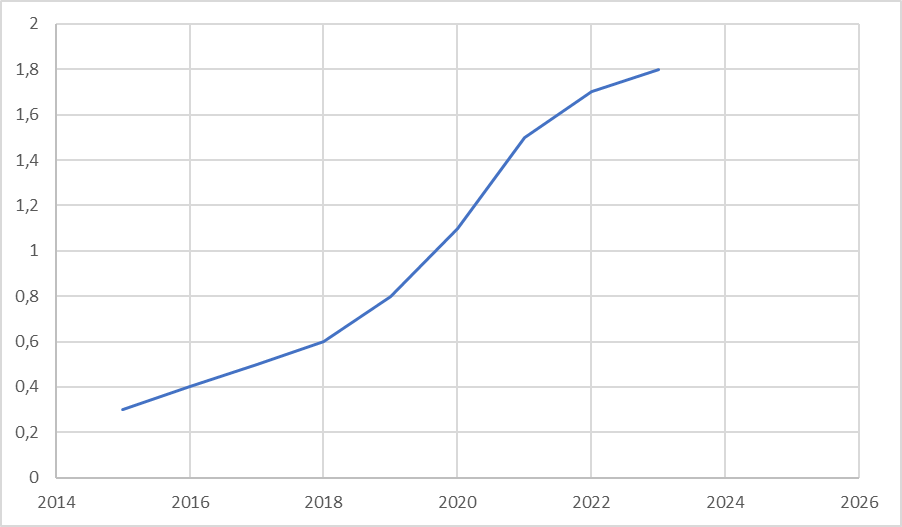
Figure 1 - Approximate estimate of Valve Software's revenue from the buying/selling of skins and the percentage from transactions of their resale by players in billions of USD
There are about forty different cases that can drop for players with varying probabilities. Each case contains a number of weapons of different rarity and value . Generally, from the forty existing cases in the game, no more than five reliably drop, resulting in a geometric increase in demand for the remaining thirty-five types, and prices for skins within these cases will be much higher than those from standard cases. Thus, we observe what is known as «bipolar» demand; on one hand, the naturally limited number of cases attracts more players, but on the other hand, this demand is artificially maintained and sometimes provoked by Valve itself—many cases over time are either removed from the «permanent five», being replaced by others, or disappear from the lineup altogether. Consequently, skins from these cases can only be obtained by purchasing them from other players. It is precisely due to this system that farmers manage to build quite successful businesses that Valve attempts to curb, but not to the extent it would like.
3. Conclusion
There is no doubt that the topic under consideration is quite extensive, and in this paper we have touched only upon the surface of this vast mechanism of modern socio-economic relations. However, even this evidence base is sufficient to confidently conclude that the influence of Counter-Strike 2 on the modern economy cannot be overlooked. As a result, we arrive at a well-supported belief that yes, modern in-game trading relationships often have a real reflection in the economy of both countries and the world. Thus, video games represent not just entertainment, but also complex social and economic systems. The virtual economy formed around in-game purchases creates new opportunities for interaction among players and shapes unique consumption models that have real consequences.
Firstly, the in-game economy of CS2 illustrates how virtual goods can become an important element of strategic planning and team dynamics. Players not only earn in-game currency but also use it to make decisions that can affect match outcomes. This highlights the importance of economic literacy and strategic thinking in gameplay.
Secondly, social interactions in CS2 demonstrate how virtual goods impact players' status and identity. Weapon skins become symbols of success and skill, creating new social norms within the gaming community. These changes also affect team dynamics, where economic decisions can either strengthen or undermine relationships among players.
Thirdly, consumer psychology in the context of CS2 reveals players' motivations for spending on virtual goods. Emotional engagement and the desire for self-expression become key factors driving players to invest real money into the game.
Finally, the future of virtual economies in games like CS2 opens new horizons for social initiatives and projects. Games can serve as platforms for charitable events or educational programs, highlighting their potential as tools for addressing social issues. Thus, the impact of purchasing items in games on real economies and social relations is multifaceted and requires further study. Virtual worlds are becoming an important part of our reality, shaping new social connections and economic models. Understanding these processes can help us navigate better through a rapidly changing world of technology and social interactions.