
Features of the Coverage of Geopolitical Issues in Transnational Online Mass Media (The Case of Kosovo)
Features of the Coverage of Geopolitical Issues in Transnational Online Mass Media (The Case of Kosovo)

Abstract
We are witnessing that technological development, especially in the last decade, has greatly influenced and transformed the way communication works and in which form it is conducted. Today, without adequate technological communication, complemented by the traditional ones, it is difficult to create and maintain a proper image of the state alongside the competitive level in the world. This trend has also transformed into diplomacy, which today is called digital diplomacy or e-diplomacy. The purpose of this study is to examine how digital communication, through international media, influences the representation and perception of the Republic of Kosovo in the global context. E-diplomacy has become trending worldwide, and its influence is rising each day. Social media platforms are moving alongside serious newspapers in the race for information spread and reliability. To address this objective, a study has been conducted analysing ten of the most relevant digital international newspapers, examining whether they contain information related to Kosovo, and categorising the content based on the sentiment. The findings indicate that only 20,5% of the news articles contained a positive sentiment, 20% neutral and 59,5% negative. In addition, interviews conducted with state diplomats indicate the effort the state makes in order to create and maintain a positive national image. Nonetheless, various components are uncontrollable and therefore lead to certain diplomatic results which need further strategic responses.
1. Introduction
In the contemporary digital era, communication is no longer a linear exchange between two parties, but rather has evolved into a multi-layered, complex process involving technology and an audience which is always open for interpretation. While traditional communication theories point out factors such as noise, bias or channel limitations, the growth of digital platforms has transformed the manner in which information is produced and transformed, particularly in political and diplomatic contexts. This transformation is relevant for states seeking to maintain a representative international image, since digital communication creates global visibility and can increase the risk of biased or false representation. Despite extensive research on digital media, limited research is conducted on how smaller or politically sensitive states use these platforms to navigate their reputation. Therefore, this study addresses this observed gap by examining the case of the Republic of Kosovo, in terms of its communicated and interpreted image in the international digital space, while contributing to a context-specific perspective in the broader field of digital diplomacy and strategic communication.
Each interaction in the human species starts with a sign, symbol or language usage; this act of comprehension needs two or more parties to be considered successful. The meaning created by the exchange of information depends on the environment, time and context. Yet when a response is not generated from the stimulation of one side of the party, communication fails to be attained . The road of the message is sometimes not linear since noise is present in the process, and only a changed version of the initial message is transmitted. The information received by the mass is typically biased at the moment it is released from the source . In order to avoid these scenarios, strategic communication styles have to be implemented, especially when dealing with political and diplomatic matters.
The weight of the decisions and consequences of all actions was on the shoulders of countries and policymakers; however, with the inclusion of information technology, changes have occurred. Information technology, often described as a way in which computer systems “manipulate” data and information, is comprised of computer hardware and software applications, and in the context of this paper, focuses on websites, e-mails, online conferences, social media, online classrooms and much more. Through the digitalisation of the information spread, a lot of actions and interactions have become faster by being electronic.
“...Communication is essential for the creation of something known as a community at both the domestic and international level” .
As an example of the influence and role of information technology in international communication, the Republic of Kosovo is taken. This state has experienced its last war during 1998-1999 and is still in a fluctuating political state. Going back in time, negotiation was attempted; however, it was unsuccessful. The negotiation proposal for Serbia and Kosovo held in Rambouillet and Paris for an “Interim Agreement for Peace and Self-Government in Kosovo” was signed only by Kosovo . Without the agreement of both parties, Serbia attacked the Kosovo territories, where the total number of people who were forced from their homes, even though many sources state differently, was the largest event in Europe since World War II . One of the probable troubles in the ruling strategies of the time was the Western policies, which were focused on containing the crisis rather than solving it, which led to the catastrophic outcomes . Kosovo was declared an independent Republic on 17th February 2008. Less than twenty years later, the county has rebuilt itself economically, industrially and politically.
Traditional diplomacy relied more on closed institutional channels, whereas modern digital public diplomacy uses websites, social media platforms, virtual events, and other channels to reach a global audience. Since Kosovo has a sensitive and unevenly recognised international political position, the role of digital public diplomacy is of utmost importance and serves as a strategy for building reputation and legitimacy in the international digital world. Although media coverage constitutes the primary empirical evidence for this research, this emphasis on media coverage does not disconnect it from digital public diplomacy. Because the international media environment is part of the larger space in which digital public diplomacy occurs, analyzing representations of media will serve as an essential (and somewhat indirect) means to determine if Kosovo's involvement in digital international communication is associated with positive, negative or neutral public meanings.
This research does not suggest that the growth of digital media technology alone was enough for Kosovo to increase its standing internationally. Instead, it is suggested that digital media provided an additional communication space through which Kosovo's political activities, diplomatic challenges and international reputation were made more apparent, communicated faster, and open to be interpreted by external audiences. This distinction is particularly relevant to Kosovo since its international situation is determined both formally by the extent of diplomatic recognition from other states and informally by how its political condition (its political status), regional relationships, democratic developments, and institutional actions are represented in global public debate. In this light, the role of Information Technology has been considered here as a supplementary diplomatic/communication tool rather than as an autonomous factor affecting Kosovo's international situation.
1.1. State of the Art
In the reputation of a state, every area of expertise is intertwined and has a special spot in the influence board. If an organisation is having difficulties and it becomes public, the welfare and progress of it represents the state in the international world . Various crises can occur during the process, and managing the crises of a state or a corporation can be done using two strategies: managing information and managing meaning . The point of view together with the emotions and information is linked to, has a strong impact on the perception of it; i.e. if the president of the state interprets a situation as “not concerning”, a percentage of the masses will believe it, and panic can be avoided, and in this case, the only controlled part should be the information that gets out to the public.
Additionally, a very important component is the image that the state leaders have created. The representative figures of the state, in all important positions, are directly linked with the image and status in the international community . How these representatives of the state are shown in the world is always based on the media and news reports that get public.
The core countries of the world have more advantages and are represented in the news more than the semi-peripheral and peripheral states . This division is done through the categorisation of the modern world, which is concentrated on the capitalist value and ranks these states based on their financial baggage. Nonetheless, this has been easier to control in the times when not everyone had access to loads of information and were able to add a ‘comment’ to it.
If the relationship between the public and a corporation mirrors itself in each other’s needs, the fulfilment will reflect on the Return on Investments (ROI) . Through a trusting and honest representation of the government to its people, a lot can be achieved. After the 1998-1999 conflict and after declaring independence in 2008, the public diplomacy of Kosovo has been formulated and implemented under extremely specific geopolitical conditions. Under these conditions, international recognition of the State of Kosovo, the legitimacy of the state and the way it is perceived by other countries are major issues for Kosovo's public diplomacy. In addition to using the classic tools of public diplomacy that are based on hard power and direct influence, public diplomacy nowadays often uses soft power tools such as information dissemination, credibility and interaction with foreign publics. As Corneliu Bjola and Marcus Holmes and Ian Manor point out, small or politically disputed states often make use of digital diplomacy in order to overcome the limitations they face when trying to achieve greater visibility on the international scene and to be able to take part in discussions concerning international topics. States with limited traditional resources to express themselves internationally use digital platforms to go around structural constraints in order to convey their narrative to a global audience. With respect to this frame of reference, Kosovo is a good example because its international reputation is influenced both by the ways in which it communicates itself and by the ways in which it is represented by the worldwide press. Thus, an analysis of the presence of Kosovo in digital media not only reflects how Kosovo is seen from abroad, but also places Kosovo's digital public diplomacy within the broader theoretical debate about how new and partially recognised states use digital communication techniques to build up and negotiate their international identity.
The importance of the case of Kosovo lies in the fact that its reputation is not only dependent on the work that is done by the state but on external political happenings, such as regional tensions. Therefore, it is necessary to include two interconnected dimensions: first, the way Kosovo is portrayed in international digital media and second, the communicative tools Kosovo uses in order to present itself in the public digital media. This two-dimensional portrayal aims to represent the role of information technology in Kosovo’s international communication.
2. Methodology
This study will utilise a combination of qualitative and quantitative research methodologies, combining content analysis with assessments of the subject matter and evaluations of how international online media outlets portray the Republic of Kosovo
. Quantitative aspects include determining the number of articles about Kosovo and grouping those articles into categories based upon source (outlet), subject (theme) and overall tone (sentiment). A main goal of this project is to evaluate how international digital media outlets cover Kosovo to identify patterns that can help develop Kosovo's digital public diplomacy initiatives and better grasp the Republic of Kosovo's international identity.A total of 200 articles forms the corpus of this research. These articles were selected from ten international digital news agencies over a six-year period (from 2016 to 2021). The distribution of articles across the ten digital news agencies studied was as follows:
Distribution of articles across digital news agencies
Name | Number of Articles |
Brussels Morning | 23 |
EUobserver | 22 |
Euractiv | 47 |
Foreign Policy | 19 |
New Europe | 20 |
Politico | 16 |
The Brussels Times | 11 |
The New York Times | 7 |
The Washington Diplomat | 12 |
Voice of America | 23 |
The data set comprises ten prominent online news agencies in Europe (five based in Brussels) and five in the US. The selection of Brussels and Washington D.C. is based on their importance to Kosovo's foreign policy. The selected news agencies were chosen based on their influence, politics, global audience and availability of archived materials.
The process for analysing the articles included identifying all articles from the chosen time period that contained references to "Kosovo" and its search terms, including “Kosovo”, “Republic of Kosovo”, and “Kosovo Serbia relations”. After identifying the total number of relevant articles for each agency, they were then organised into a codebook. Articles were categorised into three levels of sentiment: positive, negative and neutral. Positive articles referred to any article indicating that Kosovo was involved in diplomatic progress, international co-operation, development, recognition or constructive political actions. Negative articles indicated that Kosovo was connected to instability, conflict, crime, diplomatic tensions, crises or problematic governance. Neutral articles typically provided objective accounts of events occurring in Kosovo without using strong evaluative language.
Coding was carried out manually by employing a pre-defined coding structure (a codebook) with two stages of analysis: thematic categories and/or sentiment. First, each news article was placed into one thematic category (e.g. Diplomacy, Elections, Crime, Regional Relations, Humanitarian Issues). Next, each article's overall sentiment was assessed. Articles indicating positive sentiment described diplomatic efforts and/progress toward improved relationships, international cooperation, recognitions, development initiatives and/or constructive political action. Articles describing negative sentiment indicated conflict, instability, crime, political tension, governmental problems and/or crisis-related reporting. Articles classified as neutral provided factual information without an overtly evaluative tone/emotional appeal, i.e. election results, official statements and/or updates about procedures.
To reduce the potential for coder bias through subjective interpretation of articles during the coding process, coders utilized established language indicators when assigning articles to a thematic category. These include evaluative adjectives, how events are framed, who is given credit/responsibility for specific events and the directional flow of the narrative. Internal validity for this study was evaluated using an inter-rater reliability check where approximately 10–15% of all articles coded initially were coded again as part of a post-coding review to ensure consistent application of category classifications.
The time frame chosen for this study — 2016–2021 — is significant. During that time, Kosovo continued its efforts to establish itself internationally through various forms of negotiation with other countries, debates about which countries should recognise it, and EU-related activities. In addition, during that same time frame, digital media's role in shaping perceptions of what Kosovo is like became increasingly important. This engagement, along with other issues associated with Kosovo, has placed it at the centre stage of international media coverage, making this the most appropriate time frame to examine the way in which Kosovo's image is created in online news outlets. The selected time frame includes the onset of the COVID-19 pandemic, during which online communication was more important than ever in terms of political visibility and international communication.
While comparing the time frames 2016–2021 and 2021–2025 could have offered further advantages, it would require creating a larger database, recoding all data collected in both time frames, and expanding the methodology to include the new time frame. Alongside coding articles for sentiment, the study categorised them into specific thematic areas, including: diplomacy, crime, elections, state building, humanitarian aid, regional relations and other recurring topics. Using this two-level coding strategy allowed us to distinguish between whether Kosovo was portrayed positively or negatively and in what substantive context these portrayals occurred. However, the theoretical section does not focus solely on the given period. By including contemporary literature on digital diplomacy and public diplomacy, the findings can be interpreted through the lens of an evolving process of electronic public diplomacy.
3. Public Diplomacy
The international exchange of information has brought about a new form of diplomacy called public diplomacy. As stated by its name, it is focused on the public and how nations can informally convey their message to other foreign societies, not merely to formal representatives of those societies. Melissen refers to this change as "the new public diplomacy" in which dialogue, image-building, long-term relations with foreign publics and soft power are major concerns for diplomats . In fact, influencing public opinion has been an important political goal since prior to the formation of the Westphalian nation-state system . In any important state stage, press conferences are a must so the citizens are informed of what is happening in their environment. Nonetheless, the goal of public diplomacy has to be the information that is spread in the foreign community as fast as the event has happened, so that no misleading information gets out of the state, because once done, it is hard to work upon it . Practically, the usage of media and other channels in order to influence public opinion in the international world is a key factor in forming a positive public diplomacy.
Historical political communication and public diplomacy were conducted using formal diplomatic correspondence, reporting by media outlets, official announcements and visits to institutions. Today, political communication and public diplomacy are augmented by a wider variety of digital communication tools (e.g., social networking sites), allowing for quicker, greater and more interactive engagement with foreign publics. As such, this transition has particular implications in the case of Kosovo where its international reputation is determined both by relations between states and by its presence in the digital public sphere. Thus, while it is reasonable to treat the historical modes of conducting diplomatic communications differently than those used today, they cannot be viewed as separate entities; instead, as a single continuum.
3.1. Kosovo’s Digital Diplomatic Tools
The central instruments used by Kosovo's Digital Public Diplomacy include the formal government and ministry websites, the online communications of the Ministry of Foreign Affairs and Diaspora, Embassy website pages, official social media sites of political leaders and institutions, digitally held press conferences, international media interviews, involvement with online campaign initiatives, dissemination of state-oriented content on international news agencies and social media networks. These instruments are both for the distribution of information, as well as framing Kosovo as a democratic, co-operative and globally connected actor. The significance of these instruments can be particularly evident during times of heightened diplomatic tensions; elections; bilateral negotiations; and attempts to increase awareness about Kosovo politically and socially among foreign publics.
The distinction in how Kosovo uses e-governmental public diplomacy cannot be based solely on whether or not a government has established a website, a social media account, as there are now standard features of state communication. Rather than what tools governments have, it is the political role those tools will serve that defines Kosovo's approach. Most consolidated states use their digital instruments for cultural promotion, policy promotion, economic development, and/or national branding. However, in the context of Kosovo, digital public diplomacy also serves to address issues of recognition, legitimacy, statehood, regional security, and membership in the global community. Kosovo will continue to require internal political and institutional stability while also needing to present a positive image of its involvement in international affairs. This includes a need for a consistent message about what Kosovo represents.
3.2. Electronic Public Diplomacy and the Case of Kosovo
In recent years, the increased use of technology has led to many changes in the nature of public diplomacy. According to N.J. Cull , there are five main elements of public diplomacy, namely listening, advocacy, cultural diplomacy, exchange diplomacy, and international broadcasting. What this indicates is that while public diplomacy is often viewed solely as the provision of information to foreign publics, it actually encompasses the development of long-term relationships between the state/actor and foreign publics. The key difference here lies in the fact that public diplomacy does not deal primarily with governmental entities or formal diplomatic agents. Instead, it deals with foreign publics through societies, media outlets, NGOs, diaspora communities and international public opinion.
C. Bjola and M. Holmes argue that digital diplomacy is a subset of the larger shift towards digitalization in international politics. Digital tools alter how diplomats interact with each other, provide self-representations, and respond to international events. Furthermore, digital diplomacy is not simply social media engagement. I. Manor suggests that digitalization has changed not just how foreign ministries and embassies engage in communication but also has transformed their organizational structure. Therefore, digital diplomacy represents a broad range of activities beyond simple social media usage.
Based on the above definitions, we define electronic public diplomacy as the strategic utilization of digital platforms by state institutions/diplomatic actors to communicate with foreign publics, disseminate official narratives, counterbalance international representations and enhance the image, legitimacy and credibility of a state in the global public sphere. Public diplomacy defines the general relationship between the state and foreign publics. Digital diplomacy defines the overall use of digital tools in diplomatic work. Therefore, electronic public diplomacy defines the intersection of these two approaches; i.e., the use of digital communication to achieve public facing diplomatic objectives. A. Mazumdar notes that digital public diplomacy can be understood as either an online extension of traditional public diplomacy or as a new array of practices created by participatory digital technologies.
From the authors’ perspective, electronic public diplomacy can be described as a state's organized efforts using digital means to influence the views held by foreign publics about the state. It is not implied that the state is able to control what people think about it. International media coverage, political rivalries at regional levels, competing foreign policy interests, etc. all impact how countries are perceived by others. The article refers to electronic public diplomacy as referring to the mechanisms/tools used by a state to facilitate participation in forming images of itself. For example, in Kosovo's case, this distinction is particularly relevant since Kosovo's international image continues to be closely tied to issues surrounding recognition of the state, building/stabilizing the region, relations with Serbia and Kosovo's desire to further integrate into EU/international organizations.
Kosovo's electronic public diplomacy takes place via numerous different institutional and communicative channels such as: The official webpage of the Ministry of Foreign Affairs and Diaspora; Embassy/consulate webpages; Official social media pages; Press Releases; Public statements; Interviews; Online Publications; Digital Campaigns; Communication with international journalists. As stated by the Ministry of Foreign Affairs and Diaspora itself, its public information structures are designed to allow for the dissemination of official viewpoints to local/international audiences
. Further stated by the Ministry of Foreign Affairs and Diaspora, these structures include maintenance of Ministry/embassy webpages; management of social networks; preparation of media releases; organization of press conferences; and contribution to the promotion of public/cultural/digital diplomacy. The mechanisms/tools utilized by Kosovo for electronic public diplomacy are more than mere technological devices. They serve strategically by enabling Kosovo to convey its institutional viewpoint regarding its actions; respond to politically sensitive developments; highlight positive aspects of diplomatic accomplishments; communicate democratic/cultural values; and oppose negative/unbalanced depictions of Kosovo in the international media sphere.Thus, in the case of Kosovo, electronic public diplomacy should not be analyzed as simply whether or not Kosovo uses digital platforms. It should be viewed as a strategic approach for establishing legitimacy, visibility, and credibility. Much of Kosovo's international representation will continue to be formed by outside media narratives associated with conflict/disorder/negotiations/regional rivalry. Thus, Kosovo's digital diplomatic tools must create a more comprehensive/balanced view of Kosovo. This would include portraying Kosovo as a democratic/cooperative/culturally active/internationally engaged nation.
The most recent academic work continues to illustrate the necessity of understanding electronic public diplomacy as a developing and context-specific practice
, , . Many contemporary studies have identified digital diplomacy as no longer being merely about sharing information, but rather it is now a formative process that is participatory, strategic and influenced by technology’s capabilities and user interaction , , . As Ilan Manor notes, the digitalization of public diplomacy has altered not just the instruments used but also the norms and practices of state actors’ engagement with foreign publics using various platforms at all times , . In addition, B. T. Mazumdar indicates that digital diplomacy represents both an extension of the existing practices of public diplomacy and a variety of new, interactive forms (for example, personalized engagement; informal communication) made possible through new forms of interactive communication . Moreover, the findings from more recent empirical research undertaken specifically on the case of Kosovo demonstrate how smaller or partially recognized states are capable of overcoming their structural diplomatic limitations through the use of digital platforms in order to increase their international presence/visibility and contest political constraints within the global sphere . Research conducted to date on digital public diplomacy demonstrates that digital platforms enable greater reach, increased transparency and enhanced soft-power projection potential for states. However, this development has created new challenges for states such as Kosovo that include the risk of misrepresentation, disinformation and loss of control over narratives .3.3. The Brussels Times
Initially, as a newspaper, the Brussels Times was established in 1965; later, with the involvement of the internet all over the world, it was adapted into a digital news channel in 2014. Its articles are concerned with international and national matters and public affairs in order to develop the professional and diplomatic readership. One third of the news related to the Republic of Kosovo has been positive, mostly regarding political tendencies of improving the relationships with the world.
3.4. EUobserver
EUobserver is considered to be the leading newspaper about the European Union and a very informative channel about Europe and its relations in general. It has been functioning since 2000, and it is concerned with themes such as migration, climate change, democracy, corruption, transparency, civil rights, culture, education and more. The portrayal of Kosovo in EUobserver is done quite often. Positive articles do occur, such as the €76 million from the EU to help ‘green’ Kosovo power plant, the opening of the Kosovo embassy in Jerusalem and more. Most of the articles highlight Kosovo’s ongoing history with Serbia, going back to war crimes and victims who are still missing and the on-and-off conversations about independence and territory division.
3.5. Euractiv
Euractiv is an online newspaper founded in 1999 with its headquarters located in Brussels. Its content is mostly related to EU policies and written and translated in English, French, German, Spanish, Italian, Polish, Slovak, Czech, Greek, Bulgarian, Romanian & Serbian, reaching up to 80% of Europeans in their native language. Almost one -quarter, exactly 23%, of the news is neutral ones, which describe election results, European calls to Kosovo or even political conclusions. Few (8%) news articles hold Serbia’s perspective on the political commonalities, as if “Kosovo is responsible for the counterpart’s stance on the matter”. The two independent states are present in most of the political news worldwide, yet conditioning one’s moves with the other is rarely done.
3.6. Brussels Morning
The next chosen online newspaper is the newest, since it started operating in 2020 with its headquarters in Brussels. The newspaper covers news of politics, its members and the situations with a European perspective. The “Kosovo effect” is a term that has been used in many newspapers, which represents the situation in which Kosovo declared its independence, along with the impact it has had on the international world. An important feature of the articles published by Brussels Morning is the amount of neutral sentiment usage. Over 60% of the material concerning Kosovo is statements of representatives of the state, events happening in the EU regarding Kosovo and opinions of valuable figures of politics.
3.7. New Europe
It was established in 1993 under the name Balkan News but changed its name to New Europe, thus widening the angle of information reporting. The news for Kosovo does occur often. These are concerned with important announcements such as the opening of the Kosovo embassy in Jerusalem, the re-opening of the Kosovo visa-free travel, the contentious EU enlargement debate and more.
3.8. The New York Times
Due to the inaccessibility of all the articles, the ones which could be examined for this research have a rather negative connotation. Based on the analysis of these news reports, for the readers of this online channel, Kosovo is positioned alongside negative sentiments in 56% of the cases, resulting in an unlikely country to reside in.
3.9. Voice of America
Voice of America (VOA) is an American broadcaster, since 1942, which processes news in digital form, TV and radio in 47 languages and has stations all over the world. A total of 1812 articles have “Kosovo” as part of their terminology; the focus is more in the last two years. From all the articles, which were randomly chosen, the majority of them mirror the instability of the state in the political arena. Some articles are mainly about the presidential or prime minister elections, which show no nuance of bias, but serve as informational news with no negative or positive sentiment. Kosovo is also referred to as a "breakaway province" of Serbia and unfortunately, almost all of the international news is interrelated with Serbia or the US, which shows low cooperation with the other states.
3.10. Politico
The article that informs the world about the previous Prime Minister being infected with Covid-19 is present in two news channels, along with the ongoing negotiations about the Serbian – Kosovar relationship, which is present in all channels. In an article, the present Prime Minister Kurti is represented as “a disruptor poised for power”, which carries a negative connotation and representation to the world. The overall political background in the Republic of Kosovo is unstable and it is highlighted as well.
3.11. Foreign Policy
Almost all the news was related to either the US, Kosovo, Serbia or Russia. The fact that no other country was mentioned leaves space for analysis since in all of Kosovo’s time as an independent state, there were obviously other relations than the above-mentioned.
3.12. The Washington Diplomat
The Washington Diplomat, based in the US, has been operating for 26 years and reaches an audience of 120,000 people annually. It contains news related to the state of Kosovo, which has more or less been similar to the other analysed news channels. The positive sentiments that describe the state and its political situation are present, including female Ambassadors reflecting on strides and hurdles for women in politics, state recognitions from Israel, Humanitarian acts towards Albania and much more. The news that reflects a negative sentiment is from a political yet generic view, since not too many details are given of the environment or meetings happening monthly or annually for important matters of the state.
4. Discussion
Around 67% of the articles are related to Diplomatic matters, including neutral statements, positive changes in states related to Kosovo and issues which need to be resolved (Fig. 1). Humanitarian acts such as donations to Kosovo are also present on the web, with the case where vaccines are sent to Kosovo and other states as donations, millions of euros as help for building a green power plant and the world, along with Kosovo itself, sending help and goods to Albania due to the earthquake damages.
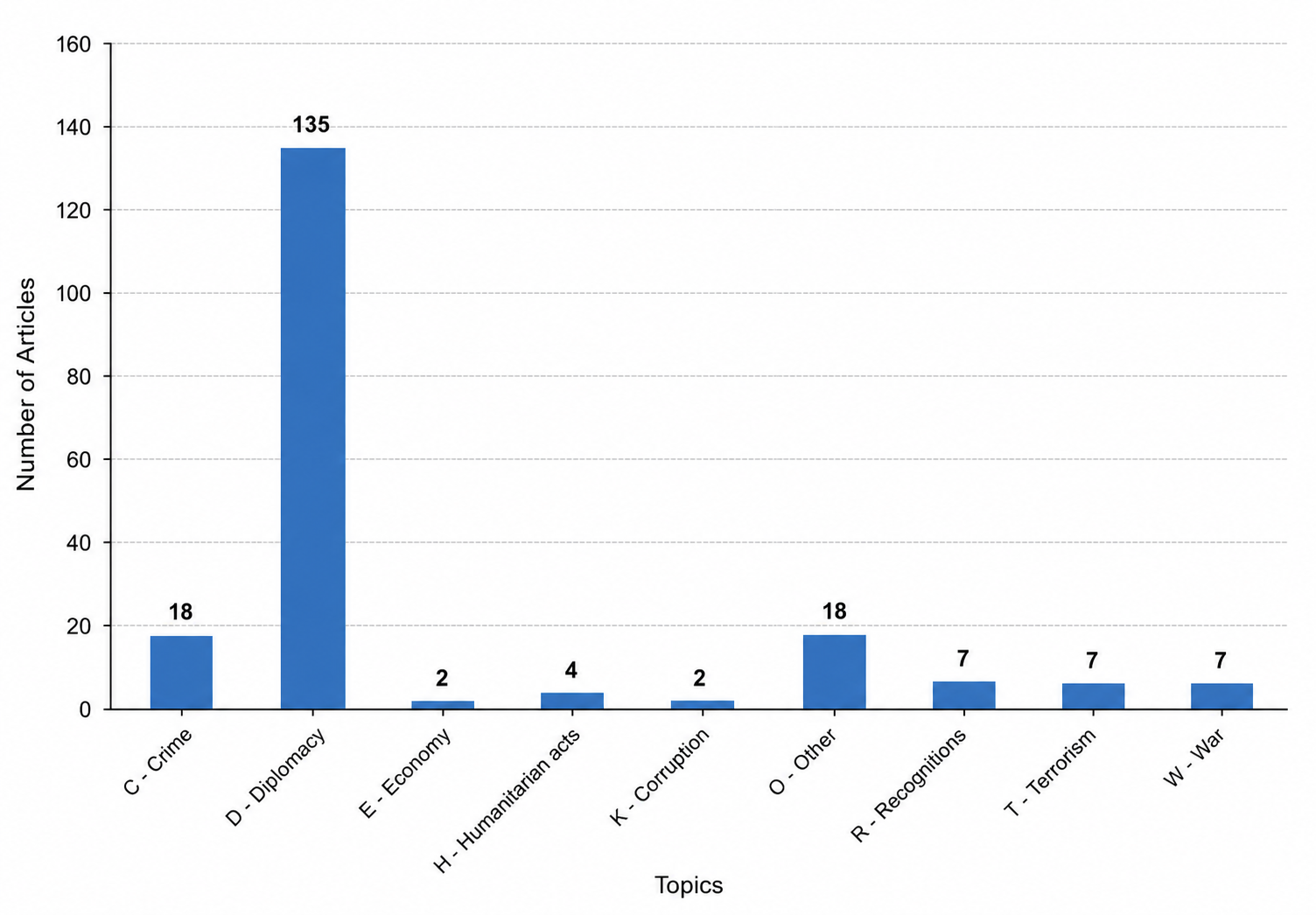
The overall areas of the search with the frequency of occurrence
Based on the analysis of the results taken from all the news channels, the majority of reports relate Kosovo to negative terminology and thus present the state as unstable, problematic and unsafe.
The results indicate that Kosovo's digital public diplomacy will remain limited as long as much of its international exposure is influenced by external news coverage and not by an obvious and recognisable public diplomatic framework created and promoted by the State. International representations of Kosovo are largely influenced by international media, instead of a well-defined and strategic approach to digital public diplomacy. These results suggest that there needs to be better coordination among institutions, proactivity on their part, and strategically aligned communication to positively influence international perceptions.
Specifically, with regard to Kosovo the studies found that many foreign news agencies tend to link Kosovo to Serbia; the negotiation process; political instability; crime; regional disputes; or other similar outstanding political problems. Therefore, in order for Kosovo to improve its use of e-diplomacy (electronic diplomacy), it will need to take its electronic diplomacy efforts from simply being present on the web, and transition into developing an effective and integrated effort to create their own narratives about themselves. Therefore, it seems that while being digitally visible is one aspect of developing digital public diplomacy for Kosovo, the second — and arguably most important — aspect is ensuring that Kosovo becomes visible in a manner consistent with its evolving institutional capacities, democratic developments, international partnerships, and civic achievements.
The EUobserver has the largest score of the negative related articles in the overall study, and the least for the New York Times, yet this comparison cannot directly be done since the first one has more articles about Kosovo than the latter (Fig. 2). In the right calculated proportion, the news web New Europe carries the most positive sentiment, where Kosovo is presented in a better light, where positive events do occur.
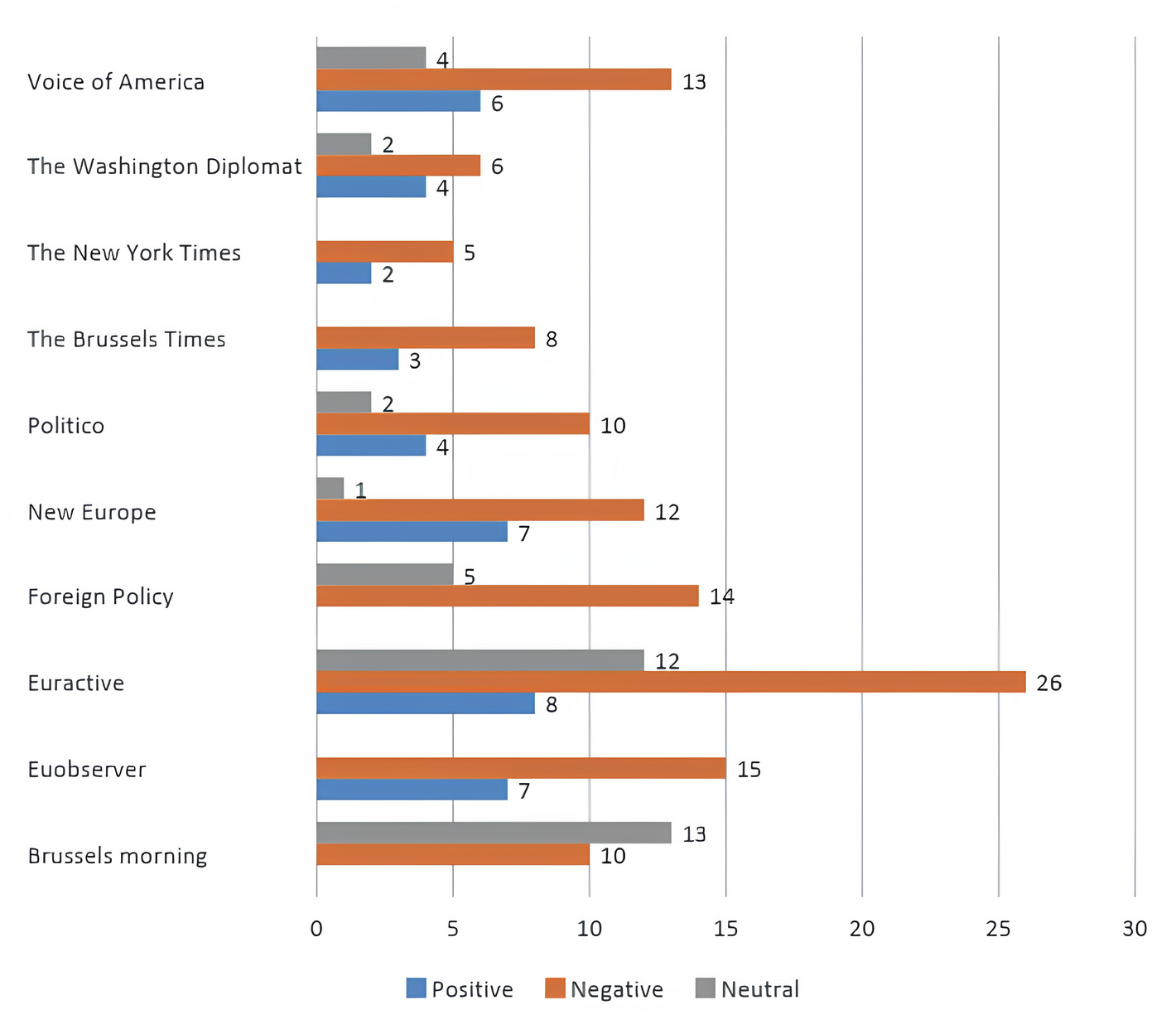
Articles related to the Republic of Kosovo with a focus on the sentiment
From all the collected data, only 20,5% of the news articles contained a positive sentiment, 20% neutral and 59,5% negative (Fig. 3). Each year, especially from 2019 until now, a rise has been detected. Nevertheless, in 2021, the same trend has declined in negative and neutral sentiments, with positive sentiments remaining constant.
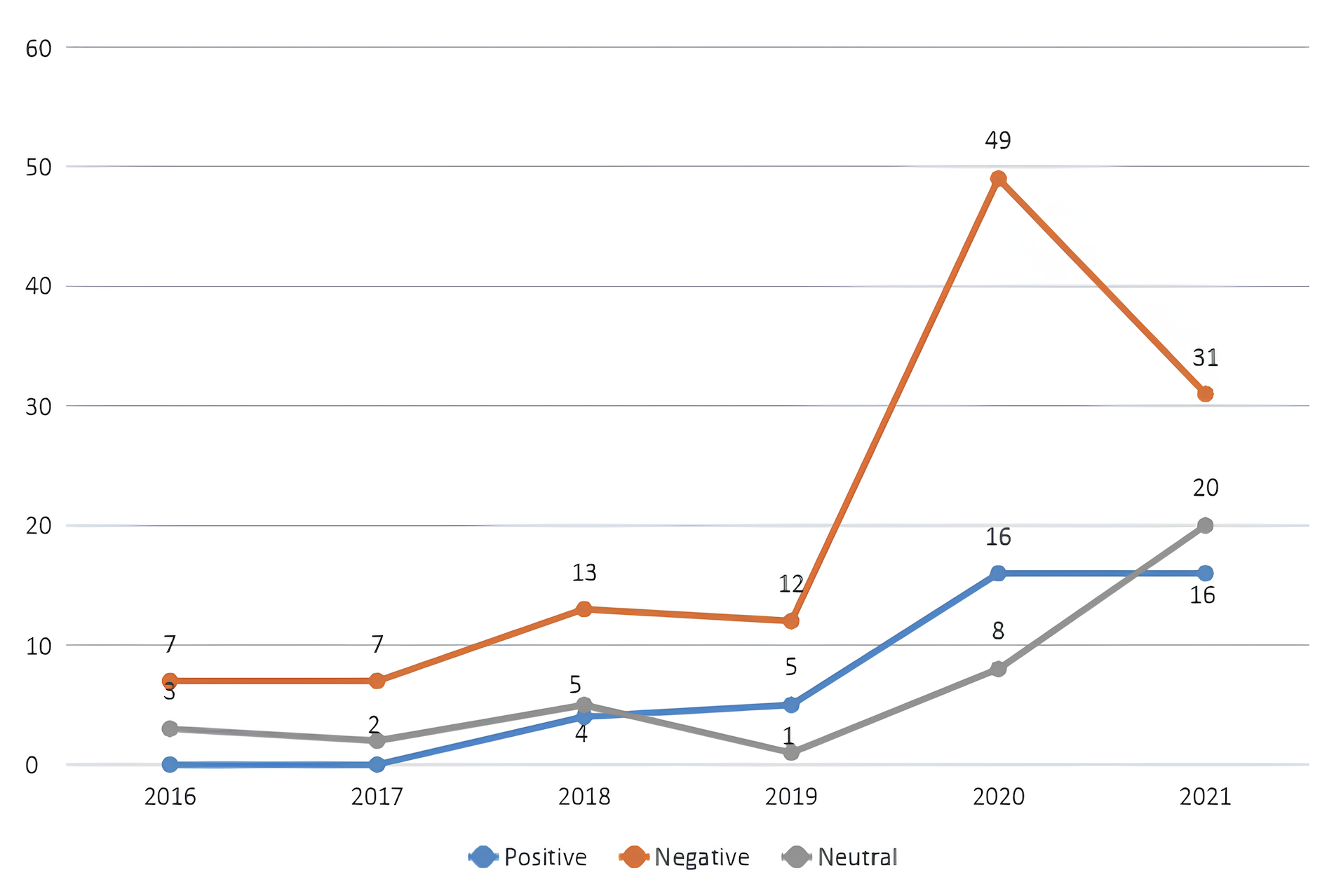
Sentiment of digital news through 2016–2021
5. Conclusion
The intended goal of this study has been to understand the power communication has in the diplomatic world using the most trending channels in the case of Kosovo. To always improve these processes, a lot of communication theories and methods have been created; some may use the co-orientation method
or the division of communication into three lenses all of which serve the same purpose of creating clearer forms of it. International communication has been examined, and research shows that this field of expertise focuses on the communication process, which happens internationally concerning issues and matters of states.The Kosovo example shows that electronic public diplomacy is particularly important for States whose international status still has a politically sensitive nature. The use of digital platforms can allow these States to have direct contact with foreign publics, but it will never substitute other forms of international diplomatic activity, the establishment of institutional credibility, nor political stability. Thus, in order to be effective in developing an electronic public diplomacy strategy for Kosovo, all of these forms of communication need to be coordinated by official State communications, international media relations, cultural activities, diaspora networking, and institutional messaging.
Kosovo can build a stronger image internationally by reducing the potential for one-sided representations through strategically planned and openly communicated communications. In order to increase resources that can contribute qualitatively to creating digital content on social media and in the international arena, a larger body of professionally standardised and contextually rich reports will lead to a more equal representation of Kosovo internationally. Additionally, given the decline in the perception of the image of Kosovo after independence, we propose to create a detailed plan on how to improve the image by implementing simultaneous training sessions created by the state for its citizens. These projects would teach the citizens the importance of the digital streaming services that are used by them on a daily basis and how they can contribute to the overall reputation of the state.