
BIOMASS PRODUCTIVITY AND SUGAR AVAILABILITY OF THE INVASIVE PLANT HERACLEUM SOSNOWSKYI FOR BIOETHANOL PRODUCTION
BIOMASS PRODUCTIVITY AND SUGAR AVAILABILITY OF THE INVASIVE PLANT HERACLEUM SOSNOWSKYI FOR BIOETHANOL PRODUCTION

Abstract
Sosnowsky's hogweed (Heracleum sosnowskyi Manden) is a highly invasive plant species whose resource potential is examined in this article. Due to its high biomass production, it must be managed sustainably. This study investigated H. sosnowskyi's biomass productivity, water-soluble sugar availability, and appropriateness as a raw material for the synthesis of bioethanol under natural field settings. During the 2024 growing season, field observations were made on a natural population in the Moscow region. It was shown that due to the high lignin content and insubstantial enzyme accessibility, enzymatic treatment of dry biomass did not significantly improve sugar recovery as compared to water extraction alone. The amount of water-soluble sugar in biomass significantly reduced during drying and storage, and it did not surmount 2.5–3.0% of dry matter. Obtained results show that although H. sosnowsky has a high biomass productivity, under the investigative conditions, dried biomass is not appropriate for effective sugar extraction and bioethanol synthesis. Sugar availability is heavily influenced by the handling and processing of biomass, and only fresh plant material exhibits useful potential for applications that are related to bioethanol.
1. Introduction
One of the significant environmental problems of the twenty-first century is the spread of invasive alien plant species. It is commonly acknowledged that biological invasions, especially in agricultural, peri-urban, and abandoned environments, are a major cause of biodiversity loss, ecosystem degradation, and disruption of ecosystem services , , . The introduction, establishment, and spread of invasive plant species throughout Europe and Eurasia have been further accelerated by globalization, increased international trade, changes in land use, and climate change , .
Sosnowsky's hogweed (Heracleum sosnowsky Manden) is one of the most aggressive and pervasive invasive plants in the Russian Federation. This plant was first brought in as a potential feed crop in the middle of the 20th century, but because of its remarkable growth rate, great ecological flexibility, and abundant seed production, it quickly evaded cultivation and spread throughout large areas , , . Numerous parts of Russia, including the Moscow region, have reported large-scale H. sosnowsky infestations, which pose a major risk to public safety, natural biodiversity, and agricultural output , .
H. sosnowsky propensity to create dense monospecific stands that restrict native plants and change soil characteristics, light availability, and microclimatic conditions is a major factor in its invasive success , . Long-term persistence in soil seed banks is made possible by the species' abundant production of seeds with heterogeneity and extended dormancy, which makes eradication attempts more difficult . Apart from its environmental impact, H. sosnowsky poses a significant risk to human health since its sap contains phototoxic furanocoumarins that, when exposed to UV light, can result in chemical burns and severe dermatitis , , .
H. sosnowsky is currently managed using chemical, mechanical, and agrotechnical methods. Although glyphosate-based herbicides are thought to be an efficient chemical control method, their usage is frequently limited by environmental rules, proximity to water bodies, and public concerns about herbicide use , . Although mechanical management techniques, like repeated mowing, are frequently used, they necessitate long-term repetition and precise timing prior to blooming since they do not eradicate the root system and permit regrowth , . As a result, managing hogweed produces a lot of biomass that needs to be disposed of safely and sustainably.
On the other hand, H. sosnowsky has exceptionally high biomass productivity, reaching 50–200 t/ha of green mass under ideal circumstances , . The plant has significant levels of water-soluble carbohydrates, cellulose, hemicellulose, and proteins, which makes it a potentially useful feedstock for the generation of bioenergy , , . The use of invasive plant biomass for bioethanol production presents a viable dual-benefit strategy in the context of the world's shift to renewable energy sources and a bio-based economy: reducing the negative effects of invasive species while promoting the production of sustainable fuel , , , .
Plant biomass high in sugar and carbohydrates has long been the main raw material used in the industrial manufacturing of bioethanol. Sugarcane (Saccharum officinarum) and sugar beet (Beta vulgaris) are examples of conventional feedstocks that are distinguished by their high sucrose content and recognized processing techniques , . Although they must undergo enzymatic hydrolysis before fermentation, starch-based source materials such corn, wheat, rice, and cassava are also frequently utilized , , .
Lignocellulosic and non-traditional biomass sources have drawn more attention in recent decades because of growing concerns about food security, land availability, and environmental sustainability , , . High-yielding crops with fewer cultivation requirements and competitive ethanol outputs are Jerusalem artichokes and sweet sorghum , , . Because their use does not conflict with food production and concurrently promotes ecosystem restoration and biomass management initiatives, invading plant species have emerged as an unconventional but viable feedstock in this context .
The chemical makeup of Sosnowsky's hogweed and allied species of the genus Heracleum has been the subject of numerous investigations. After the proper pretreatment, the green biomass's abundance of soluble sugars (up to 30% of dry matter), cellulose (around 45%), and lignin (20–25%) makes it an ideal substrate for fermentation , . However, the existence of physiologically active substances, especially furanocoumarins, calls for stringent safety precautions and rigorous processing technology selection .
Pretreatment, enzymatic saccharification, fermentation, and distillation are typical technological processes for producing bioethanol from plant biomass. Cellulases, amylases, and glucoamylases have been used in enzymatic hydrolysis to increase fermentable sugar yields from lignocellulosic materials . Research on the hydrolysis of unconventional biomass sources with enzyme assistance has shown notable increases in ethanol output and process efficiency . Similar methods have been suggested for processing hogweed biomass, with promising initial outcomes .
Saccharomyces cerevisiae is most frequently used for fermentation because of its high ethanol tolerance, genetic stability, and well-defined metabolic pathways , . Consolidated bioprocessing, integrated biorefineries, high-cell-density fermentation, and other recent developments in fermentation technologies have significantly increased ethanol yield and decreased processing expenses . In order to achieve fuel-grade ethanol purity, distillation and rectification are still crucial steps that call for the careful separation of byproducts including organic acids and fusel oils , . So H. sosnowsky has significant promise as a feedstock for the production of bioethanol, according to current research.
However, thorough evaluations of biomass production, processing effectiveness, and product quality under local circumstances are still scarce, underscoring the need for additional study to facilitate widespread use within sustainable bioenergy systems.
Despite H. sosnowsky's high biomass productivity and the increasing interest in using it for bioenergy, little is known about the availability of sugar and the fermentability of biomass handled under practical field and storage settings. Specifically, the effects of enzymatic treatment and drying on the recovery of water-soluble carbohydrates have not been adequately assessed using reliable analytical methods. With an emphasis on the practical constraints of producing bioethanol from dried plant material, this work fills these gaps by evaluating the biomass productivity, sugar extractability, and fermentation efficiency of H. Sosnowsky biomass under natural field circumstances.
2. Research methods and principles
The investigation was carried out in Naro-Fominsky district of Moscow Region on a wild population of Heracleum sosnowsky Manden during the 2024 growing season. Investigation was planned as an exploratory field-based case study with the goal of evaluating biomass productivity and sugar availability under representative local conditions.
Within the research area, fixed experimental plot was created (area 1m²) and marked with wooden pegs to avoid mechanical disturbance (Fig. 1, a-c). To guarantee consistency in observations, morphometric measurements, and biomass harvesting, the same plot was utilized for the duration of the investigation. From the beginning of spring, when vegetative growth first appeared, until the end of the growing season, there was constant observation.
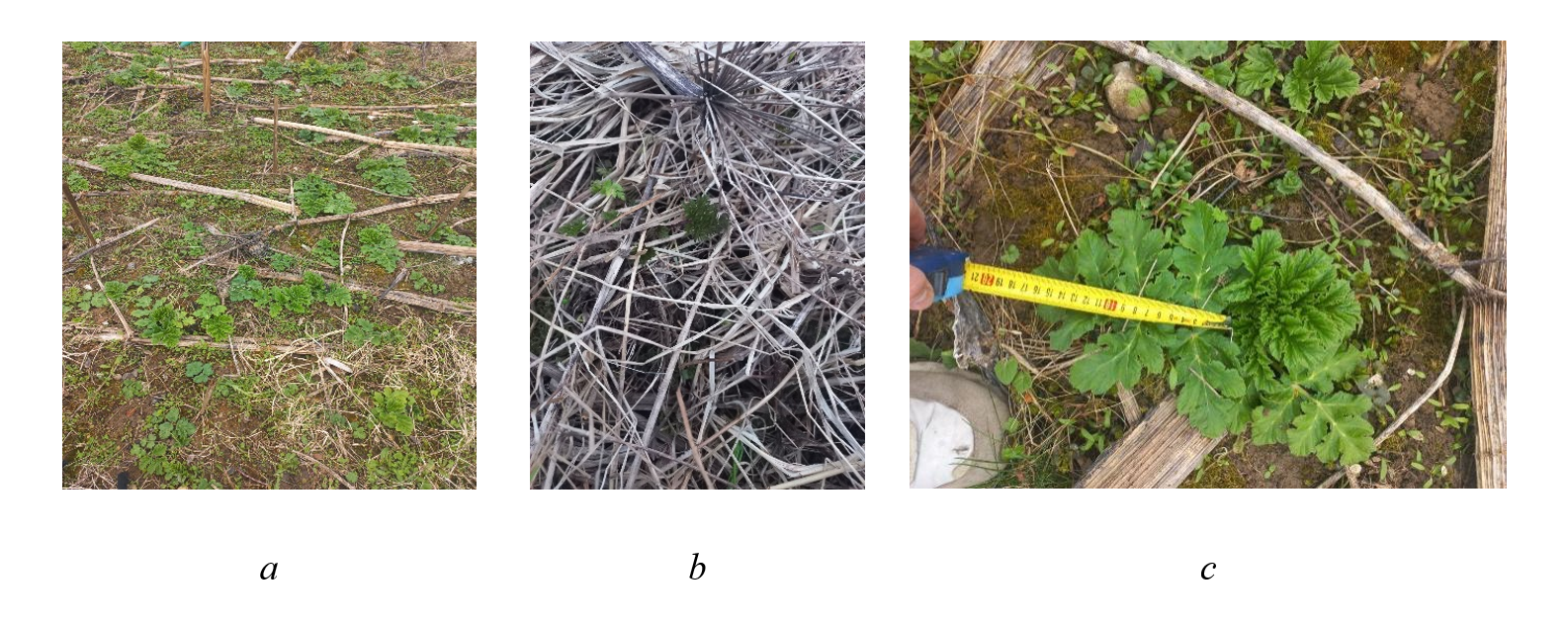
General view of the plot (a) and stages of H. sosnowsky plant development:
b - initial stage of vegetation; c - mature plant
April, 2024, author’s photo
The first stage of research continued since the first leaves appeared (April 06, 2024) until the stage immediately before flowering (June 15, 2024) (see Fig. 2, a-c). At this moment leaves’ sugar content is at its maximum. When collecting the green mass, the shoots and leaves of the plant were cut off at the ground level.
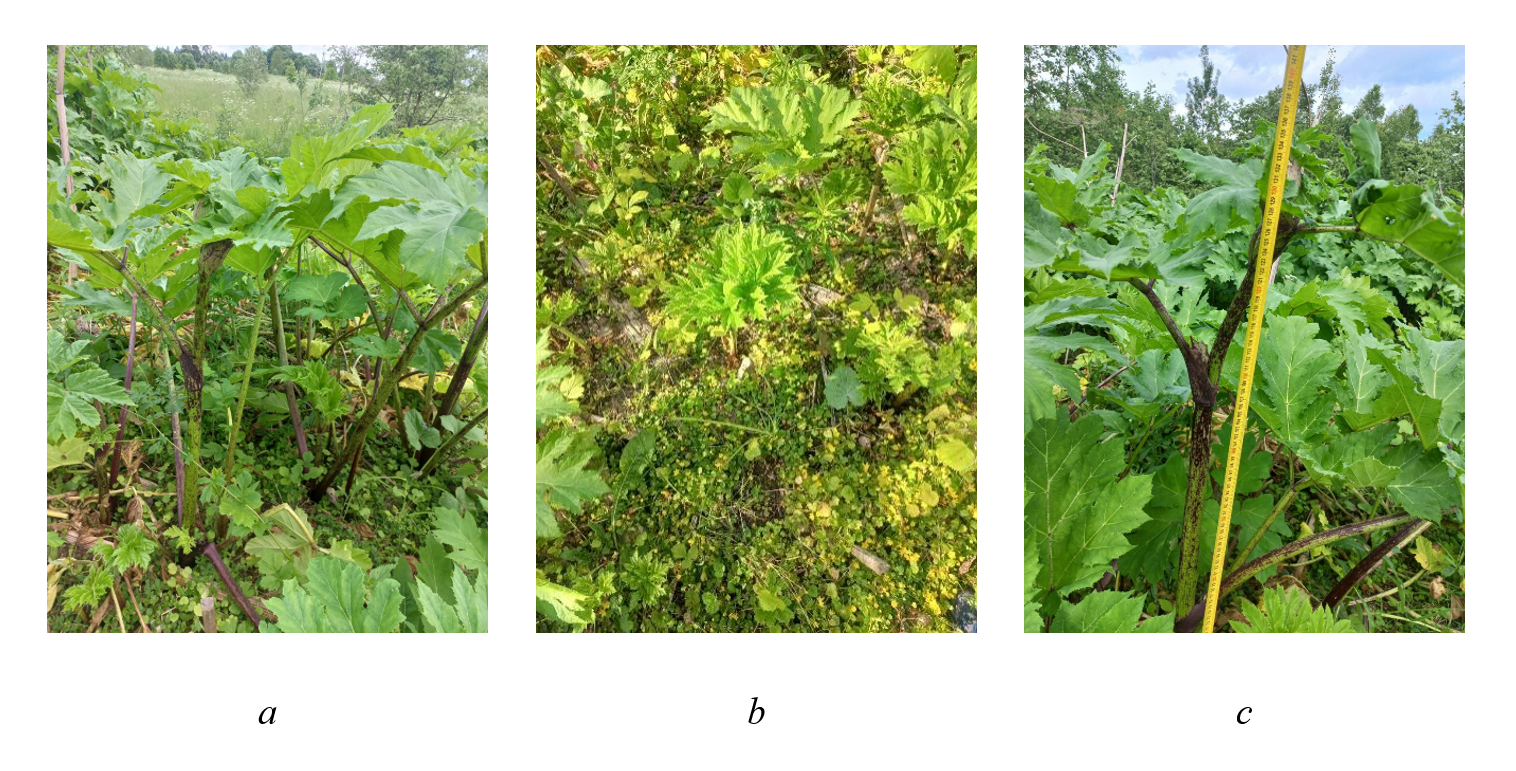
General view of the plot:
a - before plants’ cutting; b - after plants’ cutting; c - flowering shoot of H. sosnowsky plant just before cutting
June, 2024 author’s photo
The next (second) green mass harvest took place on July 17, 2024. The height of the flowering shoot remained virtually unchanged. The total weight of the harvested material was 2,200 g. The average leaf length was 68–70 cm.
The third observations were made on August 29, 2024. It became noticeable that the rate of biomass growth had decreased. The length of some leaves was approximately 50 cm, others were 20-22 cm, and the height was 47–48 cm. New flowering shoots were absent.
Based on the research conducted, it was concluded that it is advisable to harvest Heracleum sosnowskyi twice—in mid-June and mid-August. This allows for maximum utilization of the invasive plants' energy potential and prevents their seeding.
Additional plant parameter measurements were taken on September 15, 2024. It became clear that the formation of flowering shoots ceased in August and September. Leaf height increased to 53 cm, and leaf length increased to 49–50 cm. During the growing season, the green mass of Sosnowsky's hogweed (H. sosnowskyi) plants was harvested three times (twice before flowering at the budding stage, and once at the end of the plant's growing season). The total weight of the green mass was 11,100 g, and after drying, 1,250 g.
All field and laboratory operations were conducted strictly in accordance with safety procedures because of the well-established phototoxic characteristics of H. sosnowskyi. Protective gear, such as rubberized gloves, windproof coats, thick pants, and high, closed shoes, was worn throughout field observations and morphometric measurements.
3. Extraction of Water-Soluble Sugars
Laboratory experiments were conducted at the Department of General Pharmaceutical and Biomedical Technology of the RUDN Medical Institute. To produce the wort and increase its sugar content, crushed plant materials subjected to enzymatic hydrolysis were used. Variants of aqueous extraction of the raw materials were also tested. Wort variants were prepared from crushed dry raw materials (0.5 mm fraction) of the plant at a hydromodulus of 1:8. For enzymatic hydrolysis, the raw materials were poured with water (t=100°C) and kept in a water bath at t=70°C for 1.5 minutes. Amylase ("Amylosubtilin") was then added, and after an hour at t=58°C, for hydrolysis over the next 60 minutes other enzyme preparations: "Amylosubtilin", "Cellolux-A", "Glucavamorin", "Protosubtilin" in various combinations were added. Since the ideal temperature ranges for the various enzyme preparations varies (for example, 50–60°C for Cellolux-A, 55–65°C for Amylosubtilin, 55–60°C for Glucavamorin, and 40–55°C for Protosubtilin), a realistic compromise of 58°C was chosen.
Wort variants in the form of an aqueous extract of the raw materials (t=25÷27°C) were also used. Preliminary measurements of the sugar content of the extract samples were measured using an ATC Portable Refractometer.
Seven extraction variations with varying enzyme compositions and temperature regimes were investigated:
1. Water extraction at room temperature at 25–27 °C.
2. Water extraction at 37–40 °C.
3. Enzymatic extraction using individual commercial enzyme preparations at 700C ÷580C: Amylosubtilin (A), Cellolux-A (C-A).
4. Enzymatic extraction using combinations of commercial enzyme preparations at 700C ÷580C: Amylosubtilin (A), Cellolux-A (C-A), Glucavamorin (G), Protosubtilin (P).
Sequential heating, first at 70°C and then at 58°C, was also used to carry out enzymatic hydrolysis in a water bath, reflecting the temperature conditions applied uniformly across enzymatic extraction types. Following extraction, samples were manually compressed, allowed to cool to ambient temperature, and then filtered through gauze. The resulting liquid extracts were then put into vacuum tubes so that the sugar concentration could be determined analytically.
3.1. Sugar Analysis
For qualitative and quantitative analysis of the carbohydrate composition of the samples, nuclear magnetic resonance spectroscopy was used, a Bruker AVANCE NEO 700 NMR spectrometer equipped with a Prodigy cryoprobe. The studies were conducted in the laboratory of the RUDN University. The extracted materials' specific sugars, such as fructose, glucose, and sucrose, were identified and measured.
4. Results
4.1. Biomass yield and moisture content
During the 2024 growth season, Heracleum sosnowskyi above-ground biomass was collected at three phenological stages. With a total seasonal production of 11100 g m⁻², or 111 t ha⁻¹, the species showed high green biomass productivity (Table 1).
Biomass Yield of Heracleum sosnowskyi during the 2024 growing season
Harvest | Date | Green Mass (g/m²) | Dry Mass (g/m²) | % of Total Dry Yield | Yield (t/ha) |
1 | 15-June-24 | 8600 | 968 | 77 | 9.68 |
2 | 17-July-24 | 2200 | 248 | 20 | 2.48 |
3 | 05-Oct-24 | 300 | 34 | 3 | 0.34 |
Total | Full Season | 11100 | 1250 | 100 | 12.50 |
The accumulation of biomass was significantly biased toward the early vegetative stage; 77.5% of the total green mass came from the first harvest on June 15.
Fig. 3 illustrates the sharp decline in both green and dry biomass yields in subsequent harvests. The dry matter yield totaled 1250 g/m⁻², representing a mass loss of 88.7% after shade drying, which underscores the exceptionally high moisture content of fresh hogweed biomass.
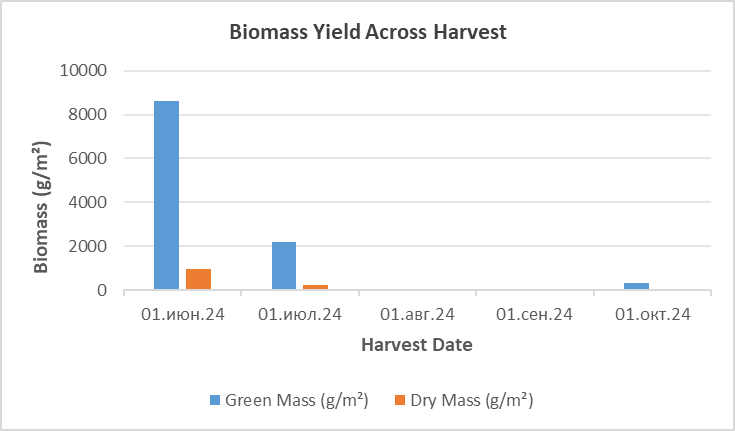
Seasonal above-ground biomass yield (green and dry mass) of Heracleum sosnowsky across three harvests during the 2024 growing season
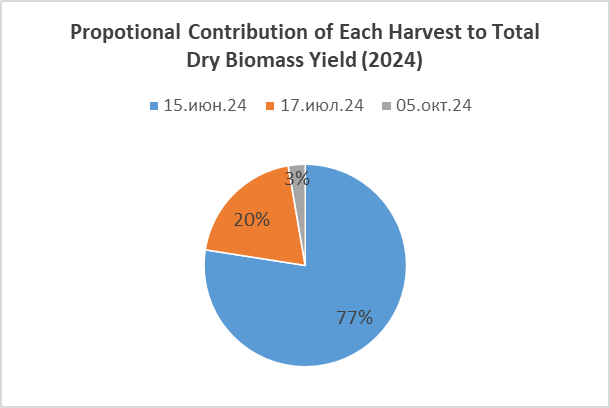
Proportional contribution of each harvest to the total seasonal dry biomass yield of Heracleum sosnowsky
The results of determining the composition of carbohydrates in the conditions of the experiments are presented in Table 2.
Qualitative and quantitative content of sugars in samples under the conditions of the experiment
Amylosubtilin (A), Cellolux-A (C-A), Glucavamorin (G), Protosubtilin (P)
№ of sample | Sampling variant | Fructose, % | Glucose, % | Sucrose, % | Total sugar content, % |
1 | 37-40°С | 10,8 | 10,8 | 0,1 | 21,8 |
2 | 25-27°С | 10,3 | 11,8 | 0,1 | 22,3 |
3 | A+(C-A) | 5,9 | 9,5 | 1,4 | 16,8 |
4 | А+(C-A)+G+P | 7,4 | 11,1 | 1,05 | 19,5 |
The difference in temperature exposure is probably the reason for the lower total sugar contents in enzymatic samples (samples 3 and 4, 16.8–19.5%) as opposed to water-only extracts (samples 1 and 2, 21.8–22.3%). While water-only extractions were carried out at 25–40°C without extended heating, enzymatic hydrolysis needed extensive heating: the raw material was kept at 70°C for one hour and then at 58°C for an additional hour. Reducing sugars are known to deteriorate under such heat circumstances (e.g., caramelization, Maillard reactions). Although sample 3 in the extraction series, which was heated without enzymes, did not undergo the full two-hour heating profile utilized in the enzymatic process, it did not exhibit a comparable decline. Therefore, rather than the enzymatic action itself, heat degradation during the prolonged high-temperature phases necessary for enzyme activity is primarily responsible for the unanticipated drop.
4.3. Calculated sugar content based on NMR data
Here, "sugar yield from dry biomass" refers to the mass of sugars recovered in relation to the original dry plant material (mass of sugars / mass of dry biomass × 100%), whereas "sugar content in the extract" refers to the percentage of sugars within the liquid extract (mass of sugars / mass of extract × 100%).
The detected sugar concentrations were recalculated and reported as proportions of dry raw material and extract mass in order to assess the NMR data' practical applicability for the synthesis of bioethanol. The overall sugar content of the non-evaporated extract was equivalent to roughly 2.5% of the dry biomass and 0.28% of the extract mass, according to NMR-derived estimates. The overall sugar content rose to almost 3.7% of the dry biomass and 0.89% of the extract mass following partial evaporation.
These results verify that the total availability of fermentable sugars in dried H. sosnowsky biomass is still low and insufficient to sustain effective alcoholic fermentation, despite apparent increases in sugar concentration after evaporation.
4.4. Fermentation outcomes
During an additional experiment, aqueous extracts of dried H. sosnowsky had been inoculated with Saccharomyces cerevisiae and adjusted to apparent sugar concentrations of 6% and 12% were used in fermentation experiments. Over the course of 96 hours, no consistent alcoholic fermentation was seen. Inadequate fermentable sugar concentrations and potential microbial inhibition or contamination are blamed for the lack of ethanol generation.
5. Discussions
This exploratory case study offers a preliminary, field-based evaluation of Heracleum sosnowsky biomass productivity and sugar availability for possible bioethanol production under typical local conditions. Rather than being universal conclusions, the results should be viewed as context-specific observations that highlight practical limitations and provide hypotheses for additional research.
The species of H. sosnowsky is regarded as a potential biomass resource because of its high green biomass yield (~111 t ha⁻¹), which is in line with its reputation as an extremely productive invasive plant , . However, a major practical obstacle is demonstrated by the large mass loss upon drying (>88%) and the poor ultimate dry matter yield found at this site: processing this high-moisture feedstock may be too costly and energy-intensive for a straightforward bioethanol pathway.
The low recoverable fermentable sugar content (2.5–3.7% of dry matter) in dried biomass after storage was the most important discovery of this pilot-scale study. It should be mentioned that H. sosnowskyi biomass has a high lignin content (20–25% of dry matter), and neither a chemical nor mechanical delignification pretreatment step was used in this work. Sugar yields from the dry biomass were probably decreased as a result of this omission, which restricted enzyme access to cellulose and hemicellulose. In contrast, fresh H. Sosnowsky material has been reported in some studies to have a greater sugar concentration , . This disparity strongly implies that sugar preservation is mostly dependent on post-harvest treatment, especially drying and storage. Although the precise mechanisms (such as microbial activity or enzymatic degradation) were not determined in this work, the practical implication is evident: any utilization approach aimed at soluble sugars must give priority to processing fresh material right away.
The low sugar levels verified by NMR are consistent with the failure of fermentation under the investigated circumstances. The prospect of producing ethanol from H. sosnowsky is not completely ruled out by this pilot study. Rather, it shows that without integrated and possibly intensive pretreatment procedures, the simple method of drying, storing, and enzymatically treating biomass as could be logistically required in large-scale invasive species management is unlikely to provide a fermentable wort.
6. Limitations and Future Research Directions
This study's design as a single-site, observational case study carried out over a single growing season naturally limits its results. The statistics on biomass productivity and composition are unique to the population dynamics and environmental circumstances of the site under study in 2024. Future research must prioritize replicated field experiments across multiple sites and seasons in order to establish robust processing parameters and generalizable yield estimations.
Additionally, the limitations of employing dried biomass were the main emphasis of this investigation. The next logical and crucial step is to compare these results directly with the processing of fresh biomass in order to assess alternate, low-latency utilization pathways (e.g., direct ensiling for biogas, quick hydrothermal processing).
7. Conclusion
Due to its low recoverable sugar content, dried and stored Heracleum sosnowsky biomass in this exploratory field investigation demonstrated limited immediate potential as a feedstock for traditional bioethanol production. The results highlight how post-harvest management has a significant impact on this invasive plant's bioenergy potential. Its unique lignocellulosic and phytochemical composition may require the use of sophisticated pretreatment methods or a complete avoidance of the drying stage in order to achieve effective valorization strategies. This case study lays the groundwork for more focused, scalable research while highlighting the significance of field-based, logistical realism in evaluating invasive species for bioenergy.