
PROSPECTS FOR THE DEVELOPMENT OF OIL AND GAS FACILITIES IN THE VILYUI SYNECLISE
PROSPECTS FOR THE DEVELOPMENT OF OIL AND GAS FACILITIES IN THE VILYUI SYNECLISE
Abstract
The research area is one of the most studied on the Siberian Platform. However, the bulk of geological and geophysical data was obtained here in the 1960s–70s at a relatively low methodological and technological level. Until recently, the main focus of research here has been almost exclusively on Mesozoic and Permian sediments, forming the upper part of the sedimentary cover to a depth of 2–6 km. As a result, a number of gas condensate fields were discovered, and numerous oil shows were identified. The necessity of revisiting many areas with new concepts of their structure and employing modern technologies for oil and gas exploration is substantiated. For the first time, the issue of the expediency of additional study of the peripheral parts of the Vilyui Syneclise is comprehensively considered, where the discovery of new hydrocarbon accumulations, primarily oil, is predicted within reachable depths.
1. Introduction
The Vilyui oil and gas province (OGP), thanks to many years of intensive exploration, has become one of the most thoroughly studied territories in terms of the geology of the Mesozoic and Upper Paleozoic periods.
It has now been established through a complex of geophysical surveys and deep drilling that formations from the Riphean to the Neogene inclusive are involved in the structure of the sedimentary cover of the Vilyui OGP. Paleogene-Neogene deposits are poorly developed here. However, the stratification of the section below 3 km has been carried out purely tentatively due to the lack of paleontological data.
Numerous prospecting and exploration wells with depths of 2–3 km (rarely up to 4 km) are typically associated with anticlinal structures of orders II–III in the Mesozoic-Upper Permian section and are concentrated mainly on fields identified in the arch of the megaswell
. Almost all discovered gas and gas condensate fields are located in or near the central part of the OGP and are associated with terrigenous deposits of Late Permian, Early Triassic, and Early Jurassic age.The position of the identified gas condensate accumulations in the Meso-Upper Paleozoic part of the sedimentary cover is controlled in the section by three clay sequences (the Suntar Formation of the Lower Jurassic, the Monom and Nedzhelin Formations of the Lower Triassic). The Suntar Formation is a regional seal within the Vilyui OGP
. These clay seals are largely silted, reduced in volume, and pinch out towards the flanks of the Vilyui Syneclise.The gas condensate accumulations of the Vilyui OGP are characterized by significant oil shows in exploration and production wells, reaching commercial and sub-commercial flow rates. Geochemical studies indicate a genetic link of these oils mainly with non-Cambrian source rocks, particularly with Permian deposits. Furthermore, the Lower Triassic and Lower Jurassic clay formations (Nedzhelin, Monom, and Suntar Formations) with certain generative potential may be potential oil source rocks
.Despite the fairly high degree of geological and geophysical knowledge of the Vilyui OGP, only some patterns and features of the formation and distribution of hydrocarbon gas accumulations in these stratigraphic complexes have been identified to date.
2. Research methods and principles
The object of study is the Vilyui Syneclise, located in the eastern part of the Siberian Platform within the Republic of Yakutia (Sakha).
The research material consisted of the results of geological exploration conducted in various years within the Vilyui Syneclise.
The research methodology is based on the generalization and analysis of available geological exploration data. The authors used materials and scientific recommendations from prominent Russian scientists (A.D. Arkhangelsky, I.M. Gubkin, N.S. Shatsky, etc.). The Vilyui oil and gas province (OGP), currently identified within the eastern part of the Vilyui Syneclise as part of the East Siberian system of Mesozoic marginal depressions, was one of the first territories in Yakutia where oil and gas operations began. Its oil and gas potential assessment has changed several times
.3. Main results
The Vilyui OGP is one of the most thoroughly studied territories in terms of the geology of the Mesozoic and Upper Paleozoic periods. Within the Vilyui Syneclise, the Khapchagai gas-bearing region, associated with the eponymous large megaswell, has been characterized in more detail. In the arch of the uplift, the thickness of the Lower Cretaceous rocks is sharply reduced, and its amplitude along the underlying sediments reaches 1.0–1.2 km. The axial part of the megaswell is complicated by a number of large local structures controlling the gas fields identified here (Sredne-Vilyuyskoye, Tolonskoye, Mastakhskoye, Sobolokh-Nedzhelinskoye, Badaranskoye) (Fig. 1A, B). These are nearly symmetrical brachianticlines with areas of 200 to 400 km², sizes of 20–30 x 10–20 km, and amplitudes mostly ranging from 200 to 500 m. According to seismic data, a number of smaller structures are identified in the near-arch part of the Khapchagai uplift and on the dips of its slopes. They have areas of 20–40 km² and differ from the structures of the axial zone in their more elongated shape and smaller amplitude, not exceeding 70–100 m.
The formation processes of a sub-parallel fault zone played a significant role in the geological development of the Khapchagai uplift and its complicating structures. This zone is characterized by ancient formation and repeated activation of tectonic processes, including at the present stage of geological development.
To date, the upper part of the sedimentary cover (down to 4.0–4.5 km), represented by terrigenous formations of the Mesozoic and Upper Permian, has been studied by deep drilling in the Khapchagai gas-bearing region. A number of productive complexes are distinguished within this section: Upper Permian, Lower Triassic, Middle Triassic-Lower Jurassic, Middle-Upper Jurassic, and Upper Jurassic-Lower Cretaceous.
Based on drilling results and regional lithological-paleogeographic reconstructions, the existence of a potentially promising Lower Permian complex is assumed within the Khapchagai uplift. It is associated with the main prospects for deeper horizons of the Khapchagai uplift, which will require drilling wells with depths of 7 km or more for further study.
The lower Pre-Upper Paleozoic (from the Riphean to the Middle Paleozoic inclusive) part of the sedimentary cover is quite fully preserved in the central axial part of the Vilyui Syneclise, despite numerous stratigraphic hiatuses and erosion. However, as shown by the example of well Srednevilyuyskaya-27, the depth of the Pre-Upper Paleozoic sediments exceeds 6 km here, which under modern economic conditions is inaccessible for exploration drilling.
Due to their complex block structure and the differentiated participation of each block in vertical tectonic movements, many strata in the peripheral parts of the Vilyui Syneclise are eroded, up to their complete absence in the stratigraphic range from the Devonian to the Upper Cambrian inclusive. Considering the specific development of the Vilyui Aulacogen, sedimentary formations of Riphean age in the modern sedimentary cover are also apparently represented incompletely and not everywhere.
When analyzing thicknesses and comparing structural plans for different sedimentary cover complexes in the flank parts of the Vilyui Syneclise, buried uplifts composed of strata of the Caledonian tectonic megacomplex are identified beneath the Mesozoic and Upper Paleozoic sediments
.Volcanogenic and sedimentary formations of the Middle Paleozoic on the southern flank of the Vilyui Syneclise are less widespread than on the northern flank, and they are apparently absent in the eastern territories.
All accumulations and fields of the Vilyui OGP, with the exception of the Nizhnetyukyanskoye gas field (whose geological position is unclear), are confined to anticlinal traps. These traps are located on the arches of large swell-like uplifts (Khapchagai megaswell, Loglorsky swell), which, in turn, are controlled by deep faults.
A comprehensive analysis of geological and geochemical materials from the gas condensate fields of the Vilyui OGP indicates that the identified hydrocarbon accumulations formed through vertical migration of fluids from lower horizons and their subsequent accumulation under local seals. Upper Paleozoic coal-bearing complexes are considered the main source of hydrocarbons, whose thickness in the central sectors of the Vilyui OGP reaches 3 km or more.
All gas accumulations in the Permian sediments should evidently be considered as a single giant gas accumulation of a massive type
. Structurally, it is controlled by the Khapchagai uplift as a whole, acting as a single super-trap filled with gas almost to the spill point. The upper part of this accumulation is composed of traditional reservoirs of previously identified productive horizons (T1-IV; PT; P2-I; P2-II; P3-III, etc.). The predominant lower part of the accumulation is confined to dense impermeable and low-permeability rocks of Permian age, which can be considered as non-traditional type sub-reservoirs.According to drilling data within the Vilyui Syneclise and the adjacent central part of the Predverkhoyansk Foredeep, numerous shows of liquid oil have been identified in deposits of Jurassic, Triassic, and Permian age. The most significant oil shows (10–15, rarely up to 100 m³/day) were recorded in the arch part of the Khapchagai uplift (Srednevilyuyskoye, Tolonskoye, Mastakhskoye, Sobolokh-Nedzhelinskoye gas condensate fields, etc.). Oil shows were also noted in the Loglor uplift (Srednetyungskoye and Andylakhskoye gas condensate fields) and in many stratigraphic wells drilled on the northwestern flank of the Vilyui Syneclise (Zapadno-Tyungskaya, Khorgochumskaya, and Severo-Linden areas).
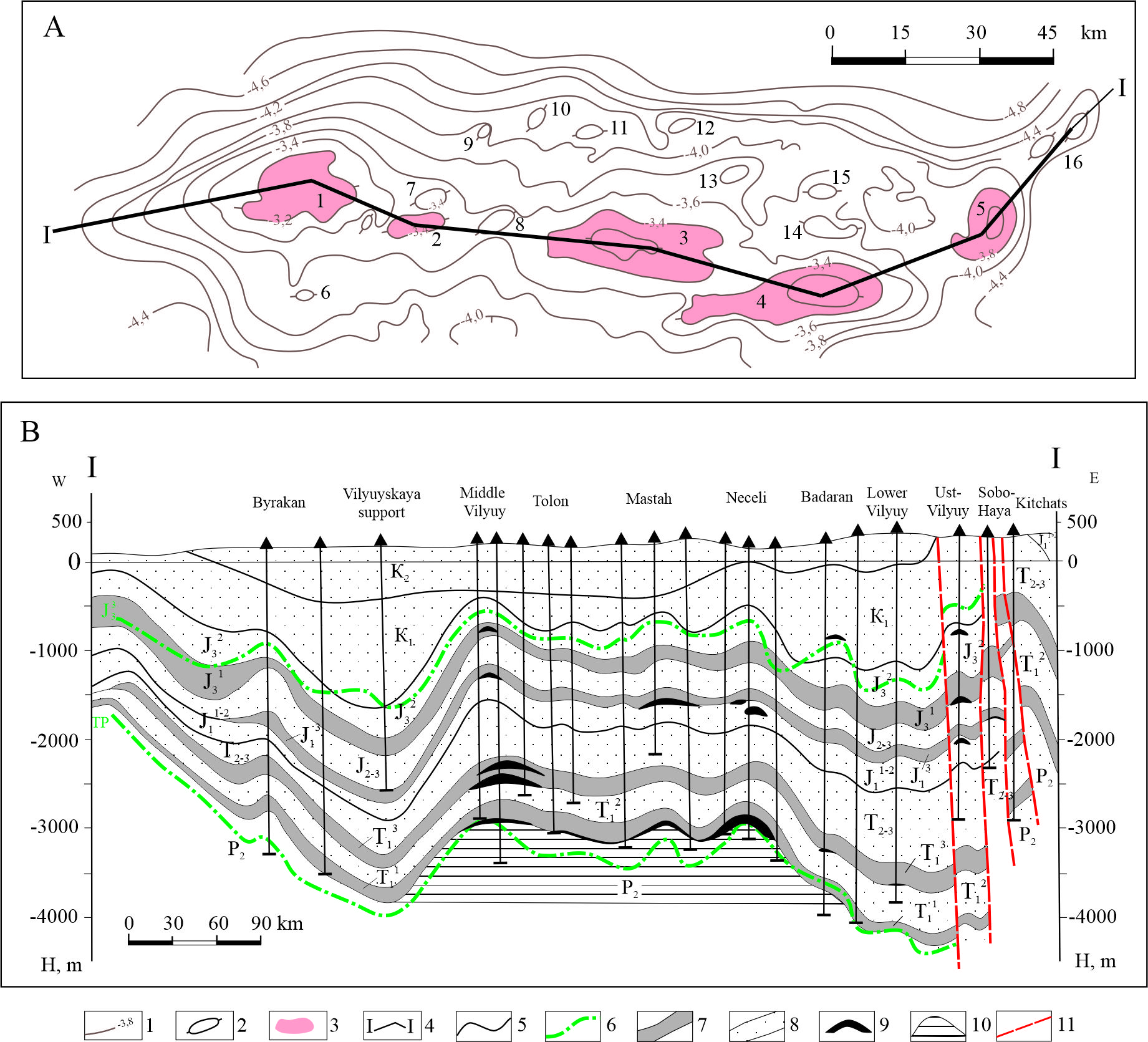
Figure 1 - Structural map of the Khapchagay megaswell along the Triassic-Permian boundary (A) and sublatitudinal geological-geophysical section through the Khapchagay oil and gas region (B)
Note: 1 - isohypses of the reflecting seismic horizon TP (Triassic-Permian); 2 - local anticlinal structures; 3 - gas condensate fields; 4 - line of the profile geological-geophysical section in the territory of the Khapchagay oil and gas region; 5 - geological boundaries; 6 - reference reflectors; 7 - regional essentially clayey screens; 8 - strata of predominantly sandy composition; 9 - gas and gas condensate deposits; 10 - predicted massive deposit in the Upper Permian sediments; 11 - discontinuous tectonic disturbances;
the structures are marked with numbers on the map: 1 - Sredne-Vilyuiskaya, 2 - Tolonskaya, 3 - Mastakhskaya, 4 - Sobolokh-Nedzhelinskaya, 5 - Badaranskaya, 6 - Severo-Tymtaydakhskaya, 7 - Verkhne-Tolonskaya, 8 - Severo-Kumakhskaya, 9 - Severo-Tolonskaya, 10 - Lonkholokhskaya, 11 - Dzhikindinskaya, 12 - Bezymyannaya, 130 - Vostochno-Bappagayskaya, 14 - Lyuksyugunskaya, 15 - Sredne-Lyuksyugunskaya, 16 - Nizhne-Vilyuiskaya;
lithological and stratigraphic section of the Upper Paleozoic and Mesozoic deposits: P2 - Upper Permian; T1 - Lower Triassic; T11 - Nedzhelinskaya suite; T12 – Taganja Formation; T13 – Monom Formation; T2-3 – Middle and Upper Triassic (Tulur Formation); J1 – Lower Jurassic: J11-2 – Lower and Middle Lias; J13 – Upper Lias (Suntar Formation); J2-3 – Middle and Upper Jurassic; J31 – Marykchan Formation; J32 – Bergey Formation; K1 – Lower Cretaceous; K2 – Upper Cretaceous
4. Discussion
Regional features of the occurrence of oil and gas generating Permian and Lower Cambrian deposits generate interest in the northwestern, southwestern, and southern flank parts of the Vilyui Syneclise. In addition, the estimated depths of buried uplifts in the Lower Paleozoic complex also make these areas promising.
The priority is the territory of the Yuzhno-Vilyuysky (South Vilyui) prospective area, which is assessed as potentially oil-bearing and more accessible for identifying, prospecting, and exploring projected oil accumulations. The main prospects of the area should obviously be associated with the Cambrian carbonate complex. Considering the probable processes of vertical and lateral fluid migration through the sedimentary cover section in the South Vilyui zone, secondary oil accumulations are quite possible higher up in the section, primarily in the basal sandy layers of the Permian beneath the Lower Triassic seal represented by clay deposits of the Nedzhelin Formation, and in the Lower Jurassic sediments beneath the Suntar clay seal.
The Permian deposits of the southern regions of the Vilyui OGP are characterized by a wider areal and vertical distribution of porous reservoirs compared to the Khapchagai oil and gas region. Reservoirs of permeability classes IV and V are noted in the upper stratum of the Upper Permian in a section penetrated by deep wells on the Yuzhno-Byrakanskaya area (400 m). In the Bayskaya well, satisfactory porous reservoirs are present throughout the Permian section.
The area of the northwestern flank of the Vilyui Syneclise is less preferable for searching for accumulations in the sediments of the Lower Paleozoic tectonic complex. In this regard, this territory should be considered as a probable oil-bearing area of the syneclise assigned for study in the second stage.
In regions like the Vilyui Syneclise, where oil and gas horizons are represented exclusively by sandy terrigenous deposits, world experience suggests that the greatest potential for discovering non-structural traps for oil and gas lies in zones of regional pinch-out.
Data on the pinch-out of Permian sediments on the southern flank of the Vilyui Syneclise are limited. It is assumed that the pinch-out is abrupt, with a thickness reduction gradient of at least 12–14 m/km. This can create stratigraphic pinch-out traps in the lower part of the section. The proposed zone of their development can be traced along the entire length of the southern flank of the syneclise. The only exceptions are certain small areas where Permian sediments lie at shallow depth. In the western part of the southern flank of the syneclise, in the predicted pinch-out zone, the prospective Permian sediment layer is directly overlain by the Nedzhelin Formation, which is favorable for the formation of stratigraphically screened traps
, . The reliability of the forecast has already been confirmed by the discovery of the Khailakh gas condensate field within this territory, where hydrocarbon accumulations are concentrated in rocks of the Taragai and Nedzhelin Formations. In the eastern part of the southern flank of the Vilyui Syneclise, in the zone of Permian sediment pinch-out, conditions are favorable for non-structural traps of oil and gas , .Paleo-highs on the southern flank of the syneclise could have served as areas for hydrocarbon accumulation. Seals could be clay strata of the Lower Jurassic, Lower Triassic, and Middle-Upper Cambrian age. Permafrost rocks further enhance the sealing. However, in the peripheral section of the syneclise, the sealing properties of these thicknesses are reduced. Therefore, in the southern part of the syneclise, the presence of oil accumulations with a gas cap is most likely. The sources of the predicted oil resources in the territories under consideration could be Cambrian domanikoid-type deposits with a high organic matter content.
Thus, when assessing the oil and gas potential of the territories under consideration, taking into account all available geological, geochemical, geophysical, and other data, as well as existing technical and economic constraints, it is most advisable to focus efforts on a detailed study and justification of the potential oil content of the southern flank of the Vilyui Syneclise. In the Yuzhno-Vilyuysky prospective area, probable oil and gas traps of various types may be associated with tectonically screened blocks, fold-related draping of underlying protrusions, and stratigraphic pinch-out against reservoir horizons. Non-anticlinal traps associated with the block structure of the sedimentary cover play a predominant role among them.
The presence of the Khapchagai gas-bearing region to the north of the Yuzhno-Vilyuysky prospective area and the proximity to the existing Eastern Siberia — Pacific Ocean (ESPO) oil pipeline make this territory very attractive for further geological research aimed at increasing the investment attractiveness of its subsoil and determining the possibility of accelerated growth of oil reserves here.
5. Conclusion
1. The Vilyui Syneclise has significant hydrocarbon potential. However, due to the uneven geological knowledge of prospective territories and the very complex structure of the sedimentary cover with a total thickness ranging from 2–3 to 10–18 km, the degree of advancement of forecasted geological hydrocarbon resources by converting them into the categories of explored and preliminarily estimated reserves of oil and gas at the present stage of study reaches only 10-15%.
2. To discover new hydrocarbon fields and further expand the resource base for the oil and gas production industry here, additional geological exploration is necessary to study the potential oil and gas potential of prospective territories in a number of fundamentally new directions. Furthermore, the expediency of returning to many areas explored in past years with the latest concepts about the specifics of their structure and more advanced modern methods and technologies for conducting geophysical surveys and deep drilling is quite obvious.