
РАЗРАБОТКА РАСЧЕТНО-АНАЛИТИЧЕСКОЙ МЕТОДИКИ ОЦЕНКИ ЭФФЕКТИВНОСТИ ПРИМЕНЕНИЯ САМОЗАЛЕЧИВАЮЩЕГОСЯ БЕТОНА И КРИСТАЛЛИЧЕСКОЙ ГИДРОИЗОЛЯЦИИ В ФУНДАМЕНТНЫХ КОНСТРУКЦИЯХ
РАЗРАБОТКА РАСЧЕТНО-АНАЛИТИЧЕСКОЙ МЕТОДИКИ ОЦЕНКИ ЭФФЕКТИВНОСТИ ПРИМЕНЕНИЯ САМОЗАЛЕЧИВАЮЩЕГОСЯ БЕТОНА И КРИСТАЛЛИЧЕСКОЙ ГИДРОИЗОЛЯЦИИ В ФУНДАМЕНТНЫХ КОНСТРУКЦИЯХ

Аннотация
Цель исследования заключается в разработке расчетно-аналитической методики оценки эффективности применения самозалечивающегося бетона и кристаллической гидроизоляции в фундаментных конструкциях, эксплуатируемых в условиях воздействия грунтовых вод и циклического увлажнения. Актуальность работы обусловлена ростом требований к долговечности подземных частей зданий, увеличением рисков подтопления и необходимостью повышения водонепроницаемости железобетонных фундаментов без непрерывного роста эксплуатационных затрат. В статье систематизированы основные механизмы самозалечивания бетона, включая автогенное заживление, применение кристаллических добавок, микрокапсулированных и биоминерализующих систем. Предложена модель выбора защитного решения, учитывающая водонепроницаемость, способность к закрытию микротрещин, сохранение прочности, морозостойкость, технологичность и затраты жизненного цикла. Выполнен расчетный пример для фундаментной плиты здания с высоким уровнем грунтовых вод. Показано, что комплексное применение бетона с кристаллической добавкой, конструктивной защиты рабочих швов, дренажа и мониторинга позволяет повысить интегральный индекс эффективности гидроизоляционной защиты по сравнению с базовым решением. Научная новизна исследования состоит в объединении материаловедческого и конструктивно-технологического подходов в единую расчетную модель, предназначенную для предварительного выбора состава бетона и системы гидроизоляции фундаментных конструкций. Практическая значимость заключается в возможности использования предложенной методики проектными и строительными организациями при обосновании гидроизоляционных решений для подземных частей зданий.
1. Introduction
Foundation structures are among the most critical elements of a building: they transfer loads from the superstructure to the soil base and are continuously exposed to groundwater, capillary moisture and aggressive underground environments. The durability of such structures therefore depends not only on the bearing capacity of concrete and reinforcement, but also on the reliability of waterproofing protection throughout the service life of the building , , , , .
Traditional foundation waterproofing systems include external membranes, rolled and coating materials, injection compounds, drainage systems, waterstops and protective screeds. These solutions are widely used in practice, but their effectiveness can decrease because of construction defects, mechanical damage, aging, local discontinuities and insufficient protection of joints. For underground structures, even local waterproofing failure may lead to leakage, reinforcement corrosion, deterioration of indoor conditions and increased repair costs , , , , .
In recent years, international construction research has actively developed materials capable of partially restoring the watertightness of cement stone after microcracking. Such solutions include autogenous self-healing concrete, cementitious capillary crystalline waterproofing admixtures, encapsulated agents and biomineralization technologies. Their common idea is to reduce permeability by forming insoluble products within pores, capillaries and cracks under the influence of moisture , , , .
For foundation structures, concrete self-healing is particularly important. Microcracks with widths of tenths of a millimeter may not immediately reduce the bearing capacity of a foundation slab; however, they can become preferential filtration paths. Under cyclic groundwater exposure, such cracks increase the risk of leaks, reinforcement corrosion and local degradation of concrete. Consequently, the waterproofing protection of foundation structures should be considered as a complex system combining material properties, external barriers, joint protection and drainage , , , .
Despite the growing number of studies on self-healing concrete and crystalline admixtures, practical foundation design still lacks applied methods for comparing waterproofing alternatives that simultaneously account for watertightness, crack closure capacity, strength, frost resistance, constructability and life-cycle costs. This gap is particularly important for structures operating under variable groundwater conditions , , , .
The object of the study is reinforced concrete foundation structures of buildings operating under groundwater exposure. The subject of the study is the technological and calculation parameters affecting the efficiency of self-healing concrete and crystalline waterproofing in foundation slabs and underground structures.
The purpose of the study is to develop an analytical model for assessing the efficiency of self-healing concrete and crystalline waterproofing in foundation structures. The research tasks include: systematizing self-healing mechanisms; forming criteria for evaluating waterproofing protection; developing an integral efficiency index; performing a computational comparison of alternative solutions; assessing microcrack closure dynamics and life-cycle costs; and formulating practical recommendations for foundation design and construction control.
2. Analysis of modern applications of self-healing cementitious materials
Self-healing concrete is the ability of a cementitious material to partially restore continuity and reduce crack permeability without direct external repair. In general terms, self-healing mechanisms can be divided into autogenous and engineered mechanisms. Autogenous healing is associated with continued hydration, carbonation and deposition of products in the crack. Engineered healing is achieved by adding crystalline admixtures, capsules, bacteria, mineral additives or other components capable of activating sealing processes when moisture enters the crack , , , .
Crystalline waterproofing occupies an intermediate position between traditional waterproofing and self-healing concrete technology. Unlike an external membrane, which acts as an independent barrier on the surface of the structure, crystalline compounds operate inside the cement stone. In the presence of water, active components react with hydration products and form insoluble crystalline products that reduce capillary permeability and may contribute to the sealing of microcracks , , , , .
Modern studies show that crystalline admixtures can reduce concrete permeability and, in some cases, increase the ability to close microcracks. Reviews of crystalline admixtures note their positive influence on water resistance and durability, although the final effect depends on the concrete mix, admixture dosage, curing conditions, crack width and moisture availability , , , , .
Biomineralization systems are based on the ability of certain microorganisms to initiate calcium carbonate precipitation in cracks. Such solutions are promising for sustainable construction, but their practical application in foundation structures is limited by requirements for the environment, survivability of biological agents, cost and technological complexity , . For this reason, the present article focuses primarily on crystalline and mineral self-healing mechanisms that are easier to integrate into conventional monolithic concrete technology.
Domestic studies also emphasize the relationship between self-healing, penetrating admixtures and improved watertightness, reduced reinforcement corrosion risk and increased maintainability of underground structures. Russian-language sources consider both material aspects of self-healing concrete and applied waterproofing solutions for foundations and underground structures , , , , .
For foundation structures, the most practical interest is represented by systems that can be integrated into standard concreting procedures and do not require complex maintenance. Therefore, the proposed methodology considers a combined solution: concrete with a crystalline waterproofing admixture, external membrane protection, waterstops in construction joints, drainage and quality control procedures , , , .
Comparison of concrete self-healing and waterproofing mechanisms
compiled by the authors on the basis of [1], [2], [3], [4], [5], and also [6], [7], [8], [23]
Approach | Mechanism of action | Advantages | Limitations |
Autogenous healing | Continued hydration, carbonation and deposition of products in the crack | Low cost, natural mechanism | Limited crack width, dependence on moisture |
Crystalline admixtures | Formation of insoluble crystalline products in capillaries and cracks | Constructability, applicability in monolithic concrete | Correct dosage and mix control are required |
Microcapsules | Capsule rupture during crack opening and release of a healing agent | High local activity | Cost, possible influence on concrete structure |
Biomineralization | CaCO3 precipitation as a result of microbiological processes | Promising for sustainable construction | Limited practical applicability and environmental requirements |
Integrated system | Combination of admixtures, external protection, waterstops, drainage and monitoring | Higher reliability due to multiple barriers | Higher initial cost |
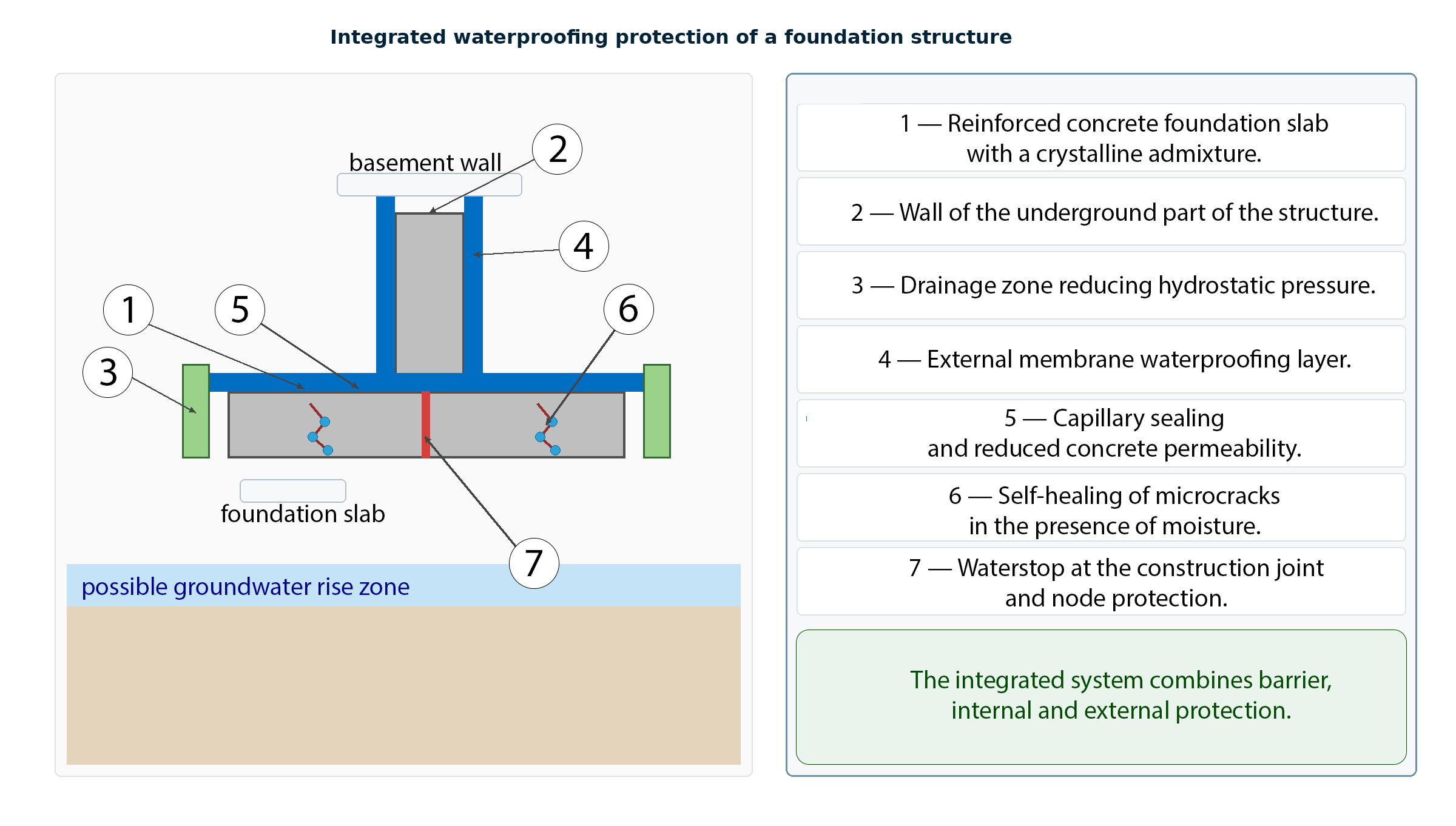
Functional scheme of integrated waterproofing protection of a foundation structure
3. Materials and methods
3.1. Regulatory and computational basis
The research methodology combines regulatory, materials-science and analytical approaches. The regulatory component is associated with requirements for the protection of underground structures against groundwater and with standard test methods for concrete watertightness, strength and frost resistance , , , , . The materials-science component concerns the mechanisms of crystalline waterproofing and self-healing in cementitious materials , , , , and also
, , , . The analytical component is used to compare alternative waterproofing solutions through an integral efficiency index.The computational part is intended for preliminary comparison of waterproofing alternatives for a foundation slab. Efficiency in this paper is understood as the ability of a solution to provide the required watertightness, reduce filtration risk through microcracks, preserve strength characteristics and remain economically justified over the life cycle of the underground structure , , , , .
3.2. Characteristics of the computational object
The case-study object is a monolithic reinforced concrete foundation slab of the underground part of a public building with one basement level. The structure operates under periodic groundwater exposure. Water pressure is assumed to be moderate; however, seasonal groundwater fluctuations create conditions under which microcracks and construction joints become potential leakage paths , , , .
Four alternative protection variants are considered:
A0 — basic concrete with external membrane waterproofing;
A1 — concrete with a crystalline waterproofing admixture and local joint protection;
A2 — self-healing concrete combined with a crystalline admixture;
A3 — an integrated system including self-healing concrete, crystalline waterproofing, an external membrane, waterstops, drainage and quality control of joints , , , , , and also , .
Initial characteristics of the computational object
Parameter | Accepted value |
Structure type | monolithic reinforced concrete foundation slab |
Design slab thickness | 800 mm |
Operating conditions | periodic groundwater exposure, cyclic wetting |
Main risk | filtration through microcracks and construction joints |
Basic requirement | increased watertightness and maintainability |
Purpose of calculation | comparison of waterproofing alternatives at the solution selection stage |
3.3. Criteria for evaluating efficiency
A system of six criteria is formed to evaluate alternative solutions. The criteria are selected to account for both the technical properties of concrete and the constructability of the solution on site. They also reflect the fact that waterproofing protection of foundations cannot be assessed only by the initial price of material; repair complexity and indirect losses caused by leaks are also significant , .
The criteria have different dimensions and physical nature; therefore, before aggregation they are converted to a normalized scale from 0 to 1. A value of 1 corresponds to the best state of a criterion, while a value of 0 corresponds to an unsatisfactory or limiting state. For benefit criteria, direct normalization is used; for cost criteria, inverse normalization is applied , , .
Criteria for evaluating the efficiency of waterproofing protection of foundation structures
compiled by the authors on the basis of [1], [2], [3], [4], [5] and also [6], [7], [17], [20], [21]
Designation | Criterion | Indicators | Weight | Justification |
C1 | Watertightness | W class, water penetration depth, relative permeability | 0.27 | key indicator of protection against groundwater |
C2 | Microcrack self-healing | crack closure ratio, maximum self-healable crack width | 0.22 | determines the ability to restore tightness |
C3 | Strength retention | relative compressive strength, no reduction in concrete class | 0.15 | prevents deterioration of bearing capacity |
C4 | Frost and water resistance | resistance to water saturation and freeze-thaw cycles | 0.13 | important for variable moisture and negative temperatures |
C5 | Constructability | dosage complexity, compatibility with concreting and quality control | 0.10 | affects reliability of site implementation |
C6 | Life-cycle economy | initial cost, repair, indirect losses from leaks | 0.13 | accounts for operating costs, not only material price |
3.4. Novelty of the proposed methodology
The scientific novelty of the study lies not in the general statement of the known effect of crystalline admixtures, but in forming a calculation procedure that includes this effect in the selection of a waterproofing system for foundations. The proposed method links the material ability of concrete to self-heal with structural and technological protection measures such as membranes, waterstops, drainage and life-cycle cost assessment , , , .
The methodology can be used for preliminary comparison of solutions before detailed design and laboratory testing. At the same time, it does not replace regulatory requirements for concrete and waterproofing, but serves as an auxiliary analytical tool for design justification and construction control , , , , .
Novelty of the article and difference between the proposed methodology and traditional approaches
Position | Content | Scientific and practical significance |
Traditional approach | Selection of external waterproofing by water type and structure | The protective layer is evaluated, but concrete self-restoration is not considered |
Materials-science approach | Testing concrete with admixtures for permeability and strength | Provides material properties, but does not link them with foundation technology |
Proposed approach | Joint assessment of concrete, crystalline admixture, joints, drainage and life-cycle cost | Allows alternatives to be compared using an integral index and weak criteria to be identified |
Novelty element | Introduction of a self-healing criterion into the model for selecting foundation waterproofing | Accounts for restoration of watertightness after microcracking |
Practical result | Tabular calculation and graphical interpretation of alternatives | Creates a basis for design justification of the selected solution |
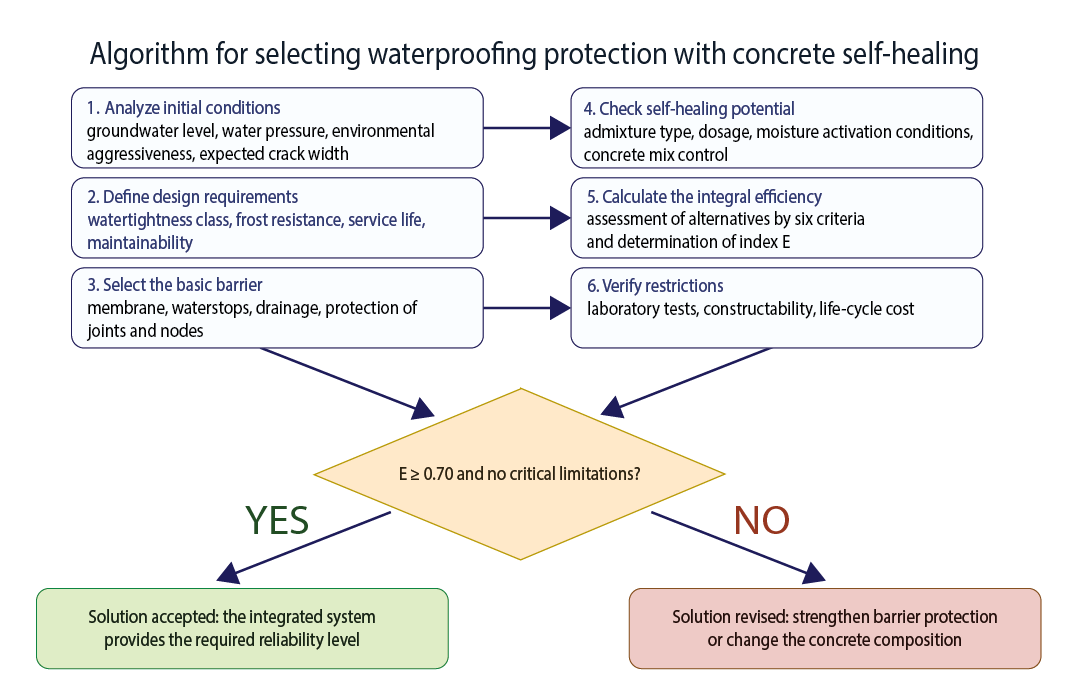
Algorithm for selecting waterproofing protection considering concrete self-healing
The integral efficiency index of waterproofing protection is denoted by E. It is calculated as a weighted sum of normalized criterion values. The index is intended for preliminary comparison of design alternatives and should be used together with regulatory checks and laboratory verification
, , , , .where:
E is the integral efficiency index;
wᵢ is the weight of the i-th criterion;
qᵢ is the normalized value of the i-th criterion.
For benefit indicators the formula:
for cost indicators the formula:
The normalization of heterogeneous indicators makes it possible to compare technical, technological and economic parameters within a single assessment model , , .
The following interpretation scale is proposed for index E:
below 0.55 — low efficiency;
0.55–0.70 — acceptable efficiency with limitations;
0.70–0.85 — high efficiency;
above 0.85 — increased efficiency for critical underground structures.
4. Computational testing of the methodology
4.1. Initial indicators of alternative solutions
At the first stage, primary indicators are assigned for each protection alternative and then converted to a normalized scale. The values in the computational example are project-analytical: they do not replace laboratory testing of a specific concrete mix, but demonstrate the procedure for comparing technical solutions. Laboratory confirmation should be performed using standard methods for watertightness, frost resistance and concrete quality control , , .
The basic variant A0 involves traditional concrete with external membrane waterproofing. Variant A1 adds a crystalline waterproofing admixture. Variant A2 includes self-healing concrete combined with a crystalline admixture. Variant A3 represents an integrated system supplemented by membrane protection, drainage and enhanced joint control. The choice of crystalline admixture and self-healing alternatives reflects published data on the influence of capillary crystalline materials on permeability reduction and microcrack closure , , , and also , , .
Primary indicators of waterproofing protection alternatives
Variant | Watertightness class | Calculated healable crack width, mm | Water penetration depth, mm | Relative strength | Initial cost index | Life-cycle cost index |
A0 | W6 | 0.05 | 70 | 1.00 | 1.00 | 1.85 |
A1 | W10 | 0.20 | 38 | 1.05 | 1.10 | 1.61 |
A2 | W12 | 0.30 | 28 | 1.07 | 1.18 | 1.58 |
A3 | W12+ | 0.35 | 22 | 1.09 | 1.25 | 1.51 |
Normalized criterion values and integral efficiency index
Variant | Watertightness | Self-healing | Strength | Frost resistance | Constructability | Life-cycle economy | E |
A0 | 0.38 | 0.20 | 0.74 | 0.66 | 0.82 | 0.62 | 0.506 |
A1 | 0.70 | 0.62 | 0.79 | 0.76 | 0.74 | 0.72 | 0.710 |
A2 | 0.82 | 0.82 | 0.81 | 0.82 | 0.60 | 0.76 | 0.789 |
A3 | 0.90 | 0.88 | 0.84 | 0.86 | 0.68 | 0.84 | 0.852 |
Decomposition of the efficiency index for the integrated A3 system
Criterion | Weight | Normalized value | Contribution to E |
Watertightness | 0.27 | 0.90 | 0.243 |
Self-healing | 0.22 | 0.88 | 0.194 |
Strength | 0.15 | 0.84 | 0.126 |
Frost resistance | 0.13 | 0.86 | 0.112 |
Constructability | 0.10 | 0.68 | 0.068 |
Life-cycle economy | 0.13 | 0.84 | 0.109 |
Total | 1.00 | – | 0.852 |
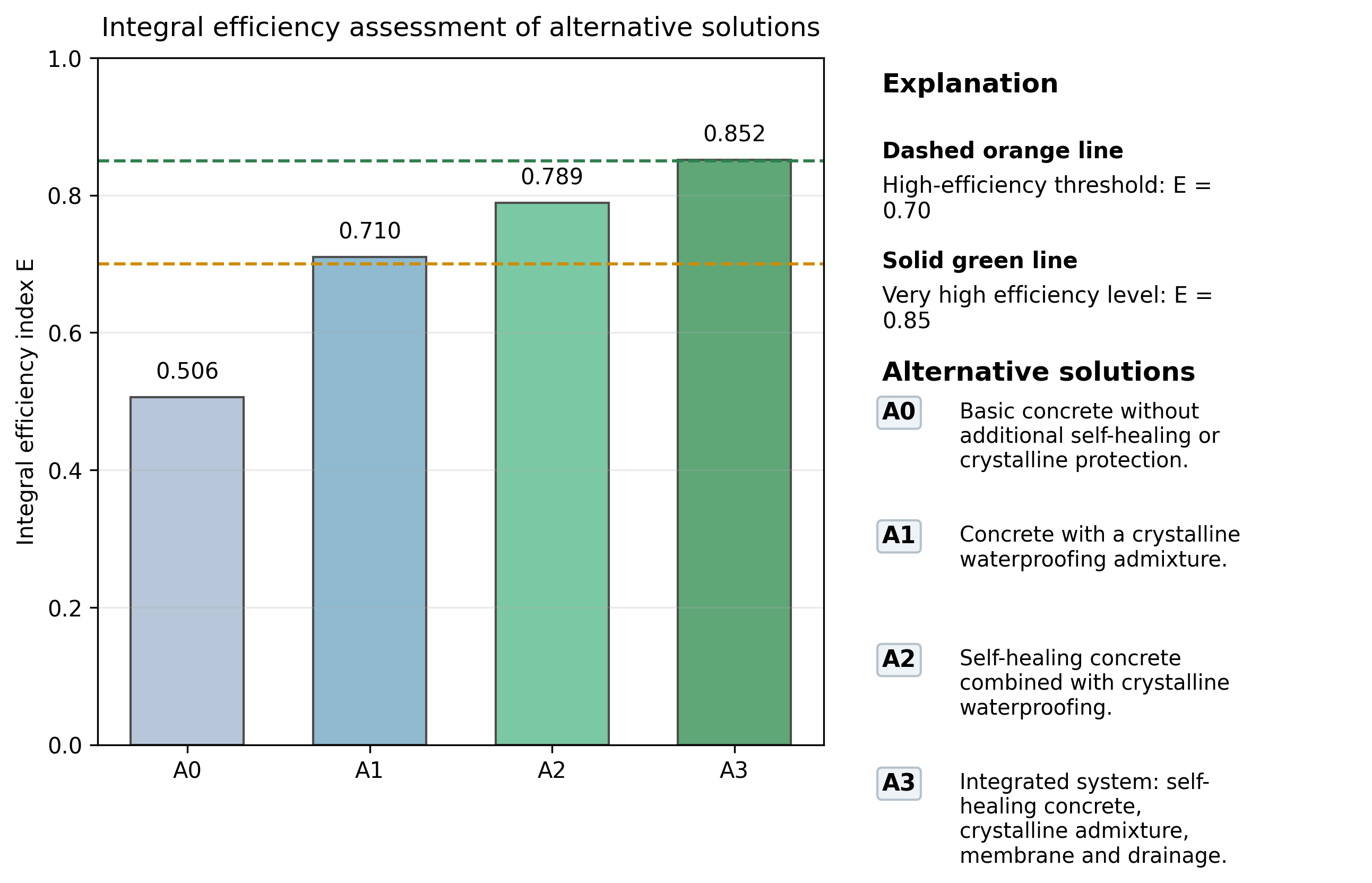
Integral efficiency assessment of alternative solutions
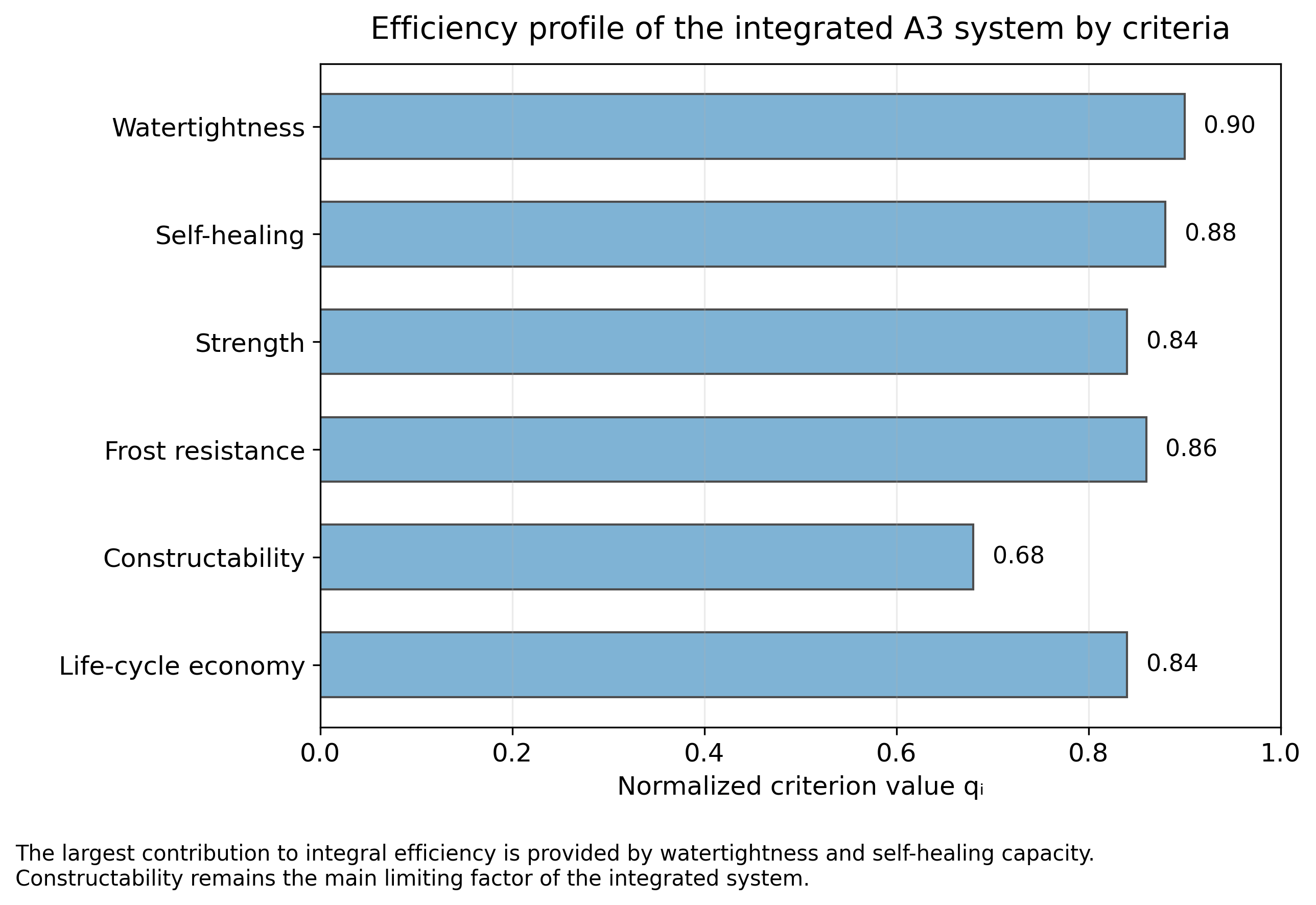
Efficiency profile of the integrated A3 system by criteria
The calculation shows that the basic variant A0 obtains E = 0.506, which corresponds to acceptable efficiency with limitations. The main limitation of the basic solution is low self-healing capacity. Even if an external membrane is installed, local defects or microcracks may remain critical filtration paths , , , .
Variant A1 demonstrates an increase in efficiency due to the use of a crystalline admixture. The normalized value for the self-healing criterion increases from 0.20 to 0.62, reflecting the ability of cement stone to partially seal capillaries and microcracks. However, the result remains dependent on proper dosing, mixing and curing , , , .
Variant A2 provides a higher index due to the combination of self-healing concrete and a crystalline admixture. Its weak point is constructability: the use of special components requires stricter control of concrete production, delivery, placement and curing , , , .
The highest efficiency index is obtained by variant A3, the integrated system. Its advantage consists not only in material properties but also in the combination of several barriers: concrete watertightness, self-healing, external membrane protection, waterstops and drainage. This solution is most justified for structures where leakage after commissioning is difficult and expensive to eliminate , , , .
4.3. Calculation of microcrack closure dynamics
For foundation slabs, not only the final watertightness value is important, but also the dynamics of tightness recovery after microcracking. In the computational example, a microcrack with an initial width of 0.30 mm is accepted. The degree of closure is estimated as a percentage of the reduction in the effective open crack width over time under water saturation. Similar approaches to evaluating crack closure and permeability recovery are discussed in studies of autogenous, crystalline and engineered self-healing mechanisms , , , .
The crack closure dynamics are shown in Figure 5 (add. mat.). The values are computational and analytical; they are intended to illustrate the proposed assessment procedure. In a real project, the values must be verified by laboratory testing of the selected concrete mix and waterproofing admixture under conditions that reproduce the expected exposure of the foundation structure , , .
Calculated microcrack closure degree over time
Time, days, % | Basic concrete, % | Concrete with crystalline admixture, % | Self-healing system, % |
0 | 0 | 0 | 0 |
7 | 8 | 22 | 30 |
14 | 15 | 42 | 56 |
28 | 24 | 61 | 78 |
56 | 31 | 72 | 88 |
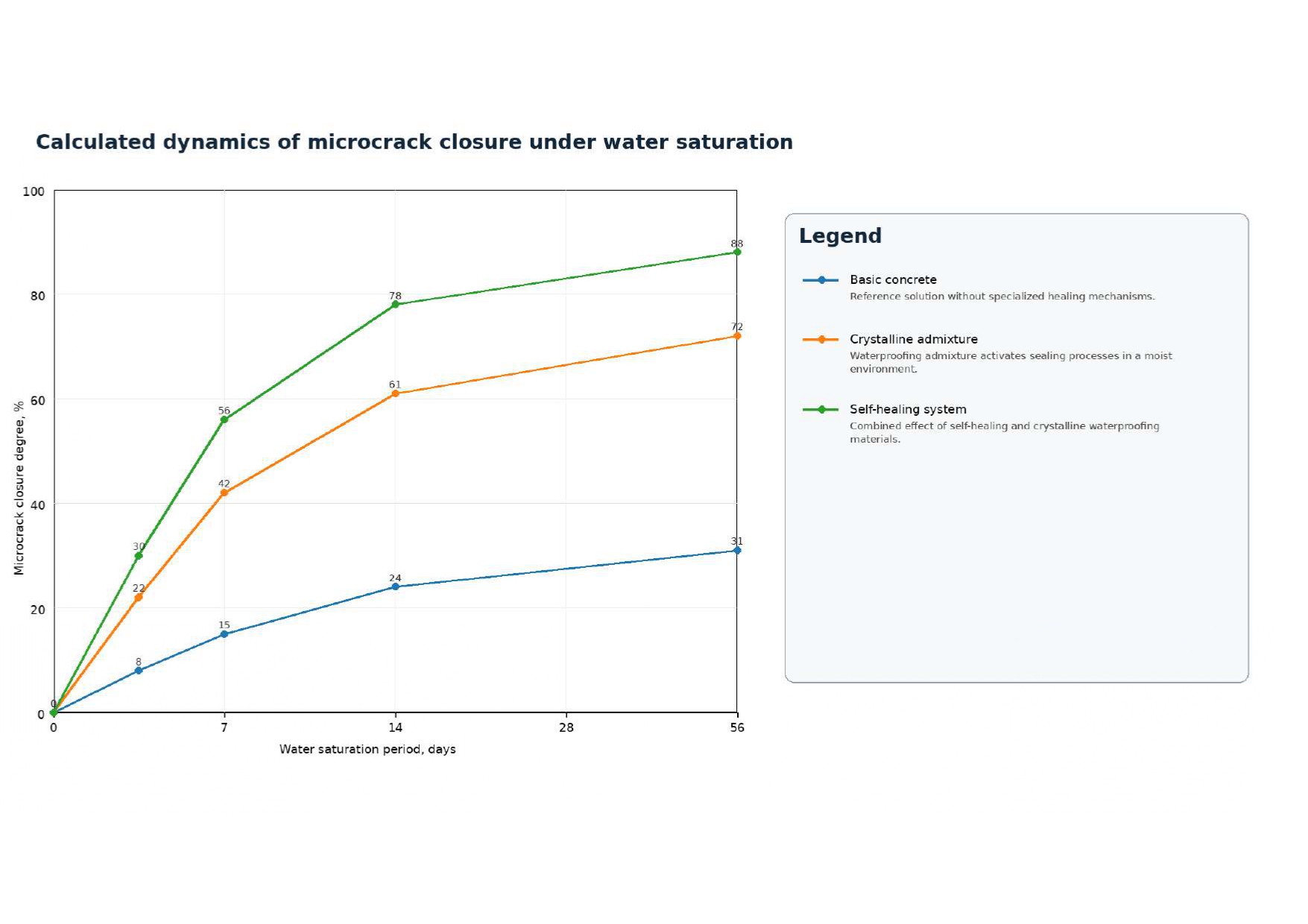
Calculated dynamics of microcrack closure under water saturation
The use of self-healing materials is often accompanied by an increase in initial costs. However, for underground structures, economic efficiency should be assessed not only by material price but also by the expected cost of repair, disruption of operation, injection works, restoration of finishes and indirect losses caused by leakage. Previous studies emphasize that durability-oriented concrete technologies should be evaluated not only by initial material cost, but also by their influence on service life, repair frequency and permeability-related damage , , , , .
The calculated cost structure in Figure 6 (add. mat.) and Table 9 shows that variant A3 has the highest initial cost index, but reduces expected repair costs and indirect losses. This is especially important for underground parking areas, technical rooms, archives, storage facilities and other underground spaces where water leakage can lead to significant operating losses , , , .
Calculated life-cycle cost assessment
Variant | Initial costs | Repair | Indirect losses | Total | Self-healing availability |
A0 | 1.00 | 0.60 | 0.25 | 1.85 | no |
A1 | 1.10 | 0.35 | 0.16 | 1.61 | partial |
A2 | 1.18 | 0.28 | 0.12 | 1.58 | yes |
A3 | 1.25 | 0.18 | 0.08 | 1.51 | yes |
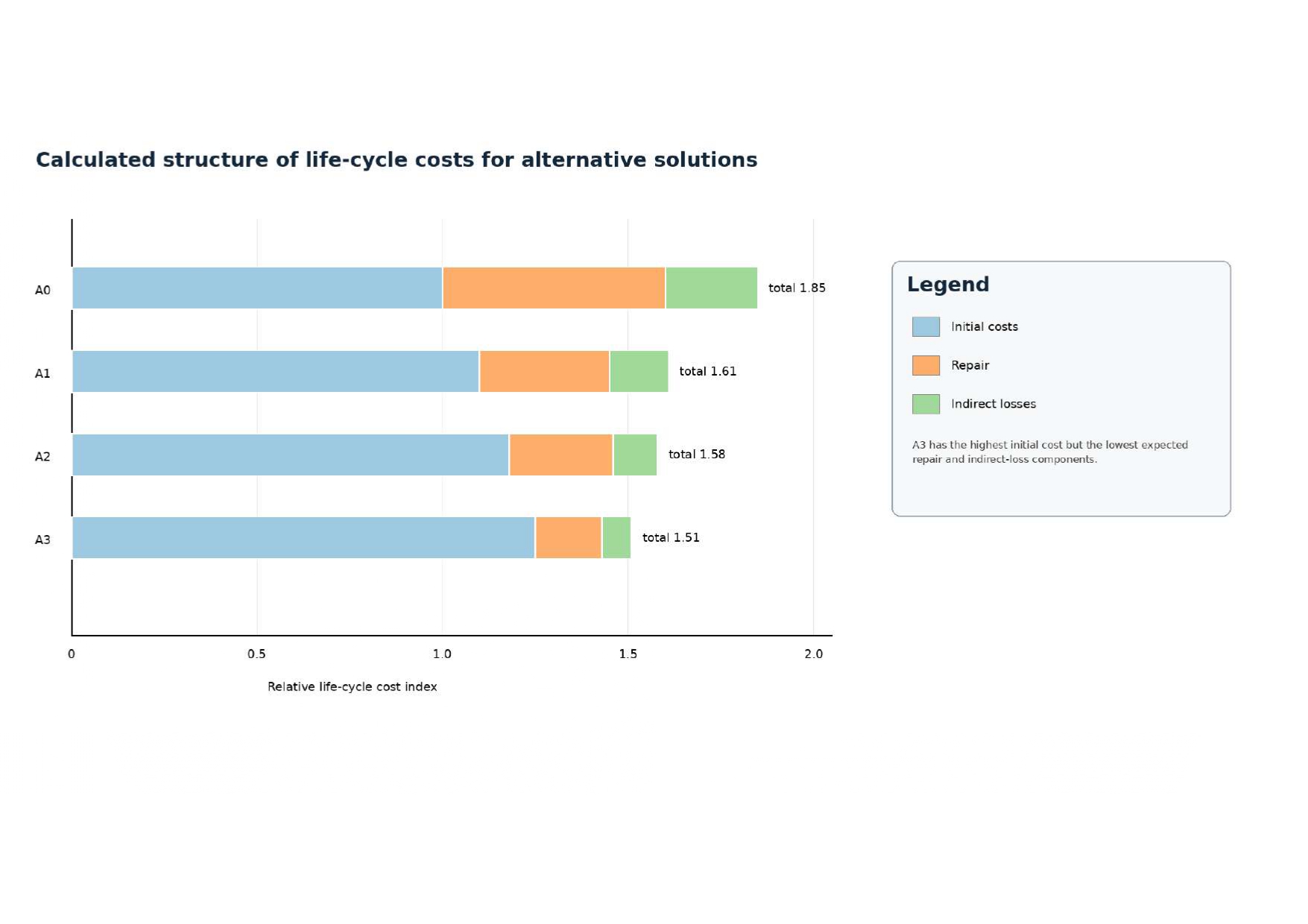
Calculated structure of life-cycle costs for alternative solutions
5. Discussion
The results obtained make it possible to formulate several provisions for the design and construction of foundation structures. First, crystalline waterproofing should not be considered a complete substitute for external waterproofing in all cases. Its most effective application is as part of a combined system that includes concrete with increased watertightness, external protection, joint sealing and drainage , , , , and also , , , .
Second, self-healing is effective primarily for microcracks of limited width. Large, through and moving cracks, deformation joints, local voids, concreting defects or serious violations of construction technology cannot be regarded as self-removable. In such cases, additional solutions are required: waterstops, injection hoses, repair mortars or design modification , , , .
Third, the effect of crystalline admixtures depends on the quality of the concrete mix. A high water–cement ratio, poor curing, non-uniform distribution of the admixture, contaminated aggregates or insufficient compaction reduce the expected effect. Therefore, the use of self-healing concrete should be accompanied by a detailed quality control program , , , , .
Fourth, the economic feasibility of self-healing concrete is most pronounced in facilities where leak repair after commissioning is difficult or expensive. These include basements, underground parking lots, technical rooms, tunnels, underground passages and structures with restricted access for repair , , .
Fifth, the proposed methodology may be integrated into BIM environments and digital construction control systems. In a building information model, elements of the foundation slab and basement walls can be associated with waterproofing parameters, crack-width limits, quality control requirements and life-cycle cost indicators , .
Table 10 is included in the discussion section to define the practical limits of applying the integrated A3 system. It shows the conditions under which the calculated efficiency index should not be used mechanically and must be supplemented by laboratory verification, technological control and life-cycle assessment , , .
Applicability limits of the integrated A3 system and ways to account for restrictions
Application limitation | Why it matters for the calculation method | How to account for it in design and control |
No laboratory verification of a specific concrete mix | Calculated E values provide comparative assessment but do not replace specimen testing | Test watertightness, frost resistance and crack closure ability |
Dependence of crystallization on moisture and curing conditions | Poor curing reduces the effect of capillary and crack sealing | Record curing regime, moisture care, admixture dosage and compaction quality |
Limited width of effectively healable cracks | Large, through and moving cracks should not be considered self-removable | Introduce a crack-width threshold and provide waterstops, injection or repair compounds |
Higher requirements for technological discipline | Non-uniform admixture distribution and concreting errors reduce the result | Include control operations in method statements, technological maps and construction control programs |
Economic uncertainty when only initial costs are assessed | An integrated system may be more expensive initially but cheaper over the life cycle | Compare alternatives by life-cycle costs: installation, repair, downtime and indirect losses |
6. Practical recommendations
As a result of the study, an analytical methodology for assessing the efficiency of self-healing concrete and crystalline waterproofing in foundation structures has been developed on the basis of published studies on self-healing cementitious materials, crystalline waterproofing and durability of concrete structures , , , , , and also , , , . The methodology links material properties with structural and technological conditions and makes it possible to compare alternative waterproofing solutions at the preliminary design stage.
The scientific novelty of the work lies in forming an integral model that links materials-science properties of self-healing concrete with structural and technological conditions of foundation operation. In contrast to traditional approaches focused mainly on external waterproofing, the proposed methodology considers the concrete itself as an active element of waterproofing protection , , , .
The computational testing showed that the use of a crystalline admixture increases waterproofing efficiency compared with the basic alternative; however, the maximum result is achieved when the material mechanism of self-healing is combined with external membrane protection, waterstops, drainage and construction quality control. The integrated system A3 obtained the highest efficiency index, E = 0.852 , , .
The practical significance of the study lies in the possibility of using the proposed model by design organizations, technical clients and construction companies at the preliminary selection stage of waterproofing protection for foundation structures. The methodology enables alternatives to be compared, weak criteria to be identified and the need for additional laboratory testing and technological control to be justified , .
Further research should be aimed at laboratory verification of calculated indicators, assessment of long-term performance of crystalline admixtures in real foundation structures, refinement of normalization ranges and integration of the methodology into BIM-based construction control systems , , , .
Recommendations for selecting a protective solution for foundation structures
Operating condition | Recommended solution | Comment |
High groundwater level | High-watertightness concrete + crystalline admixture + external waterproofing + drainage | the system should include at least two independent barriers |
Risk of temperature and shrinkage cracks | Self-healing concrete + crack-width control | crack resistance calculation is mandatory |
Large number of construction joints | Crystalline admixture + waterstops + injection hoses | special attention should be paid to concreting joints |
Aggressive groundwater | Crystalline admixture + anti-corrosion protection + concrete mix selection | requirements for corrosion protection must be considered |
High repair cost after commissioning | Integrated system A3 | life-cycle cost assessment is necessary |
7. Conclusion
As a result of the study, an analytical methodology for assessing the efficiency of self-healing concrete and crystalline waterproofing in foundation structures has been developed. The methodology links material properties with structural and technological conditions and makes it possible to compare alternative waterproofing solutions at the preliminary design stage.
The scientific novelty of the work lies in forming an integral model that links materials-science properties of self-healing concrete with structural and technological conditions of foundation operation. In contrast to traditional approaches focused mainly on external waterproofing, the proposed methodology considers the concrete itself as an active element of waterproofing protection.
The computational testing showed that the use of a crystalline admixture increases waterproofing efficiency compared with the basic alternative; however, the maximum result is achieved when the material mechanism of self-healing is combined with external membrane protection, waterstops, drainage and construction quality control. The integrated system A3 obtained the highest efficiency index, E = 0.852.
The practical significance of the study lies in the possibility of using the proposed model by design organizations, technical clients and construction companies at the preliminary selection stage of waterproofing protection for foundation structures. The methodology enables alternatives to be compared, weak criteria to be identified and the need for additional laboratory testing and technological control to be justified.
Further research should be aimed at laboratory verification of calculated indicators, assessment of long-term performance of crystalline admixtures in real foundation structures, refinement of normalization ranges and integration of the methodology into BIM-based construction control systems.