
Relationship of atmospheric parameters, convection and hail size
Relationship of atmospheric parameters, convection and hail size
Abstract
Using statistical analysis methods, a hail forecast was developed, and its maximum size was determined. To calculate atmospheric parameters, instead of real aerological sounding data, forecast products of the global atmospheric model GFS NCEP with a lead time of 24 hours were used. The studies were conducted at the Mineralnye Vody meteorological station, located in the central part of the North Caucasus. The quality and efficiency indicators of the proposed hail forecast demonstrated a high level. The parameters reflecting the quality, statistical significance and practical application of the regression model for estimating the size of hail also confirmed their relevance in predicting the maximum diameter of hail.
1. Introduction
Hail events, associated with atmospheric convection, cause significant annual damage to agricultural crops and plantations, sometimes destroying them entirely
, , . However, reliable hail forecasting is challenging due to a lack of operational aerological data: meteorological stations equipped with sounding instruments are widely spaced and take measurements at infrequent intervals, which do not always coincide with the peak of convective activity. As an alternative to traditional aerological profiles, forecast fields of meteorological parameters from global models (exemplified by the NCEP GFS model), which provide acceptable accuracy, are used , , .Furthermore, the problem is exacerbated by the fact that field studies aimed at investigating the relationship between hail size and microphysical processes are insufficient or entirely absent. It is known that hail size substantially influences the damage caused by hailstorms.
This work aims to estimate the maximum hail diameter. To achieve this aim, the following objectives were set:
- to collect information on dates with and without convective development in the area of the «Mineralnye Vody» aerological station (Central region of the North Caucasus);
- to collect forecast fields of temperature, dew point, wind speed, and direction at standard levels from a global atmospheric model;
- to forecast hail using data from the global atmospheric model;
- to estimate its maximum size.
The SPSS program was used for statistical processing and model building
.2. Research methods and principles
To forecast hail and determine its maximum size, output data from a mathematical atmospheric model with a 24-hour lead time were used. These data include air temperature and dew point, as well as wind direction and speed at standard levels.
The ratio of air temperature and temperature of dew point plays a base role in the formation of droplets and hailstones in clouds. Under the influence of ascending convective flows in hail clouds, water droplets rise into the colder layers of the atmosphere, where they freeze, forming hailstones. In addition to updrafts, a sufficient amount of water vapor is required for the formation and growth of hailstones, the transition of which to the liquid phase is determined by the ratio of air temperature and temperature of dew point. The closer the ambient temperature is to the temperature of dew point and the more powerful the convective flows, the larger the size to which hailstones can grow.
Services on struggle with the hail in the representative zone of the aerological sounding of the «Mineralnye Vody» station in the North Caucasus provided information on the dates of occurrence of convective phenomena, both with and without hail.
Based on the global model data, parameters traditionally used for forecasting convection and associated hazardous phenomena were calculated
, . The most informative parameters were :- maximum temperature difference between the cloud and the ambient air, DTM;
- level at which the temperature difference between the cloud and the surrounding air is greatest, HM;
- the vertical temperature gradient in the layer 4–4,5 km above the condensation level, DTK;
- the total specific humidity in the «Earth-5 km» layer, SQZ5;
- average moisture deficit in the 5 km layer above the condensation level, TDSR5;
- convection level, PH1;
- temperature at the convection level,TH1;
- George instability index, DJ;
- Miller integral index, TTMI;
- energy characteristic of the subcloud layer, DSS.
A discriminant function was constructed to distinguish between «hail» and «no hail». The maximum hail size was estimated using regression analysis.
3. Main results
Hail forecasting and estimation of its maximum size were conducted based on observational data («hail» and «no hail») for the period from May to August 2020. For all days of the hail season, corresponding atmospheric parameters were matched, calculated from the output data of the GFS mathematical model for the coordinates of the «Mineralnye Vody» station.
Hail forecasting was performed using the discriminant function
:L=0,056DJ-0,07SQZ5+0,0002HM+0,036TTMI+ 0,007DSS+0,06TDSR5-20,3.
Values above the threshold L≥0 correspond to a «hail» forecast, while values below correspond to «no hail».
On the results of the discriminant analysis, a contingency table was formed, from which the quality and success indicators of the forecasts were determined. These indicators were high: accuracy of the method — 77%; probability of detection of the event — 88%; accuracy of forecasting the event's occurrence — 80%, accuracy of forecasting the event's absence — 73%, probability of detection of non-occurrence — 70%.
Regression analysis was employed to forecast the hail maximum size. All predictors had a distribution close to normal and did not exhibit strong intercorrelation (with the exception of PH1, which was excluded from the analysis).
Using the step-by-step exclusion method, a regression model was chosen to estimate the maximum size D (cm) of a hail of the form:
D=-17,84+0,123TDSR5-0,056TH1+0,123DJ-0,097TTMI+0,006DSS.
The Miller integral index (TTMI) contributed the most to explaining the variations in hail diameter, its effect nearly doubling that of the moisture (TDSR5) deficit in the layer 5 km above the condensation level.
The coefficients of the equation, according to the t-test, showed statistical significance for variables TDSR5, TH1, DJ, TTMI, DSS. Fisher criterion was F=6,5>1 whis significance Sig.=0,01<0,05, confirming that the coefficients of the selected regression model are significant, and the regression equation is applicable for estimating the maximum diameter of hail.
The tolerance test showed tol=0,72>0,1 and VIF=5,5<10, which ruled out multicollinearity problems and confirmed the suitability of the parameters for further use in the model.
The quality of the model is characterized by a high value of the multiple correlation coefficient R=0,76. The coefficient of determination was R2=0,58 means that 58% of the variability in the maximum diameter is explained by the combination of selected parameters. The Durbin-Watson test (2,08) indicated the absence of autocorrelation in the residuals.
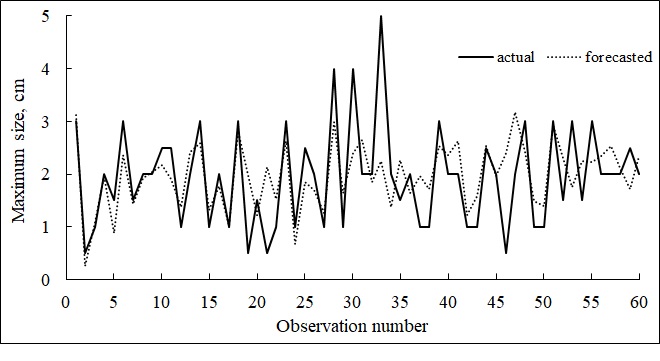
Figure 1 - Maximum hail size
4. Discussion
This study demonstrates the possibility of determining the maximum hail size based on data from the global atmospheric model GFS. Data on the maximum hail size were collected in regions where active interventions were carried out in hail processes. Such an impact on the natural process affects the values of cloud parameters responsible for the formation of hail. Studying information in areas where no interventions are carried out on hail processes will improve the accuracy of estimating the maximum hail size.
5. Conclusion
As a result of the study, the formation and increase the size hail is significantly influenced by the instability reserve, which implies the presence of sufficient potential energy for the occurrence of convective processes, as well as the temperature and humidity regime in tin the hail growth zone. The developed approaches for forecasting hail and estimating its maximum size, based on 24-hour forecast fields of meteorological elements from the National Centers for Environmental Prediction (NCEP) Global Forecast System (GFS), have proven effective and can be applied in regions without regular aerological soundings.