
Исследование пиротехнических реагентов, содержащих иодид серебра AgI и другие соединения иода
Исследование пиротехнических реагентов, содержащих иодид серебра AgI и другие соединения иода

Аннотация
В статье представлены результаты экспериментальных исследований пиротехнических реагентов, которые применяются в практике модификации погоды. Они содержат иодид серебра как главный льдообразующий агент, а также дополнительные примеси. Для проведения лабораторных экспериментов пиротехнические составы распыляют в виде аэрозоля.
Объектом исследования является льдообразующий аэрозоль.
Целью выполнения экспериментов являются исследования путей повышения льдообразующей активности кристаллизующих реагентов и контроль льдообразующей эффективности применяемых противоградовых изделий на экспериментальных установках ФГБУ «ВГИ».
Исследовано изменение льдообразующей активности льдообразующих аэрозолей со временем. По данным экспериментов льдообразующая активность пиротехнических составов со временем снижается. Также происходит уменьшение концентрации активных ядер нуклеации у обоих пиротехнических реагентов.
По данным экспериментов увеличение скорости восходящего воздушного потока более 15 м/с резко уменьшает концентрацию льдообразующих аэрозольных частиц нанометрового диапазона в объеме воздуха. При начальных значениях концентрации льдообразующих ядер 1,0×10¹⁴ м-3 происходит резкое падение концентрации на несколько порядков.
Для повышения льдообразующей активности пиротехнических реагентов предложено вносить в их рецептуры иодирующие добавки к основному действующему веществу. Это может повысить количество аэрозольных ядер нанометрового размера и усилить их гигроскопические свойства.
1. Introduction
In the practice of weather modification, inorganic and organic substances exhibiting ice-forming properties have been studied
, , , . However, substances that combine ice-forming properties with the stability of the formulation in the thermal method of aerosol formation are suitable for equipping ice-forming aerosol generators . Such substances include silver iodide, which is widely used in the practice of active effects on supercooled clouds and mists. Meanwhile, AgI has some disadvantages, the most significant being its scarcity and high cost. The price of ice-forming aerosol generators and weather modification works in general is also increasing.Since the beginning of its use in the practice of weather modification, work has been underway to reduce its concentration in pyrotechnic compositions. This is necessary to reduce the environmental effects of weather modification. Currently, the mass fraction of silver iodide in pyrotechnic compounds is 5–8%, which does not affect the ice-forming efficiency of pyrotechnic compounds
.Therefore, the issue of developing new and improving existing pyrotechnic compositions containing ice-forming reagents remains relevant.
One of the ways to increase the effectiveness of pyrotechnic compounds is to use additives that lead to the activation of silver iodide, as well as to improve the technology of preparation of compounds. To do this, it is necessary to study the influence of various factors on the ice-forming properties of silver iodide. Such experimental studies are conducted in conditions that simulate a natural cloud environment. It is also necessary to search for ways to modify pyrotechnic compositions based on silver iodide. Laboratory samples of pyrotechnic compounds are usually more active than factory-made pyrotechnic compounds
.In order to find reagents devoid of the above disadvantages, FSBI "High-Mountain Geophysical Institute" conducts experimental and theoretical studies on ways to increase the ice-forming efficiency of crystallizing reagents and anti-hail products.
2. Research methods and principles
Experiments to study the ice-forming efficiency were carried out in large and small cloud chambers based on the Federal State Budgetary Institution "High-Mountain Geophysical Institute".
The general diagram of the laboratory equipment is shown in Figure 1:
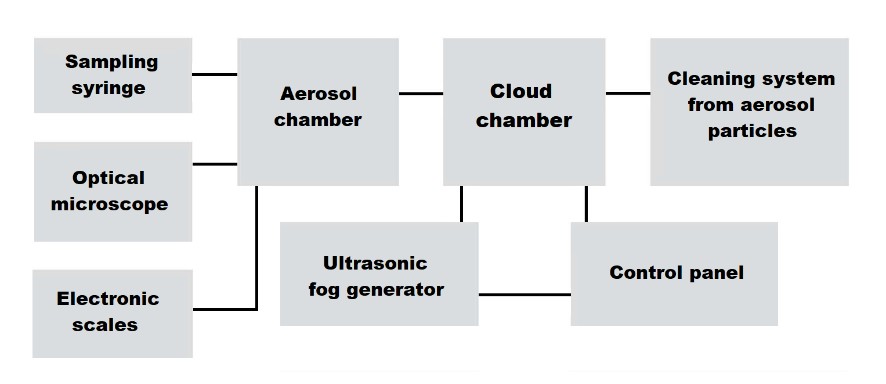
Standard composition of laboratory equipment
A device for producing artificial fog is connected to the cloud chamber through a pipe with a diameter of 10 cm. The device consists of a 100-liter tank, at the bottom of which there is an ultrasonic fog generator. A fan is mounted on the lid of the device to introduce water vapor into the cloud chamber.
The small cloud chamber is a cube with a volume of 1 m3 with thermally insulated walls and an observation window. A refrigeration unit and a fog generator are connected to the small chamber. At the bottom of the cloud chamber, there are thermostats covered with lids. They are designed to capture ice crystals that form in a supercooled cloudy environment on reagent particles. A typical diagram of a small cloud camera is shown in Figure 2.
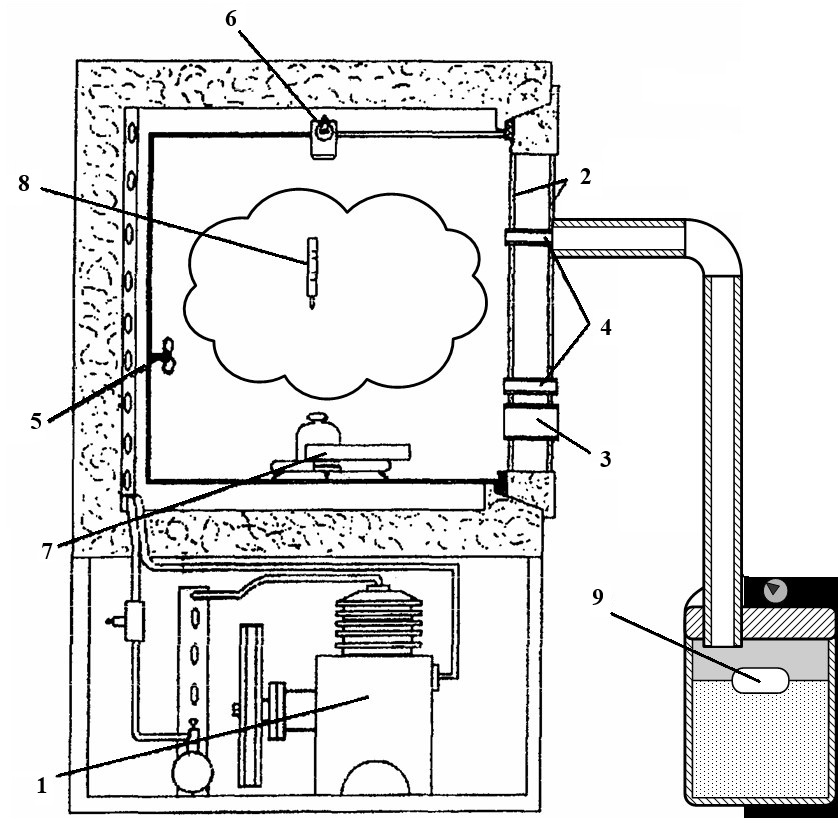
Cloud chamber diagram:
1 – refrigeration unit; 2 – double window; 3, 4 – tubes; 5 – fan; 6 – light; 7 – thermostat; 8 – mercury thermometer; 9 – fog generator
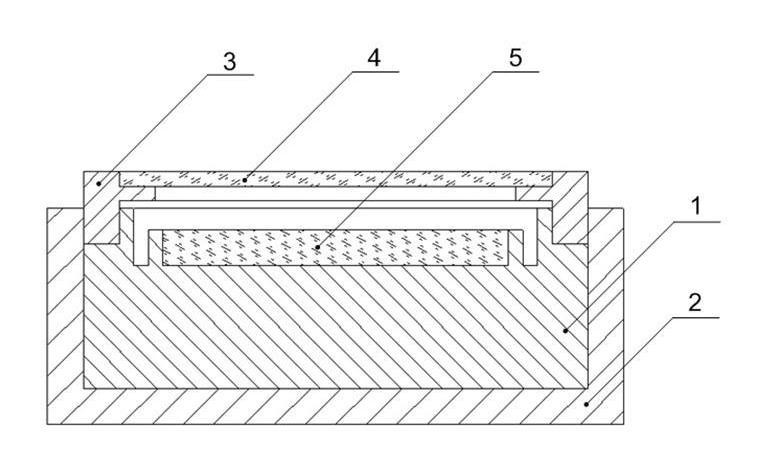
Thermostat:
1 – thermostat housing; 2 – thermal insulation housing; 3 – thermostat cover with transparent glass; 4 – glass; 5 – mirror glass slide
Steam was introduced into a large cloud chamber, and a humid environment with a relative humidity of 80% was created. A sample of the reagent weighing 0.2 to 2 g was weighed and burned in an air jet. The velocity of the vertical jet of air directed inside the cloud chamber was 10 m/s. In a number of experiments, the flow rate was increased to 15 m/s or more. The jet simulated blowing of the reagent stream with an upward flow. As is known, powerful convective clouds contain updrafts that reach speeds of 30–40 m/s during intense hail processes of category 3 and 4 , . In our case, flows with a velocity of 10–15 m/s reflected processes of low intensity.
Then the resulting mixture of moist air and an ice-forming aerosol was kept for 2 days. Samples were taken every 300 minutes using an aerosol particle counter and the particle concentration of the experimental reagent samples was determined.
To determine the ice-forming properties, an aerosol air sample was taken from a large cloud chamber and introduced into a small cloud chamber. Previously, an artificial cloud environment was created in a small chamber, and thermostatically controlled substrates were placed at the bottom of the chamber. The air temperature was -10 °C.
After applying a sample of the ice-forming aerosol, the formation of ice crystals was monitored using an illuminator. With the appearance of the first crystals in the field of view, the substrates were alternately opened. Each substrate was opened for 1 minute, after which it was removed from the cloud chamber and the next substrate was opened. All the substrates were alternately examined using an optical microscope. When studying each substrate, 4-5 frames with crystals were selected and photographed using an automated system.
The calculation formula for calculating the specific yield of active ice-forming nuclei
where
The parameter of the specific yield of active ice-forming nuclei
The time of each experiment to determine the specific yield of active ice-forming nuclei depends on the concentration of ice crystals formed and the time of their complete precipitation. The average precipitation time for ice crystals is 5 minutes. When re-seeding supercooled fog, the experiment time increases to 10 minutes. After each experiment, the cloud chambers are cleaned.
3. Main results
Two pyrotechnic reagents, C1 and C2, containing equal amounts of silver iodide and iodine, were selected for the study. Both pyrotechnic reagents were based on silver iodide and ammonium perchlorate. Pyrotechnic reagent C1 contained potassium iodide, while pyrotechnic reagent C2 contained iodoform as an iodinating additive. It should be noted that differences were found in the combustion products of pyrotechnic reagents C1 and C2. During combustion of C1, hygroscopic potassium iodide particles are formed, which facilitate the immersion mechanism of ice formation. Water absorption and the formation of an iodide solution are observed on the surface of the hygroscopic particles of pyrotechnic reagent C1. The iodide content in the solution (I/Ag molar ratio) is 30 times higher than that in the aqueous solution on the surface of pyrotechnic reagent C2 particles.
Figure 4 shows data on the ice-forming activity of the studied reagents during prolonged exposure of the aerosol to an environment with a relative humidity of 80%. For ease of presentation, the results are presented on a logarithmic scale.
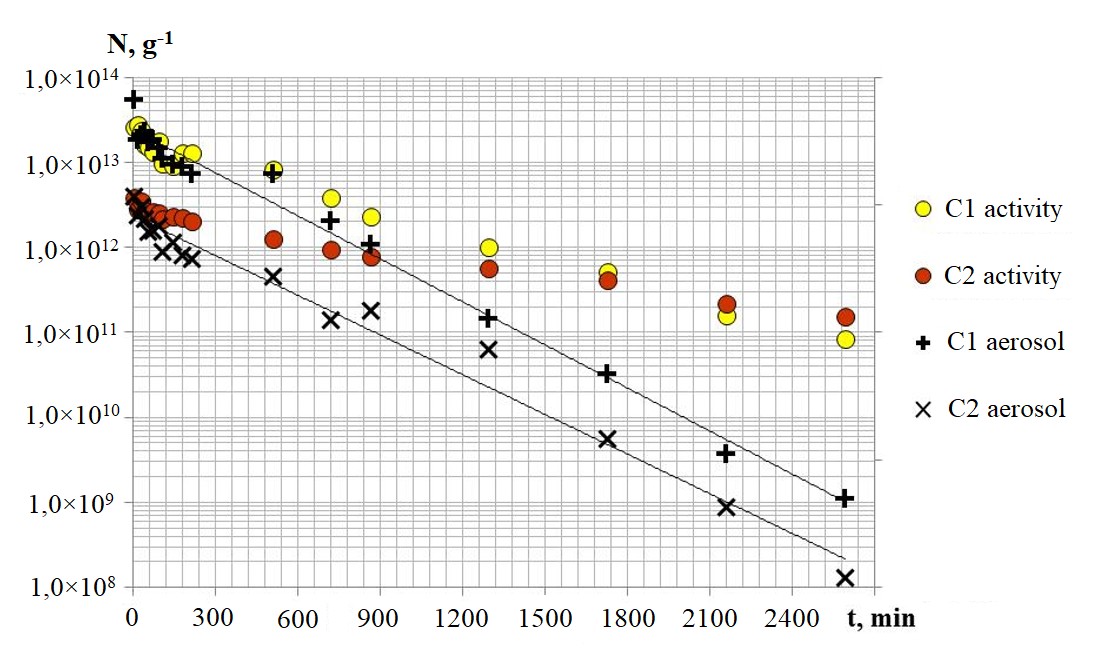
Changes in ice-forming activity and particle concentration over time
It is likely that the crystal structure of the ice-forming substance in the particles of pyrotechnic reagent C1 changes due to the solubility of AgI in the presence of I- ions. Recrystallization processes of silver iodide reduce the number of defects on the surface of its crystal. This phenomenon, in turn, leads to a change in ice-forming activity.
Despite the high ice-forming activity of pyrotechnic reagent C1, which reaches values of 1.0×10¹⁴ ice particles per 1 g of reagent at a temperature of 10 °C, a further increase in reagent activity is possible.
In
, the relationship between the particle size of pure AgI and the probability of their ice-forming properties is given, i.e. if we consider the actual temperature range for anti-hail operations as -3÷ -10 °C (270-263 K), then with all the differences in data, it can be argued that the particle size of the aerosol effective in this temperature zone should exceed at least 40 nm. Silver iodide particles with a size of 50 nm already exhibit almost 100% ice-forming activity at subzero temperatures (Figure 5).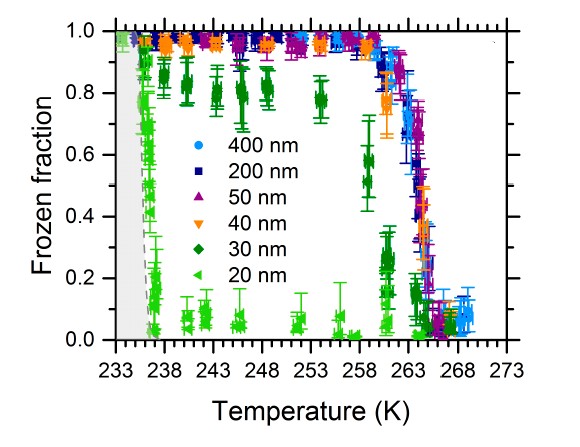
Ice-forming activity of silver iodide particles of different sizes
based on [14]
It should be noted that the ice-forming aerosol of silver iodide loses its ice-forming properties over time. This is due to the effect of air currents on the aerosol. At flow speeds greater than 15 m/s, Brownian coagulation plays a role in the formation of ice-forming aerosol, sharply reducing the concentration of nanometer-sized particles in the air . This process affects the ice-forming activity. With initial values of the concentration of ice-forming nuclei of 1.0×10¹⁴ m-3, within 0.5 minutes from the moment of aerosol formation, there is a sharp drop in concentration to 1.0×10⁹ m-3 or less.
Thus, increasing air flow velocity leads to rapid coagulation of ice-forming aerosol particles and dilution of the aerosol jet, which reduces the number of ice nuclei.
One way to compensate for such losses in the ice-forming activity of reagents is to use special iodinating additives (iodine compounds with alkali metals and ammonium) (Table 1). These additives are designed to enhance the hygroscopic properties of the ice-forming reagent and suppress the decomposition of silver iodide (AgI) at high aerosol formation temperatures. Iodine-containing pyrotechnic reagents are characterized by sublimation temperatures significantly exceeding the decomposition temperature of silver iodide.
Characteristics of pyrotechnic reagents with additives of iodine compounds
based on [15]
Pyrotechnic reagent | AgI, % | Iodizing additive, % | The ratio in the initial reagent I/Ag | Ratio after sublimation I-/AgI |
N1 | 6–10 | KIO3, 35-44 | 7,04 | 53,33 |
N2 | 8–12 | NH4I, 12-17 | 3,42 | 0,17 |
N3 | 7–9 | KI, 11-13 | 3,12 | 7,85 |
N4 | 2–3 | KI, 3-5 | 4,07 | 9,85 |
According to Table 1, the atomic ratio of iodine to silver for most pyrotechnic reagents is at least 3. However, excess iodine in the pyrotechnic reagent leads to a significant excess of soluble iodides over AgI in the ice-forming aerosol.
The I- : AgI molar ratio in pyrotechnic reagents exceeds 3:1, which is due to the dissolution of silver iodide in the iodide solution of the hydrated portion of the aerosol particles. This results in the formation of complex compounds of the following type :
AgI + xMeI = Me2[AgIx+1],
where Me is an alkali metal or ammonium ion, and x ranges from 2 to 3.
The dissolution of silver iodide has been studied in detail for potassium, sodium, and ammonium iodides (Figure 6).
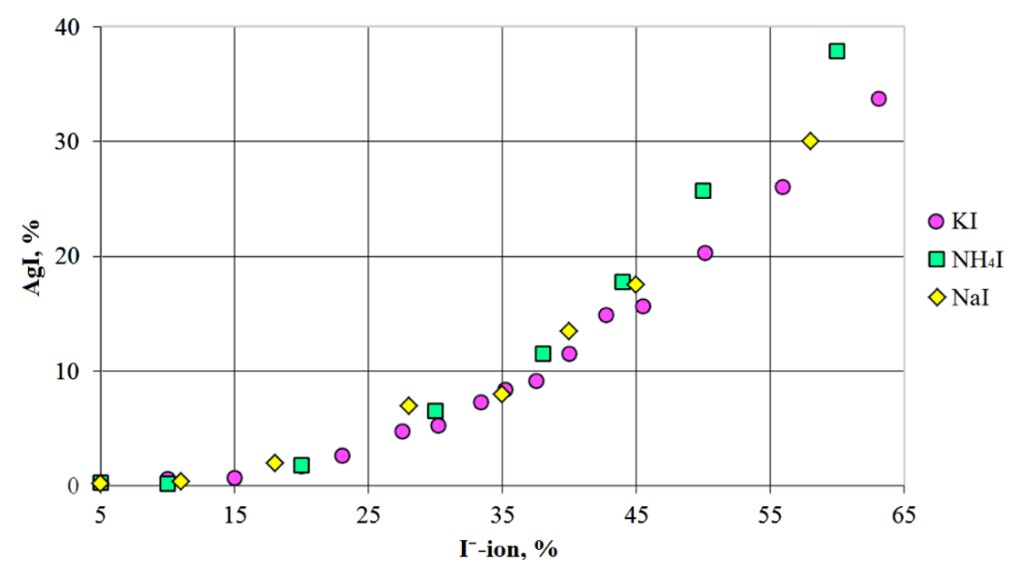
Solubility of silver iodide in solutions of potassium, sodium and ammonium iodides
based on [17]
Increasing the solubility of AgI can trigger a process of structural changes in silver iodide aerosol particles. According to Fletcher's theory , a process of equalization of the crystalline and surface properties of silver iodide aerosol particles and a decrease in their ice-forming activity over time is possible.
Based on experimental data, it is possible to draw conclusions about the need to take into account changes in the spectrum and composition of aerosol nuclei during operation of anti-hail products at low temperatures. This is due to the dependence of the spectra of the ice-forming aerosol on the concentration of the ice-forming aerosol, the velocity of the updraft, the air temperature, and the type of reagent. Tests of experimental samples should be carried out in laboratory conditions as close as possible to the actual conditions of use of exposure controls.,
The results obtained can be used to evaluate the ice-forming effectiveness of anti-hail products in real-world conditions.
4. Conclusion
Experiments were conducted to study the ice-forming activity of pyrotechnic reagents C1 and C2, containing silver iodide and additional components. The experimental results showed that for both pyrotechnic reagents C1 and C2, ice-forming activity and the concentration of active nucleation nuclei decrease over time.
The ice-forming activity of pyrotechnic reagent C1 is an order of magnitude higher than that of C2 for periods up to 600 minutes, initially reaching 1014 particles per gram. The indicators then level off, but the concentration of aerosol particles continues to decrease over time to values around 109 particles per gram of pyrotechnic reagent.
The introduction of iodizing additives into pyrotechnic reagents can potentially increase ice-forming activity to 1019 ice-forming nuclei per gram of reagent. This figure can be achieved by increasing the number of nanometer-scale aerosol ice-forming particles, as well as by increasing the hygroscopicity of the particles.
Airflows with speeds exceeding 15 m/s reduce the concentration of nanometer-scale ice-forming aerosol particles in the air. From an initial ice-nucleus concentration of 1.0×10¹⁴ m-3, the concentration drops sharply to 1.0×10⁹ m-3 within 0.5 minutes.
Based on the research results, it can be noted that testing of prototypes should be carried out in laboratory conditions as close as possible to the actual conditions of use of exposure controls.
The results obtained can be used to evaluate the ice-forming effectiveness of anti-hail products in real-world conditions.